

Ammonites—Shared Efforts: Memorial Day Field Trip to Lake Texoma
by Neal “field trip” Immega, HGMS member
(Published in the September 2005 The Backbender’s Gazette)
Squid? It may seem very strange to go to the north of Texas to look for squids, and that is what the park ranger on Lake Texoma thought. More than one passerby commented to Inda, while she was holding down “headquarters” at the boat dock at Lake Texoma, that there were people on the lakeshore who did not seem to be fishing like normal folks. Indeed, it looked like they were wandering around, beating on the rocks with hammers! It wasn’t that they held Inda responsible for our actions; they just seemed to find the very strange behavior of these rock-pounders worthy of comment.

Inda might have been smart to deny all knowledge of our group, but no, she bailed us out. She reported that the ranger had no comprehension of what a fossil squid looked like, but he reckoned that there was probably no bag limit for 90 million year old, marine squids in a freshwater lake. Whew, I did not know that Inda could fast-talk a ranger. I wonder if I could rent her out to Brian Honsinger for duck hunts.
A little ancient history—a classically trained British paleontologist named a fossil squid for the rams horn headpieces worn by priests of the Egyptian sun god Ammon- Ra—i.e., ammonite. A sun god seems appropriate because North Texas was having more than its share of sun just then. Now, I wouldn’t go so far as to say that ammonites exposed in Lake Texoma were causing the drought. My patented Immega rain jinx arrived with the field trip, cooled things off a bit, but did little to raise the level of the lake. Excellent! You probably recall that Peter Ragusa’s trip last year did very well even though the lake was high. I do think we must have found the place where old ammonites went to die. Well, actually, it was more the place where ammonite shells ended up after they died, bloated with gas, rose to the surface, and washed ashore— maybe the strand line of the Cretaceous sea.
For us to find an ammonite fossil, its shell must have been filled with lime mud. This is not as easy as it sounds. This critter was not a snail with a single, spiral chamber. Ammonite shells, like those of the modern chambered nautilus, had septa (separators) between their chambers. All we find now is an internal mold of the filled chambers and the suture lines of the septa. This is because their shells were aragonite, an unstable form of calcium carbonate. All too often we only find the outer living chamber because that is open to the ocean and easy to fill with lime mud, producing just a partial spiral. The shell has to be broken to fill the inside chambers with lime mud. Very rarely was the shell material preserved. Jewelry-grade ammonite shell material, “ammolite,” comes from places like Canada and South Dakota where the ammonite shells were buried in a rock that did not allow water penetration to dissolve the aragonite.
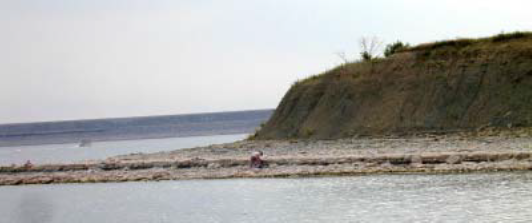
It is just a lucky accident that the Corps of Engineers decided to build a dam in a place where Cretaceous shales alternate with limestones containing ammonites. The shales are very important because ammonites found in the limestone just above a shale layer are much easier to extract. Equally important is that wave action from the lake erodes the limestone/shale package much more quickly than a 100% limestone section. The Hill Country of Texas has lots of ammonites, too, but they are not so easily extracted because the rock is almost all hammer-ringing limestone.
Row, row, row your boat! Our trip that found the much lower water level revealed a much wider collecting area, just as if Moses (or Ammon-Ra?) had parted the lake for us. The only problem is that HGMS was not the first one there. People had been collecting a lot because there were piles of ammonite sections laid out on the rocks. We had to work for our ammonites, but that is only fair. Last year we had to hand carry the ammonites a mile or more to the cars parked at the main boat dock. I warned the field trip participants that we had to find a different solution, and people were very creative.
One member, Tom Lammers, is a serious remodeling contractor (and dino dig slab maker). He and his business partner are not afraid of real work, and they know about demolition! Their solution to the transportation problem was to bring a canoe with three kids to power it, and to move Tom’s pickup to the old boat dock to shorten the voyage. The lack of a road did not stop Tom—he just drove cross-country to the boat dock. The kids have a great future in industry as long as they do not learn about things like minimum wage. They cleaned the place out of ammonite fragments—a volume job.
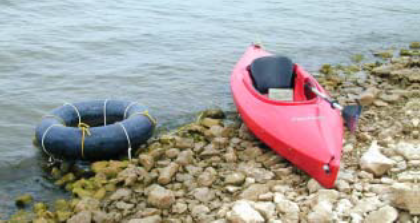
Rick Rexroad, our Paleo Section President, devised a great solution involving a kayak and an inner tube. He loaded the tube with enough ammonites to almost sink it, and just paddled back to the boat ramp. Picture a bright red kazoo pulling a rubber ducky! The only problem came when Rick returned by himself in the evening to transport more fossils. It seems that a local (and well known) criminal ripped off his kayak while Rick was moving his equipment from lake level to the top of the boat ramp. Fortunately an alert boater got a license plate number, and Rick was able to get help from the local sheriff to get his stuff back—everyone was incredibly helpful. Oddly, the thief did not take any of the ammonites. No taste!
Al Mowery has to get the “heavy equipment award.” He brought a canoe and a portable engine-powered air compressor to run his jackhammer. Okay, he never had to deploy the jackhammer, but he was PREPARED. I was glad that I did not have to help levitate this device into his canoe.
All together now! The real story is about the cooperation among our field trippers. The size of our prey made working together a really good idea. Stand by for an exposé on our Past HGMS President Elizabeth Fisher. Those of you who know Eliz will recall that she is a bit puny compared to Tony, Rusty, and me. But that is all right, because she was smart enough to bring along Al Mowery as her heavy. Al must have gotten strong from his gold mining activities, though maybe not from handling large quantities of bullion. Actually, I do have some doubts about Eliz’s wisdom, because she told me that she wanted the biggest ammonite in the state! No way—the Texas Memorial Museum has some that are four feet across that weigh more than 300 pounds, and those were not found at Lake Texoma. Whew, saved by geology! Unsuccessfully, I pointed out that the really pretty ammonites are those with a distinct keel and distinct ribs that stick out with a double row of knobs on the edge. These beauties max out at a foot across and are suitable for discriminating collectors. The big ones are smooth without distinguishing features and are mostly suitable for Paul McGarry to cement into the rock wall around his house. I failed to convince her. Some people just want quantity rather than quality.
Eliz went to the site I call “Ammonite Beach” and quickly glommed onto the biggest ammonite there. Everyone who had been there before walked right past it because it was embedded in a nice hard limestone block that just happened to weigh about a thousand pounds. Eliz attacked it like a woodpecker with a tiny rock pick—and the hammer just bounced off. This was probably a good tactic because Al shooed her off and started in with a serious pry bar and a much bigger hammer. In an effort to avoid being sucked into this project, I stood around taking pictures and offering sage advice like “Don’t stand directly in line with the swing of the hammer,” and “Don’t put your toes under the rock while you pry on it.”
I took dozens of pictures, but Eliz paid me to include this one which shows just her working on the fossil, as if she had done it all by herself (she remembered that I run a business called Incriminating Photos, Bought and Sold). Sunday Bennett claimed that she was gathering evidence for my business with her nonstop video camera, but to me it looked like she was just experiencing the effects of too much sun and was standing around talking to herself.
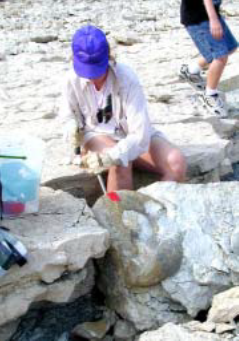
After Al’s delicate extraction, the ammonite weighed about 200 pounds and did not seem inclined to go anywhere by itself. It needed to go boating, but only Rusty Bennett had the muscle to get it into the canoe, so he did just that—an amazing act of levitation. (Just in case you find yourself in the same situation but superman is off doing something else at the moment, Tony Lucci suggests that people can move serious loads by putting the load on a tarp and having four people grab the corners.) You might think that Al and Eliz could then paddle happily off to the boat ramp, but no. The rangers roared up to their very heavily loaded canoe and nearly swamped it. The rangers said that they wanted to see whether Al had a life jacket in the canoe, but I suspect that they just wanted to see what was going on.
Onward, toward the dock, and we were almost done. Superman, a.k.a. Rusty, got the huge but homely fossil out of the canoe into the pickup, and finally Eliz had her prize. Truly, it was a group effort. This ammonite now resides in Eliz’s garden, but all of us have visiting rights!! It’s not sour grapes; her ammonite is so plain that it is appropriate to leave outside because no one will steal it.
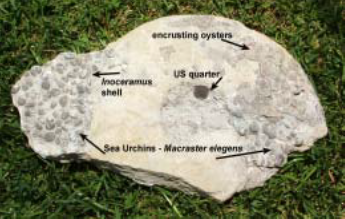
Diane Sisson gets the
award for the best specimen
of the trip. She has
a really good eye and
found an ammonite surrounded
by sea urchins,
and she got one like it a
year ago! It is a really
nice piece that we are going
to feature in the update
of the Texas Cretaceous
Echinoids book.