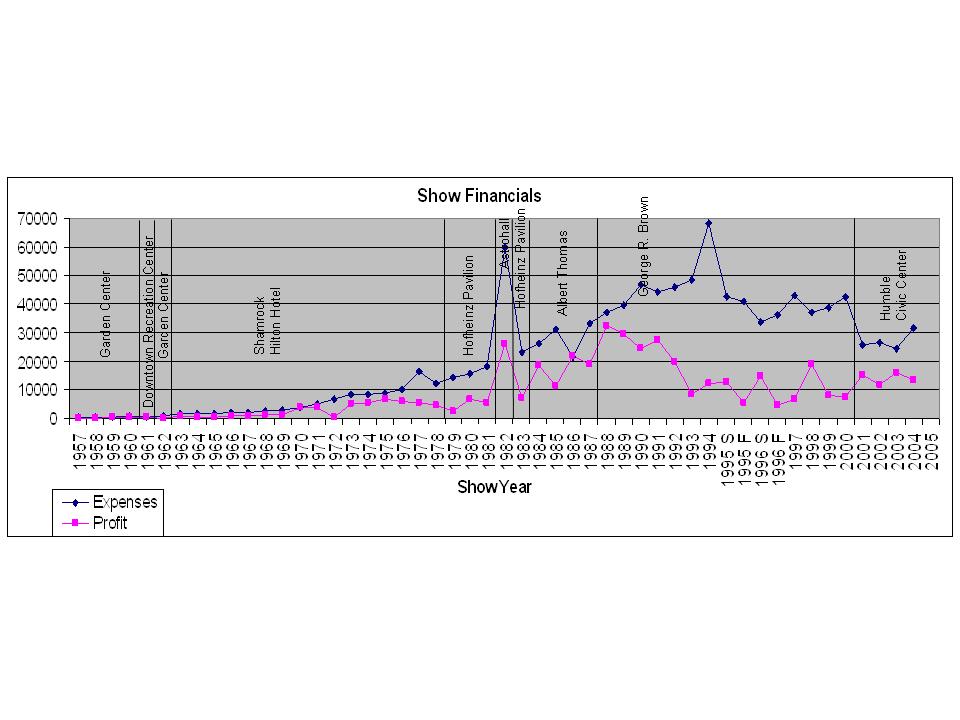
As we are now up to the present decade in the history of the show, I feel there are some current club members who deserve special recognition as a result of service to the Society above and beyond the call of duty. These members can still be found around the club, helping out as they have done for decades and serving as an inspiration to us all:
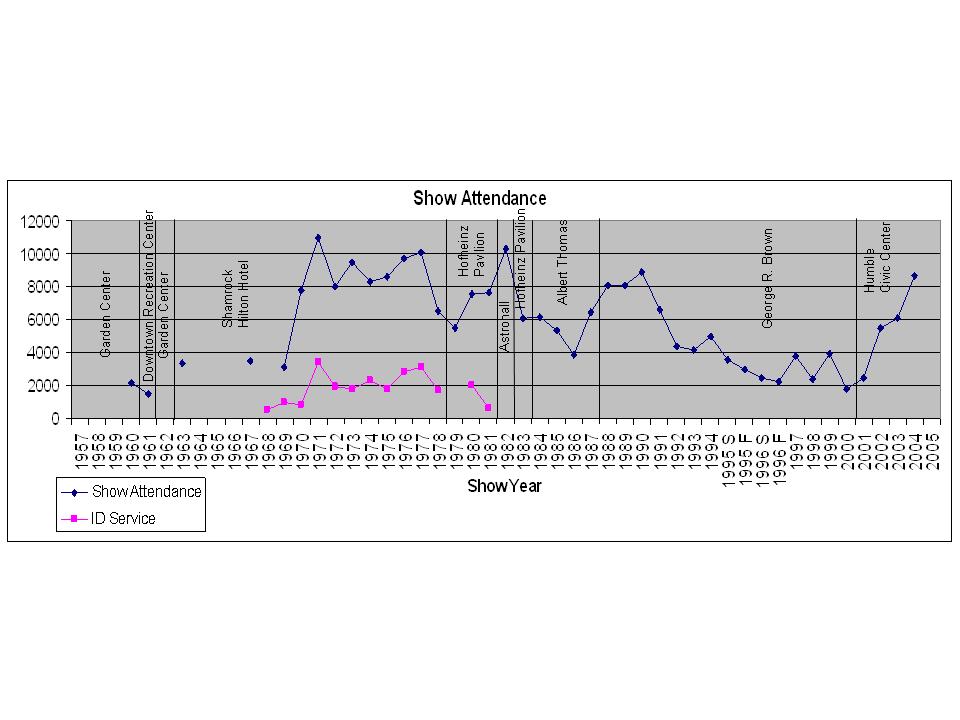
Irene Offeman – Irene and her husband, Richard, joined the fledgling club in 1960. By 1961, Richard was President and Irene was Show Chairman. (In case anybody is counting, that was 45 years ago!) In 1968, wanting to spread knowledge about mineral and fossil ID, she formed the ID Service at our show along with Ed Pedersen. This important service to the public and our club lasted 14 years until 1983 when the responsibility was taken on by the various Sections.
In 1969, Irene and Myrt Yarbrough were instrumental in fostering the idea of special interest sections within the club. When that came to pass, she held the first paleo classes, and thus was born the Paleo Section. She has either led or has been a mentor and guiding force behind the Paleo Section during its entire existence. She still makes Paleo Section meetings when she is able to get a ride from another member.
Art Smith – Art was first tapped by Irene Offeman for mineral ID in the ID Service in 1972. He continues doing this on a yearly basis because it’s what he loves doing. He has now performed this service for 34 years.
He decided to join the club after the 1973 show specifically to share his love of minerals and mineral collecting with other enthusiasts in the Mineral Section, capably led by Ed Pedersen. When Ed was transferred to Denver in 1978, others had to step up to run the Section, including Art, Ron Carman, and Steve Blyskal, who all shared terms as Section Chairman.
Soon after we moved into the new clubhouse in 1985, Art agreed to be the Librarian because the post was open. Initially we didn’t have many books, and Art started donating portions of his own library to the club. Today, thanks to Art, we have a large, well-stocked and indexed library that is available for our members to use. Art continues to run the library, along with being the de facto historian and providing mentorship of the Mineral Section.
Tom Wright – Tom joined the club in 1977. By 1979 or 1980 he was teaching classes at the old clubhouse, where he had to haul his equipment down to the clubhouse and haul it away again at the conclusion of the class. His classes include chasing and repose, lost wax casting, and mold making.
Tom’s involvement with the show began in 1982 when he became the Working Exhibits Chairman for the National Show. In 1984 while he was Vice President of the club, he agreed to help run the show but found himself Show Chairman when the person who was to perform that task disappeared. He has continued to help out on Show Committees since that time, including stints as Publicity Chairman in the fall of 1996 and in 1997.
His leadership of the club began in 1983 when he resurrected a declining Lapidary Section. He was President in 1985 and 1986, Past President in 1987, President again in 1990 and 1991, and Past President in 1992. He started being Clubhouse Chairman in 1992 and has continued that post throughout most of the 90s and 2000s. You can still find him at the clubhouse on most Saturdays, helping teach others lapidary and faceting arts.
Gary Anderson – Gary joined the club in 1979. He naturally gravitated toward helping out at the shop in the old clubhouse under Tom DeHart. When we moved into the new clubhouse in 1985, Gary became the Shop Foreman. He held this post until the early 2000s when the running of the shop became a committee task. You can still find him there on most Saturdays, polishing his own agates, petrified wood, and dino bone, while helping instruct others on the proper use of the equipment.
Gary’s service to the show began in 1985 when he started organizing the rental trucks needed to transport our equipment and supplies from the new clubhouse to the show. He also started laying out the electrical plans for the show and working with the venue electrician to make sure we had power at the show. This became an important task as the show rapidly expanded in the late 80s. His work with the George R. Brown Convention Center electricians in the 1990s was crucial to make sure our power needs were met.
His leadership of the club began in the early 1990s when he led the nominating committee for most of the first half of the decade. But by 1995 his luck ran out, and, finding no other candidates, the committee turned on him and coerced him to take the presidency. He was President in 1996 and 1997, Past President in 1998, President again in 1999, and Past President in 2000.
Charlie Fredregill – Charlie joined in 1985 after going to the 1984 show and seeing Tom Wright perform lost wax casting. This interested Charlie very much, and he wanted to learn how to do it. In the process, Charlie and Tom became good friends because they shared similar interests. Charlie started helping peripherally with the show in the late 1980s.
In 1990 with Tom as President, Charlie became a Board Director, and in 1991 became 1st VP, again under Tom. Also in 1991, Tom convinced Charlie to become Show Chairman, not because Charlie was experienced or had an interest in doing this, but because the Show Committee was in tatters after Ben Noble and R.C. Estes got through with it. This led to Charlie’s presidency in 1992 and past presidency in 1993 and 1994. Because Charlie ran a printing business, he printed the BBG for several years, and he also printed publicity material for the show until his retirement.
But Charlie’s real love is in the lapidary arts. He has taught and continues to teach wire wrapping, lost wax casting, soldering, and cabbing. As with Tom Wright, Charlie can still be found at the club on Saturday working on his own material and teaching others.
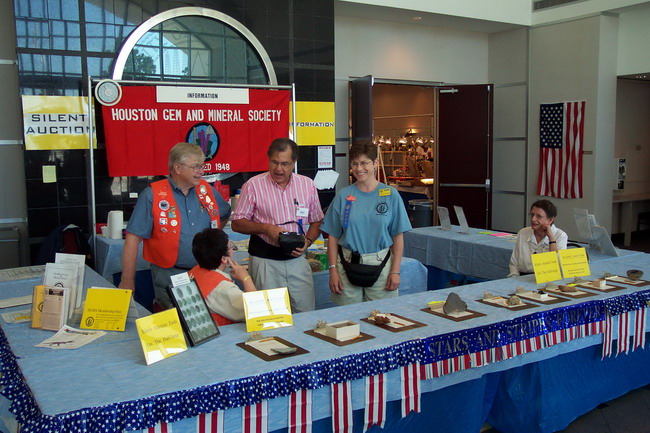
Beverly Mace – Beverly joined in 1985. She gravitated toward the Youth Section where she helped Janelle Walker for many years until she became Youth Section Chairman in 1991. This led her to be involved in the annual show because the Youth Section has a booth there. They have games for kids, interesting educational exhibits, and the “Rock Village.” She has now led the Youth Section, along with running their booth at the show, for 15 years.
In 1994 she also became the 2nd Vice President, who is the person responsible for maintaining the membership roster. Eventually, this led to her being responsible for sending out the BBG since she could make the required labels from her roster database. For many years she would give the labeled BBGs to Robert Evans to sort by zip code, fill out the required forms, and take to the bulk mail window at the Bellaire post office. But with the advent of the computer program Dazzle Express in 2001, the job became easy enough that Beverly takes care of the whole thing herself. She is now in her 12th year as 2nd VP.
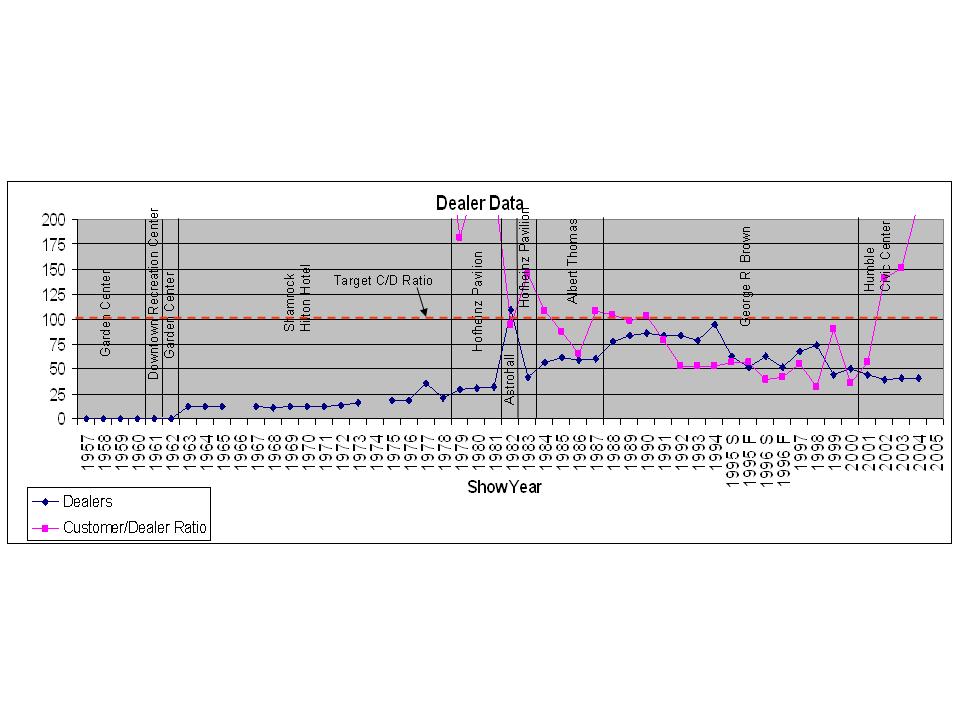
Phyllis George – Phyllis joined in 1994, making her a relative “newbie.” But she didn’t wait long to wade into the thick of it. She volunteered to become Dealer Chairman in late 1994 and held that post through both of the “2-show” years (1995 and 1996), meaning she did four shows. She earned praise from all quarters for her professional handling of the sometimes precarious situation caused by having too many dealers and not enough attendees. She was well respected by dealers and the Show Committee alike for her diligence and honesty.
During her tenure as Dealer Chairman, another sticky situation arose, to which Phyllis, in her typically helpful manner, volunteered to help remedy: Between 1992 and 1995, the BBG had been produced by a total of six people. Sometimes it wasn’t produced at all, other times it was only one or two pages. But in December 1995, the BBG was again without an editor and the club was once again desperate. Phyllis volunteered to provisionally produce it for four months while they looked for another editor. Unfortunately for her, she did such a good job at it (and actually liked it!) that everyone insisted she stay on as editor, which she did. This meant that in 1996 she arranged for dealers in two separate shows while compiling and editing 12 BBGs. Tell me that wasn’t a busy time!
Under Phyllis’ continued editorship, now in her 11th year, the BBG regularly wins awards for excellence in national competition. But recently the club had another desperate need, and in her usual manner, Phyllis stepped up to help. We started our Web site in 2000, but by late 2004 we were without a webmaster for the second time. By then having a Web site was a necessary evil, and it was simply not acceptable to let our Web site go down. So, despite knowing absolutely nothing about Web site functionality and only a little about HTML, Phyllis volunteered to be the new webmaster in January of 2005. She immediately applied herself to learning the things she needed to know in order to accomplish the task at hand.
And guess what? In 2005 HGMS won the award for the best Web site in the SCFMS. I have no doubt that 2006 will bring similar awards. (Note: We would do the same thing in the AFMS if there were such a category in national competition, but I guess change comes slowly in some quarters.)
These are but a few examples of club members who are doing what they can to make our club what it is today. We owe them and many others our thanks.
Changes in Show Philosophy: Because of the decline in the quality and financial results of our annual show, it was apparent some changes needed to be made. The change in venue was a good start, but there were other structural changes that were necessary in order to revive the flagging show. The list of five recommendations I delivered to the Board in June of 2000 (described at the end of Part 4) along with a discussion of how we achieved these goals is given below:
1) Fall is a better time for retail sales, but above all the date must be consistent. In the questionnaire sent to the club in the summer of 2000, a clear preference was indicated for having a fall show. This was traditionally the time when we have had our show, stretching back to the Shamrock days. It is also a better time of year because the Christmas shopping season has the highest retail sales of the entire year. This fact becomes painfully apparent if you contact any of the convention centers in the Houston area and ask if they have any available fall dates.
So, prior to signing a contract with the HCC, there were a number of discussions concerning a date for our show. The Board and Show Committee had decided that we should go back to our traditional show date in the month of September. However, September has the additional complication that we did not want to interfere with the Denver show, traditionally the second week of September. It turned out we didn’t have to worry about that being a problem—the HCC had three regular shows the first three weekends in September, including the Cat Show and the Stamp Show. So we signed an agreement to be on the 4th weekend in September.
However, this ended up severely irritating the Victoria Gem & Mineral Society which had their show on the last weekend in September, a date that alters every three or four years between the 4th weekend and 5th weekend. Because we were a much bigger show, several of their dealers, who were also our dealers, told the Victoria club that they would have to cancel out of the Victoria show if they didn’t move it. This the Victoria club did, but they were not very happy about it. It has taken me several years to make up this rift with them, but I believe I have done that by helping them with the success of their show and by giving presentations at their club meetings.
2) We need quality guidelines for dealer acceptance and need to be governed by the all-important customer-to-dealer ratio. Since my initiation into the Show Committee was via the Dealer Chairman position, I had first-hand experience with the complaints of our dealers. Thus, during my first year in this position, it was intuitively obvious that some drastic measures had to be taken in order to restore dealer confidence. After all, the first basic tenant of show production is that if your primary exhibitors are not happy, your show will suffer. Thus, my plan was to take some positive measures to deal with dealer dissatisfaction. At first, the only thing this could entail was being responsive to dealer needs and complaints and by being friendly to them. During this period I got to know most of our dealers on a first name basis. This friendship has transcended time, so that these dealers are comfortable with our show and our leadership.
However, warm and fuzzy feelings can be taken only so far, and it was plainly obvious more work needed to be done. My strategy for taking care of our dealers was a simple one: make the show successful and our dealers would be happy. This may be an obvious strategy, but my real objective was actually more sinister—to return to the “glory days” where we had a full show with dealers on a waiting list to get in. Why did I want to do this? Because it would make the Dealer Chairman’s job a lot easier. As it stood in 2000, it was impossible to get dealers to sign up because they really had no desire to participate in a lukewarm show. Thus, a very large effort had to be put into calling a large number of dealers just to make our numbers. In addition, at that time dealers were supposed to send half of their payment with their contracts and then the second half about three months prior to the show. This rarely happened, and it was hopeless to try to enforce it when dealers were lackadaisical about being in our show in the first place. As far as I was concerned, this attitude had to change. And it wouldn’t change unless the show itself changed.
Following this chain of logic, presuming the show was made successful once again, and presuming as a result we had plenty of dealers to choose from, then it follows that there needed to be guidelines on what kind and how many dealers we would accept. While this may sound elementary, these things were completely absent in the last half of the 1990s. (Want an example? The Houston Chronicle regularly had a table at our show. When I asked why, I was told that their money was as good as anybody else’s). We have to go back to the 1980s and the Dealer Selection Committee to see these principles in action.
So, taking a cue from our “forefathers” in the 1980s, the new Show Committees in the early 2000s worked on guidelines concerning the number and types of dealers we wanted in our show. These guidelines went through some modification in the first few years at the HCC as we figured out what worked with our new customer base and what didn’t. For instance, the heritage we were left with from the GRB days consisted of a large number of jewelry dealers. After our first show at the HCC in 2001, which as expected wasn’t well attended, the majority of complaints were from jewelry dealers. Thus, our first “structural modification” of the dealer mix was to eliminate some of them and replace them with other types of dealers. Further, we observed that high-end jewelry and “mall store” type jewelry vendors didn’t fit well in our show, and so that class of dealer was eliminated from our mix.
I haven’t written much about dealer numbers because we soon realized that we could only fit about 40 dealers into the main ballroom of the HCC, thus muting those still numerous voices that apparently never will stop calling for maximum numbers of dealers at all costs. Make no mistake—those voices were still in the club in the early 2000s. For these people, the results of our shows stretching back to 1992 mattered not; to them dealers equaled money and to have only 40 dealers meant throwing away good money. My only comment is that this is precisely the attitude that got us in this predicament in the first place.
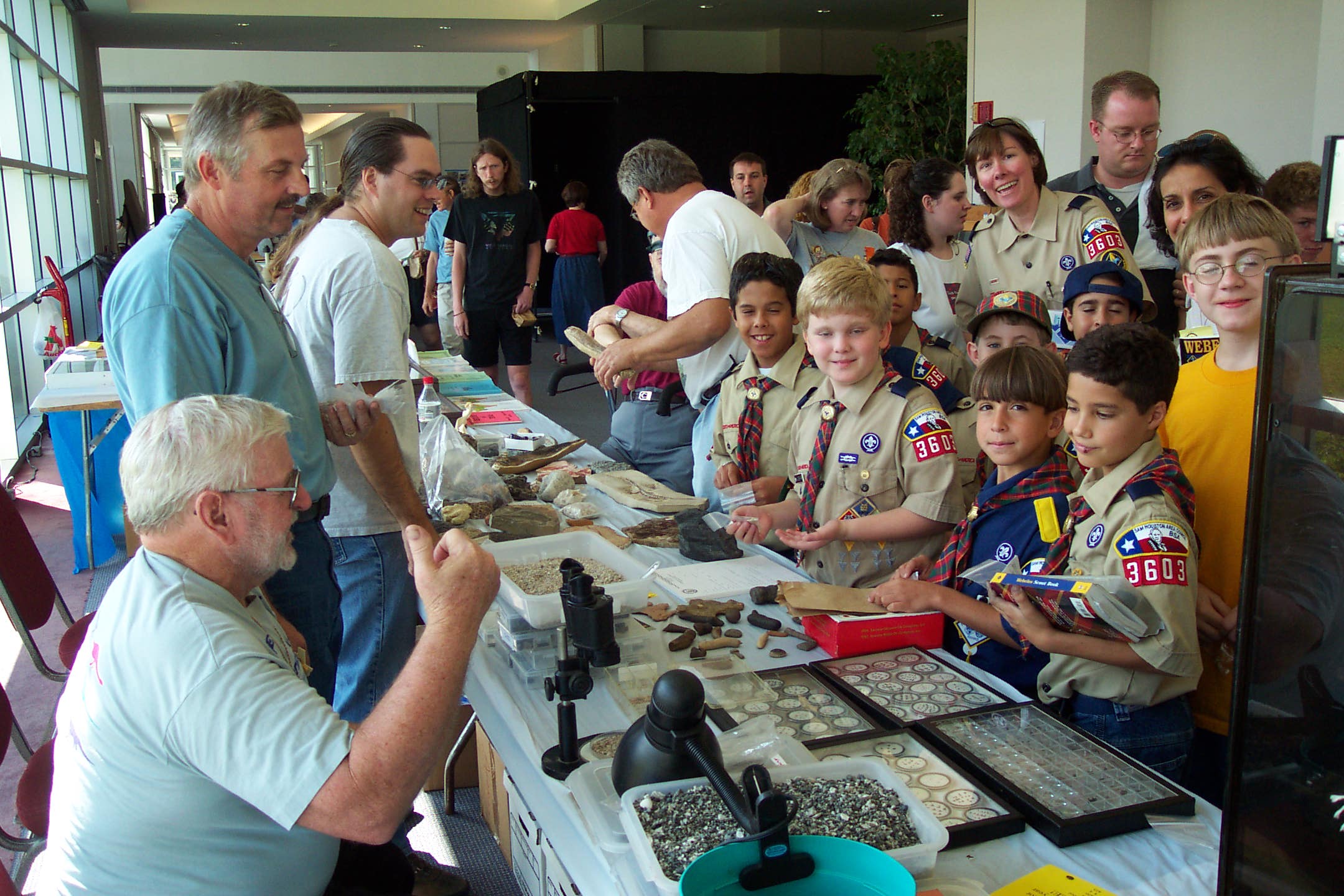
3) We need to attract kids. Back in the days of Carleton Reid, we used to have busloads of kids come to the show on Friday. Carleton was the club historian and also had an avid interest in educating kids about geology and rocks. He would visit schools, Scouts, and youth clubs of all sorts, giving presentations. He would also pass out fliers to our show and invite the teachers to bring their kids to learn more about rockhounding and the lapidary arts. Not surprisingly, we had a lot of kids attending on Friday in those days, and also not surprisingly, attendance at those shows regularly surpassed 8,000. But with Carleton’s passing in the mid-1980s, nobody emerged to replace him and so the number of kids attending our show fell into a long, slow decline. In the 1990s, the job of trying to attract kids fell to Youth Group Chairperson Beverly Mace who would send out a large number of letters to schools inviting them to our show. But she readily admits this was not adequate and that something more needed to be done. This was clearly demonstrated when a total of 121 people attended on Friday of the dismal Graduation Day show in 2000.
The question may legitimately be asked: Why should we expend effort trying to get kids to our show? After all, they generate almost no ticket income (kids’ tickets were 50 cents to a dollar in the 1990s), and they don’t spend money with our dealers. The answer to this question is two-fold.
a) For those bottom-line type of folks, kids come with parents who do generate ticket income and who do spend money with dealers. (Besides, contrary to this common misconception, in the last few years we have found that kids do have money, and they do spend it with our dealers. Just ask any of our dealers who carry kids’ items.) If the kids come on Friday with their schools, many of them go home and tell their parents about the show (i.e. free publicity), and many come back on the weekend. This is particularly true if the show is interesting and has things to attract kids and families.
b) However, the real reason we should cater to kids lies in the heart of our charter and our mission statement. The HGMS Web site identifies us as “a not-for-profit organization dedicated to study in the areas of earth science and related fields and arts. A major focus of the HGMS is education.” Inside the front cover of the BBG it says that “the objectives of this Society are to promote the advancement of the knowledge and practice of the arts and sciences associated with….” and then it goes on to list a large number of things we do. The fact is that any society or club that does not somehow attract new members, particularly younger ones, is most likely in a slow death spiral which will culminate in its own extinction.
Thus, given the acceptance of the two points above by the new Show Committee, it was readily apparent that some drastic changes were needed. One of the things I did during my first two years as Dealer Chairman was to visit the regional shows in this part of the state. These visits told me a great deal about how other clubs construct their shows. Some of these shows were successful, and I borrowed ideas from them. Some were plainly not successful, and thus I tried not to repeat their mistakes.
One of the success stories was the kids’ program at the Victoria show. A few of their club members held positions within the Victoria ISD, and thus knew what it took to attract school kids to a show on Friday. I had a long talk with these people at their show and followed this up with e-mail communications where they sent me their schedule for contacting the VISD in the months prior to the show and the letters they sent to the teachers.
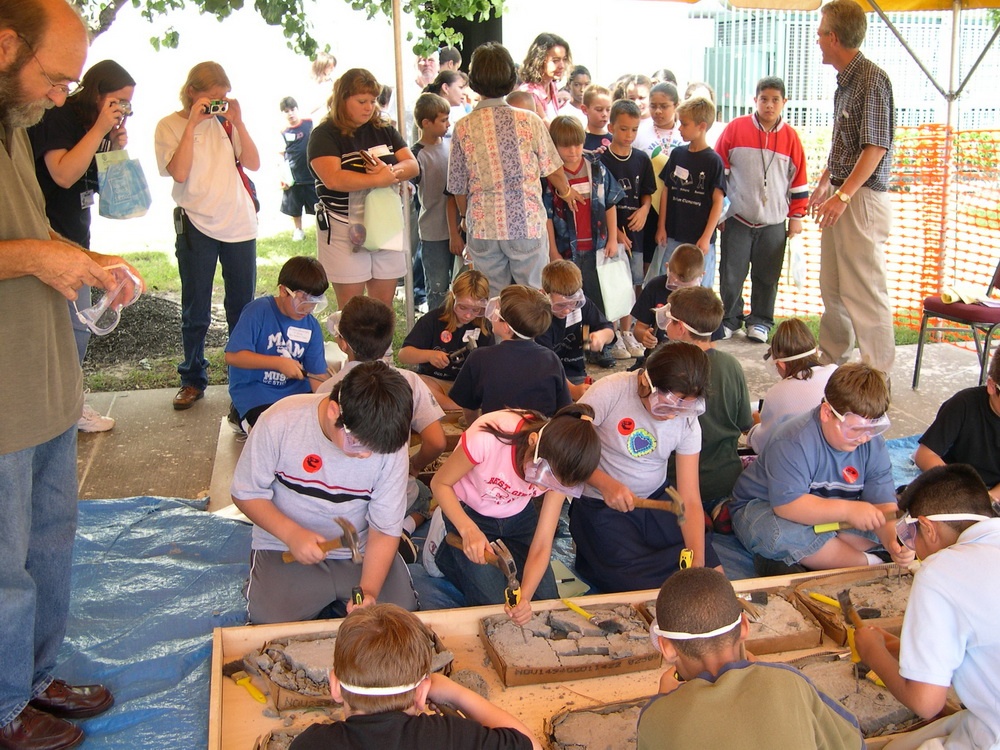
Based on this, we formed a new committee within the Show Committee called simply the Show Education Committee. I sought teachers and ex-teachers within our club to staff this committee because I knew we needed some inside knowledge of how teachers operate and what it would take to attract them to our show. Thus, in 2001 the committee consisted of Lexy Bieniek, Holly Smith, and Chris Peek, who were all teachers, Beverly Mace, who was the previous Show Education Committee Chairman, and me. Our first task was to create an earth science program for teachers who visited our show with their students. We called this School Daze. The main component of School Daze was an age-appropriate scavenger hunt that would be drawn from questions submitted by interested dealers (they all were sent a form to return with their questions) and by our demonstrators and Section booths.
To promote School Daze, we developed a flier to be sent out to schools telling them of our program. We obtained the regional databases of schools and targeted 3rd and 5th grades, which have TEKS requirements in earth science. We also attended education conferences where we developed a sign-up list of teachers interested in earth science. And finally, we also reached out to the home school community by getting on their bulletin boards, advertising in their newsletters, and attending their education conferences.
The results have been nothing short of astounding. We built an educational program from scratch, spending our first year wondering if anybody would come and facing resistance from school administrators who said we were nothing but a retail show. This morphed completely by 2004, when our focus shifted to worrying about how we were going to manage the huge crowds of kids that packed the place on Friday.
4) We need to stifle the rotating Show Committee membership problem. In Part 3 of this history, I recounted the unfortunate episode in 1984 that unceremoniously shoved Tom Wright into his first term as Show Chairman, and the consequent change in the bylaws dictating that the purpose of the Assistant Show Chairman was to learn the ropes so that he or she could be Show Chairman the following year. There were periods in the next two decades when this worked fine, such as 1991–1993 which smoothly rotated such show chairmen as Charlie Fredregill, Bill Butler, and John Emerson. However in many other years, its legacy was not so bright. Ron Carman ended up as Show Chairman in 1986, 1988, and 1989 because nobody else could be found. Ron Talhelm forged through the spring and fall shows of 1995 and the fall show of 1996 for similar reasons. During many years there were no Assistant Show Chairmen until late in the year, and so the Show Chairmen ended up doing a ton of work.
This is not how things are supposed to go. It creates an endless cycle of overworked Show Chairmen and a dearth of volunteers to take some of that load off of them because they’re afraid that the same calamity will befall them the following year. This leads to the tendency for “relearning the wheel” as new Show Committees take office after previous Show Committees have flown the coop. Anybody with a basic knowledge of business management will readily see that this is a very poor way to do business.
So, as I saw it in 2000, the first thing that had to be done is to undo what had been done in 1985. In my opinion, the Assistant Show Chairman needed to be someone who would help take the load off the Show Chairman without having to feel obligated to be Show Chairman the following year, in the same way that a company Vice President takes the load off of the President. This was accomplished in a bylaw revision effort during Elizabeth Fisher’s term as President in 2000. But old habits die hard, and the Board ended up having to further revise the bylaw language in 2005 to specify more clearly how the Show Chairman and Assistant Show Chairman are selected each year.
The next task in this transition will take some time—convincing the club membership that the Assistant Show Chairman is really supposed to do work and not just be a warm body waiting to slide over to the Show Chairman’s seat the following year.
5) We need to have an attention-grabbing headliner exhibit for the show. This is all part of the general philosophy that a show is supposed to be interesting (as was discussed in the epilog of Part 4 of this history). In that epilog, I made the case that shows are made interesting by having activities and attractions other than (and in addition to) retail dealers. It is true that people attend rock shows to see rocks. But I am striving to move beyond that and enable (for instance) families to come and enjoy the show even if only some of the family are rockhounds. The same goes for school groups, or for two friends who get together and decide to come to the show but only one is a rockhound.
But the heading of this section refers to a specific application of this philosophy—the “hook,” as advertising people call it. In today’s media-saturated world, it is very difficult to get through the background clutter and get your message to your target audience. Thus, advertising people usually rely on a single item or event that they feel will attract someone’s attention for the 3-5 seconds necessary to get the message through. If the “hook” has piqued their interest enough, they will spend more time digesting the rest of the information in the advertisement. If not, they’re gone.
I felt strongly that we needed such a hook in our show. Strongly enough that I hoped to go to lengths that most other shows would not go—give my headliner and primary supporting attractions free entry into the show. The reason this was such a sticky point is because some of these demonstrators also had stock they were permitted to sell. Thus, because of this unusual (and some would call very gracious) arrangement, it was apparent that official Board approval of this technique would be required. This was done in August of 2002 after considerable discussion among the Board.
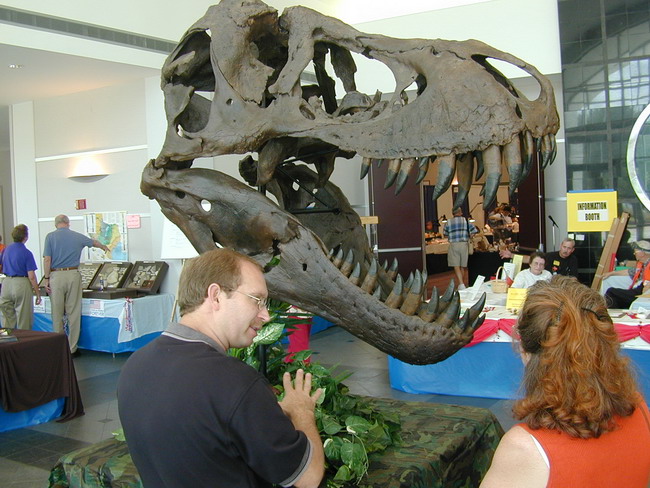
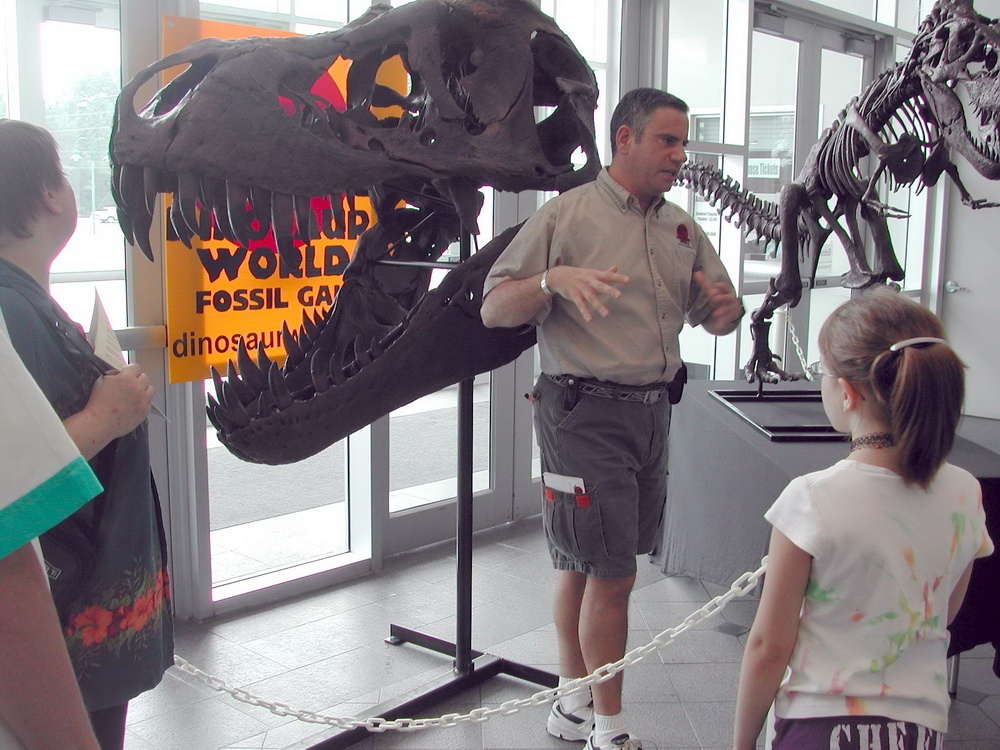
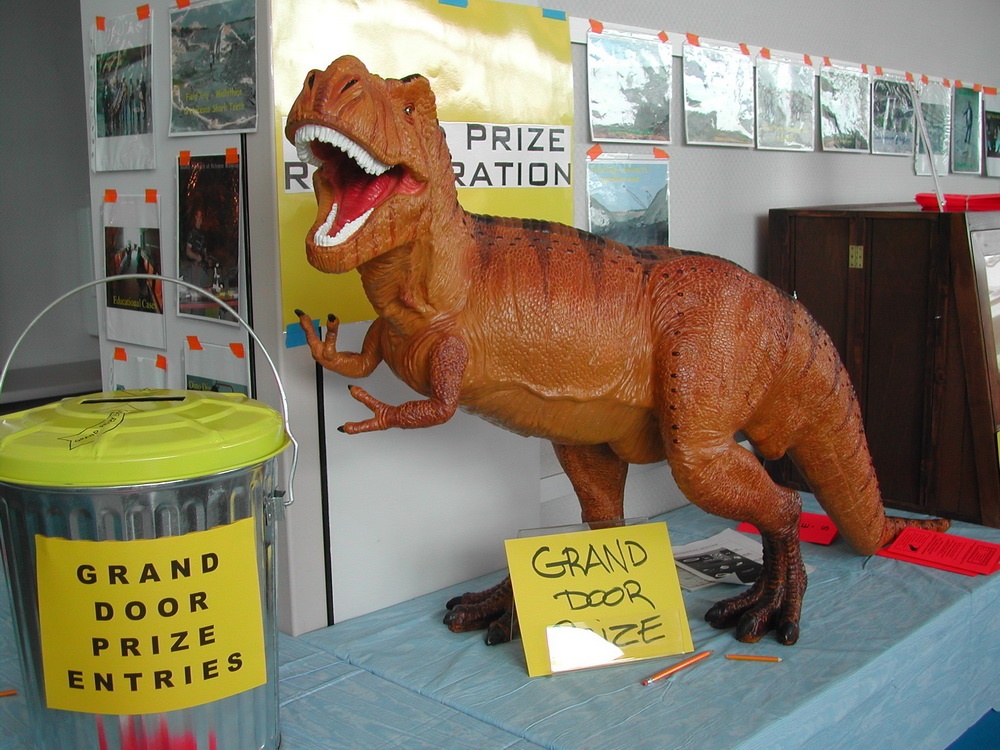
The primary headliner was Dino World. I met George Blasing at the Austin show and had some discussions with him about attending our show as a dealer. However his T. rex skull replica (“Stan”), along with his numerous other dino replicas, were very appealing, and I started thinking about creating a full-blown promotion centered on Stan. George is also very promotion-conscious, and he readily agreed to my plan. This has proven to be a very smart move as George and Stan created the “branding” we needed. This branding has become so well-entrenched that we decided to move forward with a major expansion of Dino World’s space and attractions in 2005. I’ll describe this in more detail in the section dealing with that show year.
Our secondary headliner was John Fischner’s Dreamstar Productions. John has been a known quantity to our show dating from the late 1980s. He sculpts dino models of varying sizes and works on them at the show. It was a perfect match to compliment Dino World and Stan.
2001, Our First Year at the HCC: Preparations for this show started promptly following the Board’s decision to move to the HCC in September of 2000. The Board wanted a Show Chairman to spearhead efforts for the new show. I didn’t think I was ready for Show Chairmanship so I turned down their offer. In retrospect I probably was ready, but because I remember my feelings of doubt, I can fully understand when people we now ask turn us down because they think they are not ready for the position.
In any event, I offered to be Assistant Show Chairman, and John Moffitt volunteered to be Show Chairman. Since John came from outside the Show Committee, he had a lot of fresh and different ideas about things. His main contribution was helping to revamp the publicity effort (described below). Unfortunately, his personality takes some getting used to, and turned out to be too much of a shock for the existing Show Committee, most of whom simply left. So our first task was to repopulate the committee with fresh bodies. We used the questionnaire the Board had sent out that summer for this purpose. One of the questions on that form asked if the respondent was willing to help with the Show Committee, and I called all those answering affirmative. Through that process, I met many club members that I had not known before, creating relationships that survive to this day.
John jumped right into it and started shaking things up immediately. His first move was to call the first Show Committee meeting at the house of a new member named John Lind on Tuesday, September 12, 2000. This was a refreshing change of pace and John certainly didn’t disappoint at the meeting when he gave one of his rousing speeches about new beginnings and how we all need to pull together.
We followed that with a budget presentation to the Board on October 3. Many of the items were estimates since this was our first year at the HCC. But we decided to push the envelope with publicity and asked for $13,000. The Board had no problem with that, but didn’t believe our estimate of $15,000 in ticket income and cut us back to $13,000. Along with a few other changes, the Board approved our budget. It called for $31,600 in expenses and $10,600 in profit, which was a profit margin of 33%. This alone was good news, as it was a drop of about 25% in expenses from the GRB and triple the profit margin.
New Floor Plan: There were many things to be taken care of as soon as possible. Among the top items was to completely revamp the floor plan. For this I solicited the help of the HCC management to supply me with examples of floor plans for other events at their facility. These I supplied to Ron Talhelm who graciously had his draftsman friend at Freeman Decorating work up a rough draft for our use. Over the ensuing several months, we revised this original draft and came to a consensus as to how we wanted to use our available floor space. Part of this effort included a walkthrough at the HCC on Saturday morning, January 13, 2001. Fifteen people attended, and we measured out the hallways and special events rooms, trying to envision how the different section booths would fit.