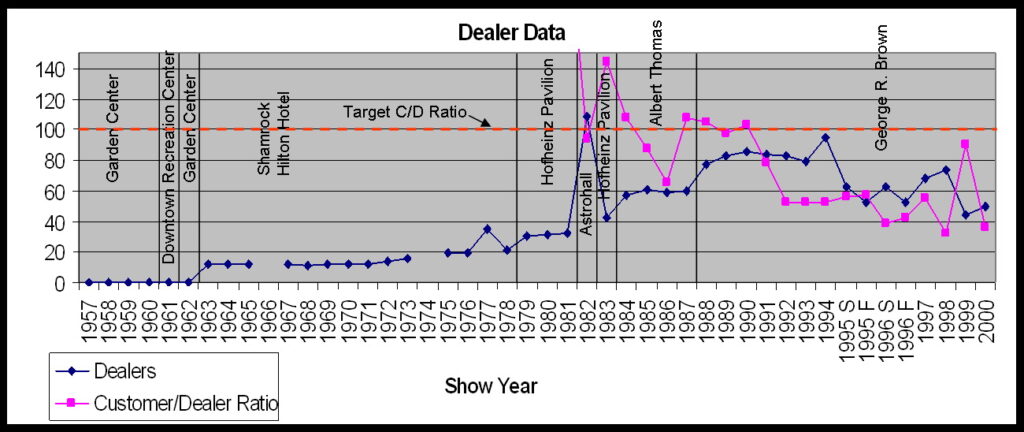
The poor customer-to-dealer ratios of the previous shows, including a miserable C/D of 39 for the spring 1996 show, was finally catching up with the club.
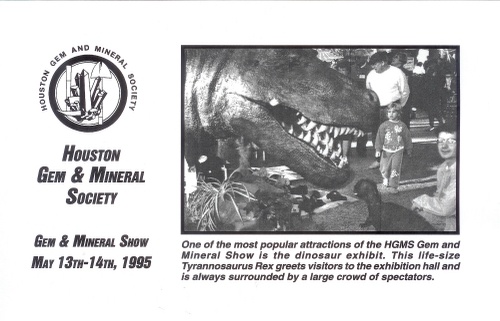
Nevertheless, special offerings were still planned. Several nature clubs signed up to participate, including the University of Houston, the Astronomical Society, and the Diving Club. The new special exhibit for the show was John Fischner’s Dreamstar Productions. John’s expertise is in sculpting dinosaur replicas. He demonstrates his sculpting onsite while the audience watches. John continues to do our show to this day.
A new innovation of Show Chairman Ron Talhelm (his third chairmanship in two years) was to have a preshow party and auction to raise awareness (and money) for the show. This successful event was held in early October and was attended by 47 club members. It has since become a regular event in our annual show preparations.
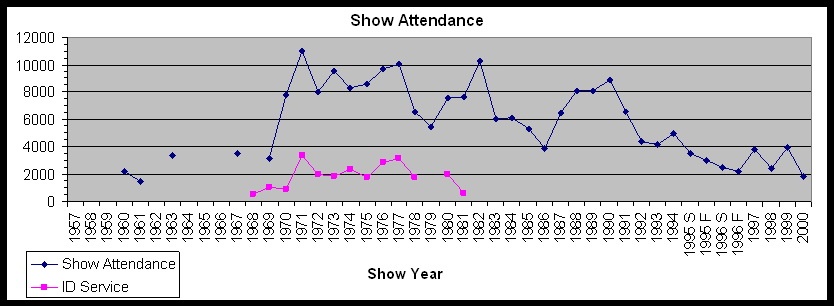
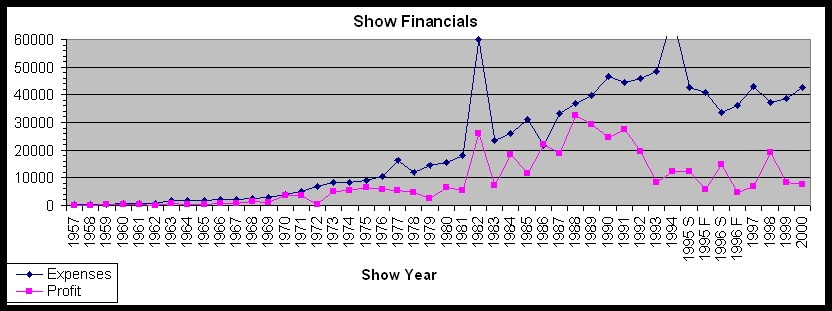
So, despite the well-run publicity effort and the professional show production, by now nobody should be surprised when I report that attendance for this show was a dismal 2,200. Split between 52 dealers, this resulted in an unsatisfactory customer-to-dealer ratio of 42. Show profit was $4,661, or a profit margin of 13%.
Post-show debriefing and analysis at the November Show Committee meeting led to a decision to revamp the publicity effort once again, as it was apparent the public was either not hearing about our show, could not distinguish our show from Intergem, or was overwhelmed with six gem and jewelry shows per year. Perhaps it was a combination of all the above. But the changes agreed upon were (1) to go back to the original moniker of “Gem, Jewelry, Mineral, and Fossil Show,” (2) to do away with the glossy postcard because it looked too much like Intergem’s (however, this did not happen), (3) to let kids in for free on Friday because of a huge drop in attendance on that day, and (4) to use paid newspaper ads in local papers only if they would also run a feature story on our club or show (this did not happen, either).
1997 – September 19–22: Preparations for the 1997 show began well before the fall 1996 show had even come to pass. The Show Committee and Board both wanted a September date, and so in August, a 1997 show date of September 19–22 was chosen. However the GRB rates had increased from $2,500 to $3,500 per day, and electric costs rose similarly. Thus, the Show Committee, with Board blessing, agreed to a 10% increase in booth fees in order to offset the increase in expenses.
The Show Committee was not the only one to increase fees. In November, the Board voted to increase membership dues because there would be only one show in 1997, and the returns on the fall 1996 show were not enough to last the club until the show in 1997. This dues increase would be finalized in early 1997.
Similarly, potential leadership voids were avoided when Terry Proctor agreed to be Show Chairman in the early fall of 1996. Following the fall 1996 show, Elizabeth Fisher agreed to take the Dealer Chairperson position. This was necessary because Phyllis Georgehad decided she would concentrate on producing the BBG (a position she took in January of 1996) and was giving up the Dealer Chairperson position. The Publicity Chairman position was open until March when Tom Wright was persuaded to step in once again.
Thus, a full-scale publicity effort began with Tom Wright, Terry Proctor, Charlie Fredregill, and Al Tarr. Terry adopted the moniker of “Golden Anniversary Show” for 1997 because the club was formed in 1948, and so this was a celebration of 50 years of existence for the HGMS. Ignoring for the moment that this was only the 44th annual show (and even this number was inflated by four years; see Appendix 2 of Part 1), this was a great marketing theme. It allowed the Publicity Committee to generate some excitement about the show, which they exploited to the fullest of their ability.
Soon they lined up John Fischner’s Dreamstar Productions to be the centerpiece special exhibit. Also slated was a replica of the Hope Diamond necklace (the creation of Phyllis George’s father), Bill Patillo’s Food Table, U of H, and HMNS. Terry got County Judge Robert Eckels to approve a proclamation stating that the week of our show was “Gem and Mineral Week.” Similarly, Rock & Gem magazine labeled our show “the Show of the Month.”
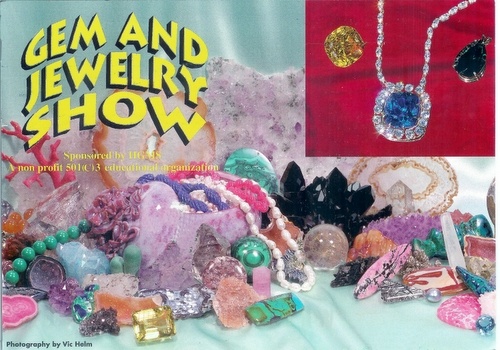
Another of Terry’s publicity ideas was to make up 50 notebooks containing photos of our club and show, John Fischner’s creations, press releases, and then giving those out to radio, TV, and newspapers. Tom Wright arranged for paid ads on KQUE and KTRH radio. Newspapers included several ads in the Houston Chronicle and in the Zest section, as well as in the Sun papers and The Village News. Charlie Fredregill printed and mailed 20,000 color postcards.
Meanwhile, new Dealer Chairman Elizabeth Fisher had some aggressive ideas of her own. She continued Phyllis George’s practice of dual contract mail-outs, totaling about 300 per mailing (which is amazing in itself). But her greatest contribution was the establishment of direct dealer contact. Instead of relying on mailings alone, she initiated a phone campaign to contact dealers who had not replied to ask if they wanted to be in the show, and if not, why not. To do this, she recruited Assistant Dealer Chairman Eileen Singleton. Between the two of them, phone calls were made to hundreds of dealers in the dealer database which by now had grown to a monstrous list. As might be expected, many of the contacts were no longer valid and those dealers were scratched off the database. They also heard an earful, which amounted to a litany of reasons why the HGMS show had become a poor show for dealers and why these dealers no longer had any interest in participating.
But this aggressive phone campaign reaped handsome benefits. The Board had been (and continued to be) obsessively self-absorbed trying to figure out how to attract more dealers to the show (although the idea that increased attendance would achieve that by itself didn’t appear to occur to anyone). So it was a great relief that Elizabeth’s methods would solve their problem for them. Through Elizabeth and Eileen’s persistent efforts, contracts continued to trickle in throughout the year, so that by show time we had 68 dealers under contract (and three were turned away at the door on set-up day!). (The target was 60 dealers, but Show Chairman Terry Proctor as well as the rest of the Board continued pressing Elizabeth to sign up as many dealers as possible). This was an incredible number considering the previous shows in 1995 and 1996 only managed to attract 52–63 dealers, and our last two shows had dismal C/Ds of 39 and 42.
Other changes were in store for the show. We would no longer have presentations given by speakers because there was too much interference with PA announcements from the information booth, and because it was a lot of effort for (what some people considered) a minimal return. In addition, there would no longer be nature and outdoor clubs at the show because they had too much difficulty recruiting volunteers to staff their tables.
But there was a concentrated effort to improve attendance on Friday, which had been rather low in recent years. To do this, the Show Committee decided to let all kids in free for that day. This would allow Youth Chairman Beverly Mace to elicit the support of HISD, which had previously refused to come to our show because of discrimination against those kids who could not afford the ticket cost. These efforts were rewarded—as many people (which included kids) attended on Friday in 1997 (over 1300) as attended on each of the other days. This was quite an achievement since Friday attendance had dwindled off to about 500-600 by 1996.
Final attendance was 3,752, producing a customer-to-dealer ratio of 55. Profits were low ($6,885) because of the high publicity expenses ($16,128). But the show had once again generated a reasonable amount of attendance (comparatively speaking), which made the club feel good about their effort.
1998 – October 16–18: The year began on a worrisome note for two reasons: First, the lack of sufficient revenue from the 1997 show meant that we likely didn’t have enough cash to make it until the fall show in 1998. President Al Tarr maintained a cash flow analysis throughout the year so that he could stay on top of our precarious fiscal situation. Belt-tightening moves were made wherever possible. As we had done in the past, the club organized benefit dinners, auctions, and sales to raise needed cash. The Paleo Section again paid for a month of the mortgage note. Due to all of these efforts, we succeeded in making financial ends meet until the show.
Secondly, we were without a Show Chairman and Assistant Show Chairman throughout the end of 1997 and beginning of 1998. Despite this, the Show Committee somehow continued to function. Gary Anderson confirmed our show date of October 16–18 with the required deposit to the GRB in October. (We had wanted a late September date but were bumped by an education conference). Elizabeth Fisher agreed to continue as Dealer Chairman and mailed out 325 dealer contracts in late December. Throughout 1998, she and Eileen Singleton continued their successful phone campaign to ensure that we had enough dealers under contract. At the January Show Committee meeting called by President Al Tarr, Ron Talhelm reported that the fall Intergem date coincided with our show date. Ron contacted Intergem and negotiated a date change whereby the fall Intergem would be held in late October.
In February, Tom Wright completed his analysis of ticket stubs from the 1997 show and reported the same results that we had seen for several years: Most people found out about the show through friends or members, followed by mailed fliers (2nd) and the Houston Chronicle (3rd). Paid radio and TV ads resulted in a very small return. Most of the discount coupons came in via the Chronicle; only a very small number were returned from the smaller Sun and Village News newspapers.
Also in February, Pat Kreuzberger agreed to be Show Chairman. He did not particularly want to take this position, but it increasingly was looking like the show would drift along indefinitely without one, so he volunteered. Pat’s self-described management technique was an interesting one: His idea of successful management was to stand back and let those who knew what they were doing take care of business. So, true to his word, he did just that. The Show Committee after he joined it looked and behaved much as it had done before he joined it. Fortunately for the club, all the key positions were in place from Terry Proctor’s Show Committee, so preparations continued to drift along as committee members went about their business.
Ron Talhelm prepared a budget that called for 60 dealers and 3,000 tickets being sold, resulting in an anticipated profit of $11,320. The same special exhibits from 1997 were confirmed for 1998—the Rock Food Table, John Fishner’s Dreamstar dinosaur sculptures, and HMNS.
Tom Wright continued to handle publicity despite the fact that his new job meant he no longer had enough time to devote to it. But there were no other takers, so he did the best he could. The postcard mailing list was whittled down to just over 5,000 names by Wayne Barnett, so costs could be reduced in the production and mail-out. The same postcard from the fall of 1996 was used (this postcard was also used in 1997). Tom got three ads in the Houston Chronicle that used red text to stand out from the background. He rounded out his effort with several radio and TV spots.
Dealer Chairman Elizabeth Fisher and Assistant Dealer Chairman Eileen Singleton sent out another huge mailing to dealers in July. As in the previous year, their phone campaign generated positive results. By August they had the 60 dealers that were budgeted. However, as in 1997, the Board, led by Al Tarr, was sufficiently paranoid about our skimpy cash reserves that they ordered Elizabethto continue signing up as many dealers as possible. This she did, and the total was 74 by show time.
But things don’t always work out as planned. A cold front stalled over Houston the weekend of the show, producing torrential downpours on Saturday and Sunday. Flooding was a potential problem, and weathermen were advising that people stay home if they didn’t have to go out. As you might imagine, attendance was slashed as people heeded this advice. Only 2,400 people attended the show, completely disappointing everybody involved.
Everybody except, of course, the Board of Directors, who immediately pronounced this a hugely successful show. Dealer Chairman Elizabeth Fisher was a hero because, due to the persistent efforts of her and Assistant Dealer Chairman Eileen Singleton, the show generated an amazing profit of $19,159. This not only got us out of our fiscal dilemma, but it allowed us to pay off the remainder of our mortgage note, which amounted to $4,570 in November of 1998. The champagne was flowing freely (figuratively speaking, of course) as the club was out from under the cloud of a mortgage note for the first time in 13 years. It was truly a threshold moment in the history of the HGMS.
Unfortunately, not everyone was as overjoyed. An attendance of 2,400 people spread among 74 dealers produced a record low customer-to-dealer ratio of 32. At no previous time in our history did we have a C/D so low. Elizabeth Fisher had gone out on a limb in many cases, promising a great show to a number of hesitant dealers. She succeeded in 1997 when attendance was relatively high, but the cards did not fall in her favor this time. We can all rationalize and say we cannot control the weather, but that only placates us—checkbooks do not pay attention to such excuses. It is a certain fact that a majority of the dealers at this show lost their shirts (figuratively speaking), although Elizabeth reported that dealers realized the poor attendance wasn’t our doing. Nevertheless, with a clear sense of déjà vu, the situation regarding dealer relations in 1994 was about to repeat itself all over again.
1999 – Labor Day Weekend: Immediately following the 1998 show, Ron Talhelm announced that since he was the Assistant Show Chairman for that year, he automatically became Show Chairman for 1999. As far as he was concerned, it wouldn’t come a moment too soon since his and Pat Kreuzberger’s personalities were at opposite ends of the spectrum.
First on the list to consider was the location of the show. Tom Wright had investigated the International Trade Center (ITC) near the Astrodome and found that it could be a possible location for our show. In November of 1998, a group led by Tom and another group led by Ron both independently visited the site. Both found that it was a large facility that was cheaper than the GRB and had lots of free parking, but it was old and some items, such as the bathrooms and electricity, would need upgrading for us to be able to use it. Tom Wright’s group came to a neutral conclusion about its suitability but Ron’s group rejected it. Since Ron was the 1999 Show Chairman, his conclusion was final.
The second issue was the show date. In August of 1998 Tom Wright convinced the Board to accept a Mother’s Day show for 1999, since his analysis showed that spring shows were more profitable than fall shows. This is certainly true if we only look at shows from 1993 onward—that was the year we moved to the Mother’s Day date, and three of the four fall shows after that had poor profits (fall 1995, fall 1996, and 1997). But my comment would be that all of the shows from that year onward were mere hollow shells of the shows we had prior to 1993, all of which were in September. The club should have been concentrating on the reason for this decline. Instead, it chose to waffle between various show date possibilities, further confusing an already confused and gem show-saturated general public.
So, Show Chairman Ron Talhelm announced in December that he would not accept the ITC as a show venue because he felt it would be a step downward for the club, and that he would try to secure Labor Day weekend in 1999 for our next show. He felt that the club would be too exhausted to get everything ready for a show in five months. He also took matters into his own hands and secured an Assistant Show Chairman (Robin Pascal) and a Publicity Chairman (Jo Fendley). Elizabeth Fisher found a replacement for herself (Scott Singleton), because she felt two years of intense effort in getting dealers was enough.
Jo Fendley and Robin Pascal did a great job with publicity for this show. Jo had recently graduated with a B.A. in marketing from U of H and thus knew the ropes. Plus she had lots of energy. Robin was also new and had lots of ideas. Together they proposed a number of publicity avenues to pursue, including small yard signs to advertise the show (Robin’s idea), putting collections in libraries (which we used to do but hadn’t for quite a number of years), producing posters for the show, and to concentrate on one TV station for a saturation ad campaign. They felt Channel 13 (KTRK) would be the best station, and arranged for a total of 11 spots to run during the show. These spots were during the 6 a.m. news, the Debra Duncan show, and the 11:30 p.m. news. Ron Talhelm even got into the act by having a 60′ x 30′ sign made that was put up on the front of the GRB during the show. And in the “coup de grace,” they managed to get a Chronicle reporter and photographer out to the show on Saturday, resulting in a very favorable article that appeared the next day in the Metro Section of the Sunday paper. This is the kind of exposure that Show Committees dream about. It resulted in a Sunday attendance of 1,725—a number not seen since the early 1990s.
If only the Dealer Committee had had the same success, the show would have been a financial gangbuster. However, the reality of the situation was that dealers were staying away in droves. The Dealer Committee consisted of your author (Scott Singleton) and Shirley Nowlin. We continued the practices of the previous dealer administration (Elizabeth Fisher and Eileen Singleton) by sending out hundreds of contracts toward the end of the year and following up with a second batch in the late spring/early summer. We also continued the phone campaign. My goal was to talk to each dealer in the dealer database. Shirley and I achieved much (but not all) of this, eliminating many dealers from the database in the process. Most of them told us they wanted to be in our database, but they were not interested in doing our show this year. “Maybe in some future year,” we were told countless times. We also heard an earful about how our club was only interested in profits and could not care less about producing good shows that would allow dealers to make a profit.
Despite our best efforts, we could only attract 45 dealers to the show. Show Chairman Ron Talhelm revised the budget in July to reflect this reality, thus reducing the anticipated profit to $7,600.
But, despite dealer reluctance to be part of a Labor Day show, the public did show up. This was an interesting twist to which the club was not accustomed. A total of 3,955 people attended the show, thanks in part to the great publicity effort of Jo Fendley and Robin Pascal, and in part to the great Chronicle article on Sunday. (We understood later from the Chronicle that we got such good coverage because they were looking for family activities that they could promote on the holiday weekend).
This result surprised everyone so much that the Show Committee wanted to rethink the predominant club opinion that spring shows were more profitable than fall shows. However, this fell on deaf ears in the Board. They had already voted in August to accept an available date of the week after Mother’s Day (May 19–21). They reconfirmed that vote when 2000 Show Chairman Robin Pascal went before them in October to present a budget for their approval.
2000 – Mother’s Day (May 19–21): Show Chairman Robin Pascal did the best she knew how with only one year’s experience on the Show Committee. But that was the way the bylaws were written (the Assistant Show Chair automatically becomes the Show Chair the next year). She still had Publicity Chairperson Jo Fendley, and the two of them cooperated on publicity. The moniker “Texas Treasures for the Millennium” was adopted, and the show description was shortened to “Annual Jewelry and Rock Show.” She obtained a quantity of tektites which the Show Committee agreed to give free to the first 200 children on each day. An interesting-looking poster was created that was white with black lettering and had the HGMS symbol in grey in the background.
Robin and Jo Fendley decided to switch TV stations to Channel 11 (KHOU) for their saturation ad campaign. The slots ran from Tuesday through Saturday of the show, with times ranging from overnight to prime time. The prices for these slots obviously varied considerably, and they chose a few prime time slots but couldn’t afford very many. Analysis following the show showed that most of these ads were useless and did not contribute to our show attendance. This is in contrast to the previous year when the saturation ads on Channel 13 (exclusively during the day) were much more effective.
Meanwhile, I continued as Dealer Chairman and continued all of the same “best practices” that I had been taught by Elizabeth Fisher. This included two mailings and lots and lots of phone calls. Dealers were much more willing to give us a chance this year because of the great show in 1999. I still heard plenty of grumbling about our choice of dates (after schools let out) and the continual change of dates. (Can’t we ever make up our mind?) But I managed to get 50 dealers to sign contracts within the condensed cycle time between the 1999 and 2000 shows.
But there were persistent problems in getting the necessary volunteers. Robin was not an “insider” like Ron Talhelm and didn’t know enough club members to gather her own Show Committee members. She was working without an Assistant Show Chairman, and I was working without an Assistant Dealer Chairman. Publicity Chairperson Jo Fendley had two other people on her Publicity Committee, but she ended up doing all of the legwork and preparation herself.
So it was a skimpily-run effort, and the results were equally as skimpy. Only 1,804 people saw fit to come to the show. This put the customer-to-dealer ratio back into the thirties (36) which meant big trouble with our dealers, many of whom abandoned us once again.
The Beginning of the End for the GRB: The repercussions started as soon as the show was packed up, and the trucks had unloaded back at the clubhouse. The Board questioned whether we had enough volunteers to run a large show as we had done in the past. Some club members thought we should go to a smaller show that would require less effort and expense, which might be feasible since we no longer had a mortgage note to worry about. Others questioned our choice of dates, or perhaps the constant changing of dates from year to year.
President Elizabeth Fisher and her Board decided that this was an important enough issue to put before the membership in the form of a questionnaire. A committee was formed consisting of Norm Lenz, Gary Anderson, Phyllis George, Tom Wright, and Wayne Barnett, whose task it was to create this questionnaire.
In the meantime, I was putting together my own analysis of show results and tabulating the comments I heard from our dealers. I was particularly incensed because I was the person these dealers came to when they wanted to vent their frustrations, and it was my reputation that was on the line when I managed to convince these guys to pay money to be in our show.
My poll results showed that two-thirds of the dealers (33) felt our show was not good enough to warrant their coming back, and 20 of them told me outright that their receipts either weren’t enough or were just barely enough to cover their booth fee. My two pages of recommendations can be boiled down concisely:
(1) Fall is a better time for retail sales, but above all the date must be consistent.
(2) We need quality guidelines for dealer acceptance and need to be governed by the all-important customer-to-dealer ratio.
(3) We need to attract kids.
(4) We need to stifle the rotating Show Committee membership problem.
(5) We need to have an attention-grabbing headliner exhibit for the show.
I presented my results to the Board in June. They completed their questionnaire in July and mailed it to the membership. Results were tallied in August. Concisely, the results were: The primary purpose of a show should be to fund club expenses with the secondary purposes of promoting ourselves, building membership, and educating the public. It was split as to whether we were achieving our objectives. We should continue having an annual show. This show should be the type we are currently having, between 30-60 dealers, at the GRB, and in the fall, but there was a split between those wanting a two-day or a three-day show, with three-day having somewhat more votes.
It appeared to me that given the questionnaire results, our membership didn’t want any changes (except to stay in the fall). However, the recently concluded show also told me they would prefer someone else do all the work. So, abiding by their wishes, I took it upon myself to start looking for another place to hold the show. I found out that we had an available slot at the GRB for September 20-23 (perfect date) but that it was in Hall B and it was just one week prior to the Grand Prix, meaning that we wouldn’t have much parking due to the presence of bleachers. But I also investigated the Sam Houston Raceway and the Humble Civic Center (HCC). I reported these results to the Board for their September meeting, and then with their approval convened a special search committee consisting of Tom Wright, Ron Talhelm, John Moffitt, and me.
We visited the two facilities in early September. I submitted our results to President Elizabeth Fisher who forwarded them to the remainder of the Board. She then immediately convened a special Board meeting for Saturday morning, September 9, to review our conclusions. I presented our results and conclusions, which were that the HCC would be able to satisfy our needs while also offering us a long-term contract for the same date each year. The Board accepted these results and voted to authorize a contract to be signed with the HCC.
Thus ended one era and began another.
Epilog—“Show Economics 101”: I wish to say from the outset that the circumstances we found ourselves in during the decade of the ′90s were not entirely of our own doing. There were two external influences that adversely affected our show:
- The GRB: In my view and the view of just about everyone else I talked to, the GRB is single-handedly responsible for the slow strangulation of our show. By not treating us as though we were worth having around, they effectively told us that we were second-rate citizens (as the Shamrock Hotel did in the late 1970s) and that our show was not worth their attention. They would reluctantly consent to having us in their facility, but only if nothing better came along. In other words, we were filler material. This resulted in us having no choice but to violate the number 2 rule in basic show economics (discussed below).
- Intergem: This show went to three occurrences per year in 1989 and four in 1995. I wonder how many other cities are lucky enough to have an Intergem show four times per year. I think this must be saying something good about our metropolitan area—that it is good enough to warrant this kind of attention. Unfortunately for us, this kind of attention meant the International Gem and Jewelry Show Inc. was sucking as many jewelry-dollars out of Houston as the market would bear. It left scant room for a relatively small nonprofit such as us to carve out a little bit of that market for ourselves.