

Heliocoprion, Buzz Saw Shark, In Texas
This article originally appeared in the January 2021 Backbender’s Gazette
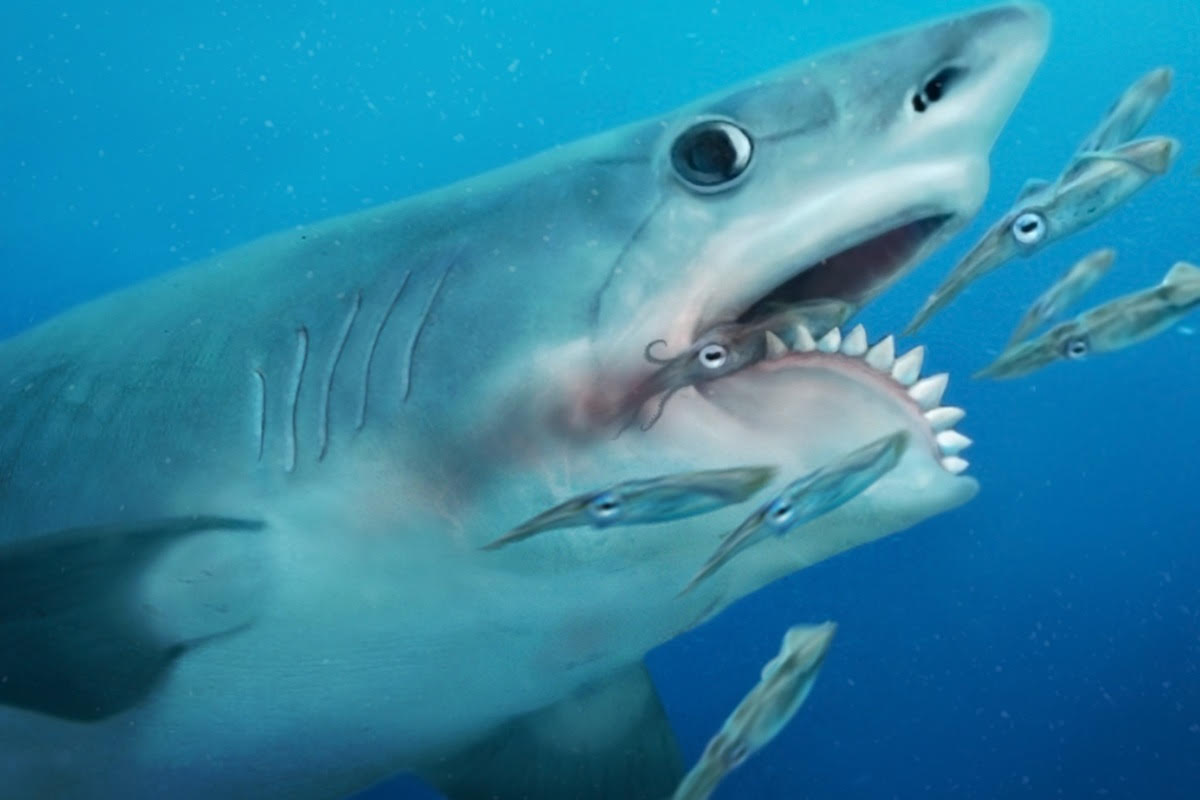
Occasionally, I do really well by doing good. An email came from one of Nancy English’s friends who wanted some fossils identified. Okay, that is a common event for me. I get some emails, and I see the usual hopeless “rusty stain on a rock” photo. The collector had a few things like crinoid stems, cross sections of ammonites, and a nice brachiopod with spines. Nothing special, until the collector mentioned that she had a Heliocoprion. Look at the photo to see a reconstruction. Note that this shark has its teeth in a single helix.
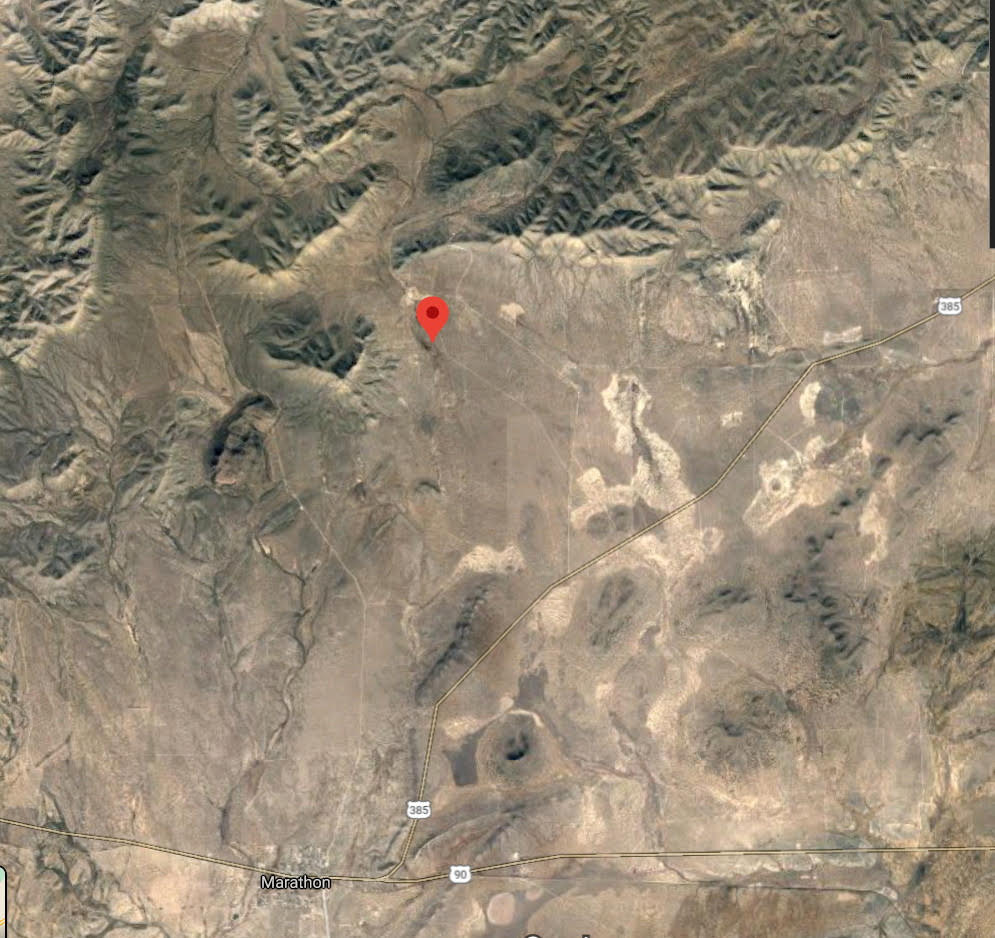
Even better, it is from just north of Marathon, TX in the Permian age rocks. These are REALLY not common from Texas. She mentioned that she found it on a field trip from the family cabin in Hess Canyon.
Click the map image to view a larger version.
You need to see some pictures of this thing. This is face view. Note that the teeth are in a whorl and the fingers for scale.
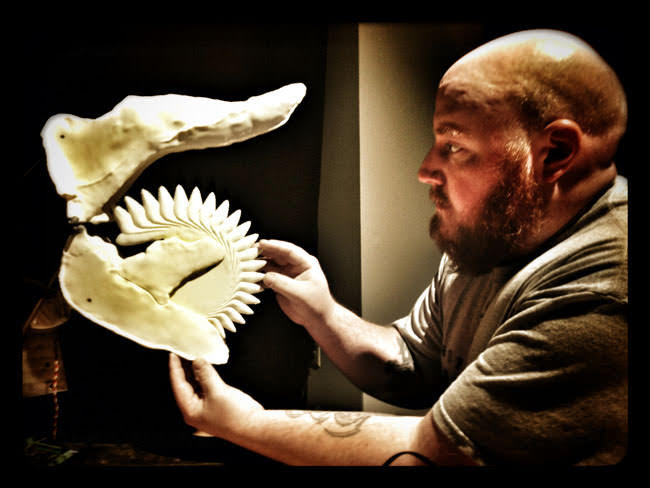
Let’s look at some reconstructions of the jaw. This shark is most commonly found in the phosphate mines in the Phosphoria formation in Idaho: The University of Idaho has the largest collection in the world. The university prepared a number of specimens for display, but they did not bother with #4. A pair of paleontologists who were working on this critter noted that #4 contains PART OF THE SKULL CARTILAGE. They took the specimen to UT Austin for a micro CAT scan and found wonderful things. They answered the question of how many tooth whorls were in the jaw – amazingly, just ONE.
Apparently there is just one tooth root which grows teeth as the spiral moves. This process is quite similar to the usual conveyor belt progression of teeth in modern sharks where there is a row of tooth roots in the jaw that produce a succession of teeth. Overly zealous cleaning probably destroyed other specimen soft part impressions. You can see the details in https://royalsocietypublishing.org/doi/full/10.1098/rsbl.2013.0057
The catalyst for this project is the artist and fish fanatic, Ray Troll. He put the correct people in touch to do the research, found the money for the CAT scan, and popularized the results. See his shark work at https://www.trollart.com/art/sharks/
So how did the jaw work in life? This is the 3-D reconstruction.
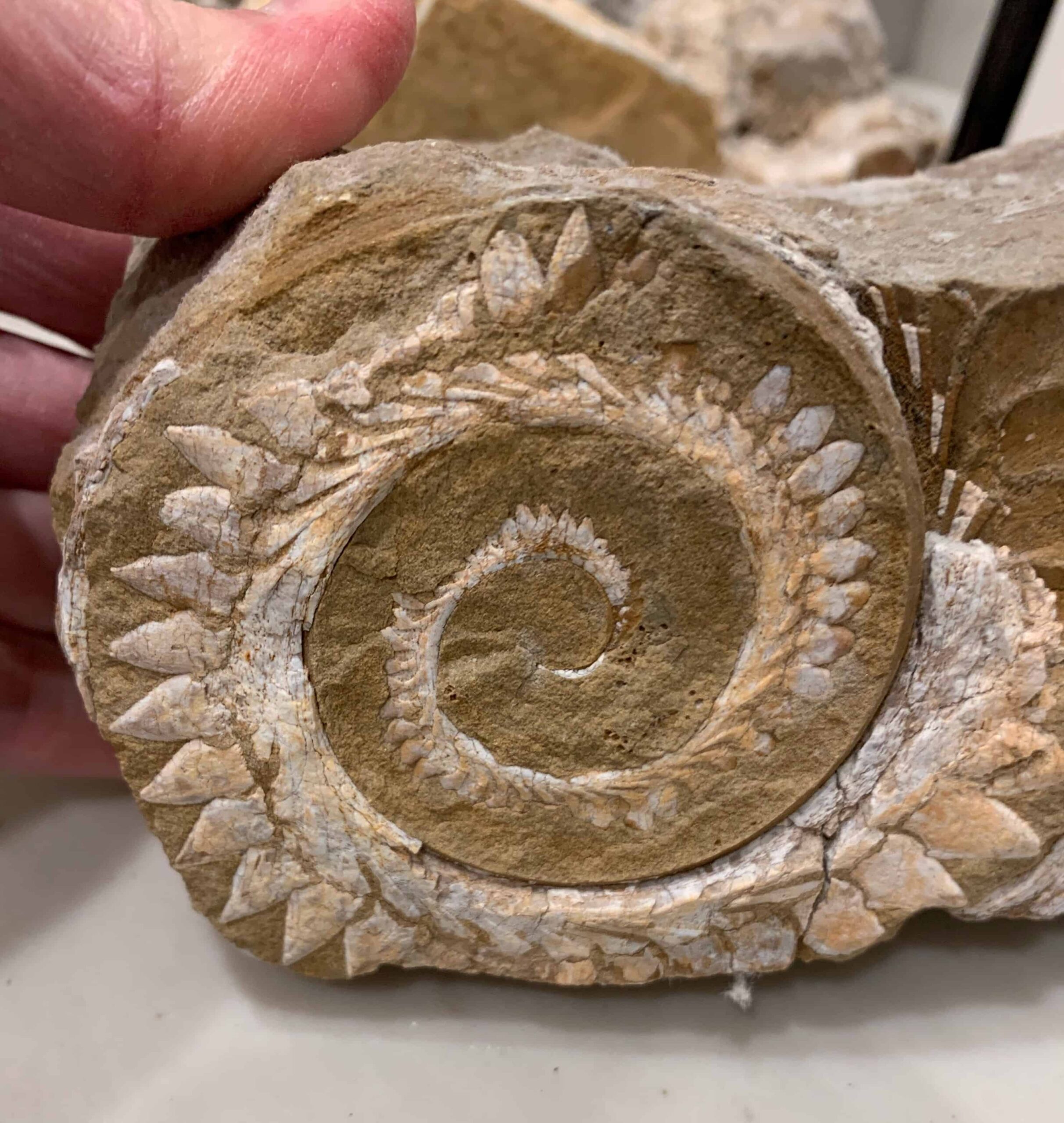
I am delighted to show you the Texas Heliocoprion, and I want you to get out there and look for more. People have been trying to reconstruct the critter behind these strange fossils for a long time. It is odd that in this case, the simplest solution did not turn out to be the correct one.
Weirdness rules!
A complete reference is Resurrecting the Shark: A Scientific Obsession and the Mavericks Who Solved the Mystery of a 270-Million-Year-Old Fossil by Susan Ewing | Apr 4, 2017