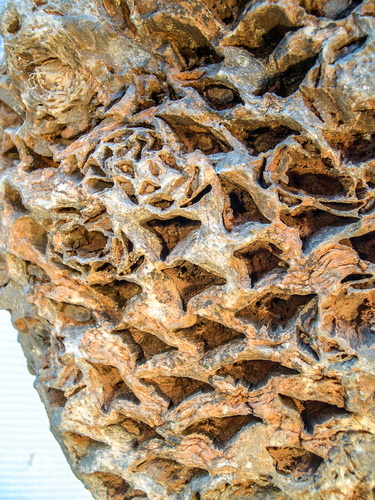
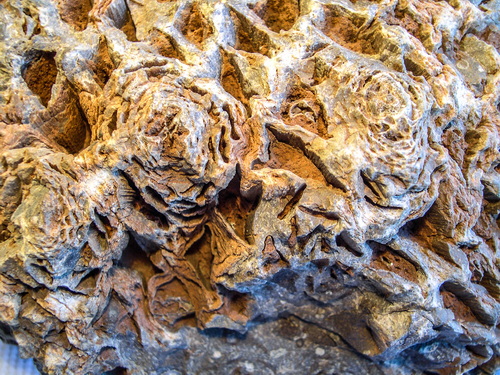
Cycad Anadomy and Fossil Occurrences in Texas
The following article was published by Scott Singleton in Fossil News, vol 12 #9, 2006
Images are the author’s from his personal collection from the Early Cretaceous Hensell Sand, Fredricksburg, Tx
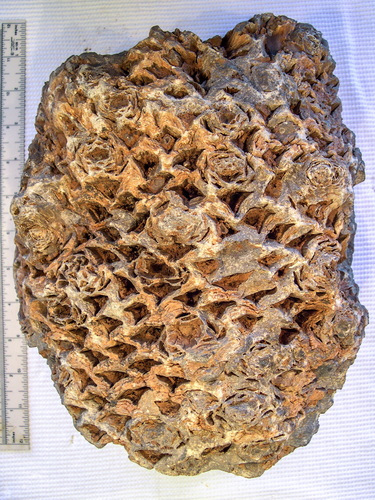
Cycadophyta presently consists of the living order Cycadales, which is comprised of three families worldwide. In the Mesozoic, cycads were represented by the Cycadales, plus another large order, Cycadeoidales (also referred to as Bennettitales). Cycadophyta is thought to have evolved from the Paleozoic seed ferns (pteridosperms), as did conifers, and eventually, angiosperms. However, Cycadales and Cycadeoidales likely arose from two distinct forms of pteridosperms. Their similarity is thought to be the result of convergent and/or parallel evolution (Norstag & Nicholls, 1997). Cycadeoid remains are much more prevalent in the fossil record, and thus it is thought they were a common constituent of the plant assemblage. (Conversely, Cycadales are relatively rare in the fossil record). Ultimately, Cycadeoids became extinct by the end of the Cretaceous. One theory postulates that they were dependent on specific insects to spread their pollen from plant to plant because the female ovule was completely encapsulated within the cone and that for some reason they lost their insect-pollinators (Norstag & Nicholls, 1997). However, others feel that the Cycadales had evolved a slightly more advanced megaspore and ovule structure, thus allowing them to survive into the Tertiary whereas many other organisms, including dinosaurs, failed to adjust to environmental changes at the end of the Cretaceous (Tidwell, pers. comm.).
Both cycads and cycadeoids occur in Texas, although they are not common or widely reported. Fontaine (1893) described an abundance of cycad, conifer, and fern leaves from the Glen Rose Formation, Lower Cretaceous (Trinity Group), two miles up the Paluxy River from the town of Glen Rose. His specimens were from limestone that he judged was deposited some distance from shore. He did not, however, mention any cycad trunks (or any wood) being found. Wieland (1931), the well-regarded early researcher in fossil cycads, described a visit to Stephenville where, through the courtesy of a number of devoted rockhounds, he obtained numerous cycadeoid trunks for the U.S. National Museum at Yale.