

We love fossils, and we put more emphasis on finding them than buying them. If you also love fossils and pick up them up wherever you go, and then wonder about them, this is the place for you!
Paleontology Section
We dig fossils! And in a big way!
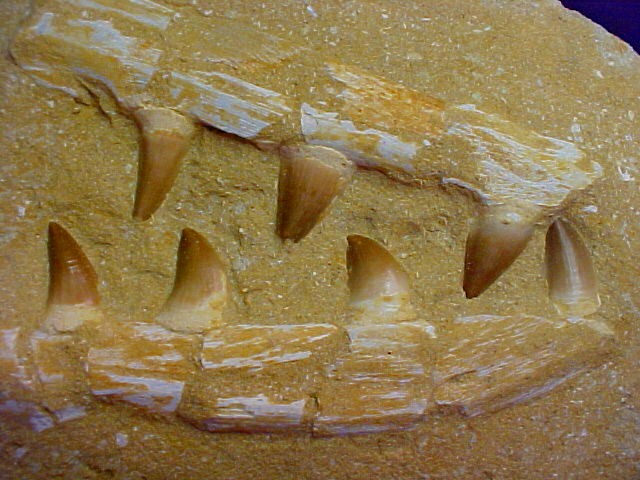
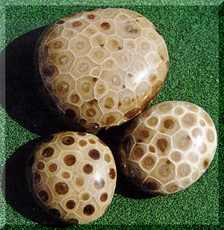

Who We Are
Join Us!
We welcome guests and new members at our monthly meetings on the third Tuesday of the month at 7:30pm. Meetings are usually hybrid -both in-person and remote – via Zoom. It’s better in person because you can look at fossils and bring in your own to show off. Maybe you can stump the Paleontologist!
Current Section officers for the Section are President Neal Immega Ph. D. paleontologist, and Field Trip Leader and Section Representative Mike Dawkins.
We generally have a Show & Tell and a talk or a project at each meeting. We have had sessions where we learn new techniques like “coal ball peels” and making thin sections of fusulinids. We also have a holiday party (in July!). At one party we had a session where we made jewelry from inch-sized Moroccan ammonites ground to show the chambers. Lovely!
For the Community
We do community outreach in several areas, giving talks for schools, libraries, Scout Geology Merit Badge programs, staffing paleo tables at our annual show, docenting at the Houston Museum of Natural Science, doing field trips for Earth Science Week, downtown building stones tours, and talks for sister rock clubs. The Paleontology Section offers a $1000 scholarship each year to a student focusing on paleontology. Click on the EDUCATION pulldown in the main menu or click on SCHOLARSHIPS for more details.
Paleo Section President Neal Immega has had great success coaching Science Olympiad students. In 2014, his teams won 1st and 7th in the nation in the High School category for Rocks and Minerals. In 2015, his teams won 1st and 10th in the nation in the Middle School category for Paleontology. See our Outreach gallery. In 2023 his team won 3rd in the nation.
Never Stop Learning
We have a 1700 volume library with everything from popular books on dinosaurs to the Journal of Paleontology. An Excel spreadsheet can be found here.
Interesting Links
The incredible true story of Mary Anning (A Child’s Contribution to Paleontology): https://matadornetwork.com/read/mary-anning-ammonite-movie/
https://en.wikipedia.org/wiki/Mary_Anning
The Fossil Academy https://www.youtube.com/user/
Palaeontologists reveal ‘the most dangerous place in the history of planet Earth’
https://www.sciencedaily.com/
https://www.port.ac.uk/news-
Pennsylvanian Fossils of North Texas: https://www.youtube.com/watch?v=VXRzTzW-aVM
Marine Carboniferous Fossils of Texas:
https://www.youtube.com/watch?v=oIlMcH5kscw
https://www.youtube.com/watch?v=LfhufFr83n8
Ice Age manatees may have called Texas home: https://www.sciencedaily.com/releases/2020/10/201001133214.htm
Dinosaur links https://artsandculture.google.com/entity/dinosaur/m029tx?categoryid=other
Watch “Could You Outrun a T-Rex? – with David Hone” https://youtu.be/08KKeW8I_nM
Spinosaurus Aegyptiacus – Giant Spinosaurus Was Bigger Than T. Rex—And First Dinosaur Known to Swim:
https://paulsereno.uchicago.edu/discoveries/spinosaurus_aegyptiacus/
Cartorhynchus lenticarpus – Pebble Toothed Marine Reptile https://www.dailymail.co.uk/sciencetech/article-8300251/250-million-year-old-marine-reptile-evolved-pebble-shaped-teeth-crush-prey.html
World’s biggest reptile egg
https://www.dailymail.co.uk/sciencetech/article-8432207/Worlds-biggest-reptile-egg-laid-prehistoric-sea-monster-66-million-years-ago.html
New Study Helps Explain How Dinosaur Skeletons Supported Massive Loads
https://www.smu.edu/News/2020/Research/Researchers-find-dinosaurs-unique-bone-structure-key-to-carrying-huge-weight
Scholarly article on Nodosaurs
https://royalsocietypublishing.org/doi/10.1098/rsos.200305
Seen Jurassic Park? T-Rex Skeleton Brings $31.8 Million at Christie’s https://nyti.ms/3jGdsGQ
National Geo – Reimagining Dinosaurs https://www.nationalgeographic.com/magazine/2020/10/reimagining-dinosaurs-prehistoric-icons-get-a-modern-reboot-interactive-feature/
Artist depictions of dinosaurs https://dinosaurpictures.org/
Study sheds light on the evolution of the earliest dinosaurs: https://phys.org/news/2020-07-evolution-earliest-dinosaurs.html
Devonian Extinction Theory:
http://www.sci-news.com/paleontology/end-devonian-mass-extinction-erosion-ozone-layer-08477.html?utm_source=feedburner&utm_medium=feed&utm_campaign=Feed%3A+BreakingScienceNews+%28Breaking+Science+News%29
Researchers propose a supernova triggered the Late Devonian mass extinction: https://arstechnica.com/science/2020/08/researchers-propose-a-supernova-triggered-the-late-devonian-mass-extinction/
https://www.sciencedaily.com/releases/2020/08/200818142104.htm
Dinosaur-dooming asteroid struck Earth at ‘deadliest possible’ angle https://www.bbc.com/news/science-environment-52795929
Extinction and dawn of the modern world in the Carnian (Late Triassic) https://advances.sciencemag.org/content/6/38/eaba0099
Asteroid impact, not volcanoes, made the Earth uninhabitable for dinosaurs: https://www.imperial.ac.uk/news/198595/asteroid-impact-volcanoes-made-earth-uninhabitable/
Scholarly paper about Asteroid Impact and Dinosaur extinction: https://www.pnas.org/content/pnas/early/2020/06/23/2006087117.full.pdf
Biosignatures may reveal a wealth of new data locked inside old fossils https://phys.org/news/2020-07-
William Buckland’s Copralite Table https://www.lymeregismuseum.
PDF here http://www.lymeregismuseum.co.
True size of prehistoric mega-shark finally revealed https://www.sciencedaily.com/releases/2020/09/200903095637.htm
scholarly article https://www.nature.com/articles/s41598-020-71387-y
https://www.nationalgeographic.com/science/2020/09/first-known-dinosaur-feather-inspired-dispute-archaeopteryx/
NO – https://www.nature.com/articles/s41598-018-37343-7
YES – https://www.nature.com/articles/s41598-020-65336-y
150 Year Scientific Dispute – Does the fossil feather from the Solnhofen quarries belong to Archaeopteryx?
https://phys.org/news/2020-09-naked-prehistoric-monsters-evidence-reptiles.html
Crickets were the first to chirp 300 million years ago https://phys.org/news/2020-10-crickets-chirp-million-years.html
150 Year Scientific Dispute – Does the fossil feather from the Solnhofen quarries belong to Archaeopteryx?
https://phys.org/news/2020-09-naked-prehistoric-monsters-evidence-reptiles.html
360-Million-Year-Old Fossil Reveals Extinct Species of Fern-Like Plant:
http://www.sci-news.com/
New Argentine fossils uncover history of celebrated conifer group:
https://news.psu.edu/story/
Burgess Shale fossil site discovered in Kootenay National Park: https://www.youtube.com/watch?v=KYrMxdTrQHw
Digitizing the vast ‘dark data’ in museum fossil collections: https://theconversation.com/digitizing-the-vast-dark-data-in-museum-fossil-collections-102833
Finding Fossils
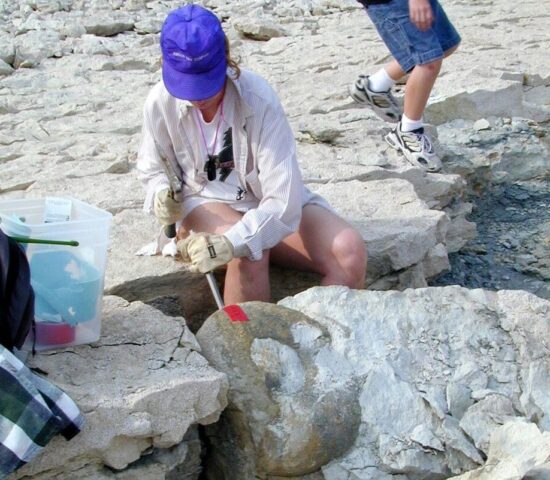
We are blessed to live in Texas with its plentiful limestone deposits loaded with fossils of many kinds. There are many great locations for fossil hunting and we have field trips. You can see some of our past field trips below.
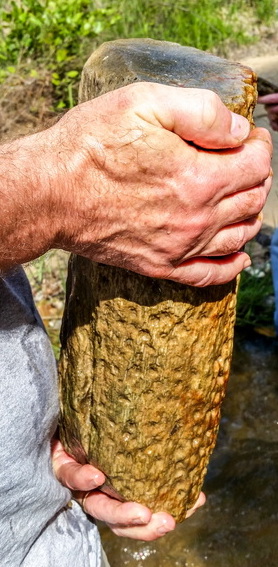
Petrified wood from a commercial tree farm – living trees – near Jasper, Texas. The corporation let the employees hunt deer and those employees let us hunt petrified wood in the past. We mined a paleo log jam in an old river bed for 20 years.
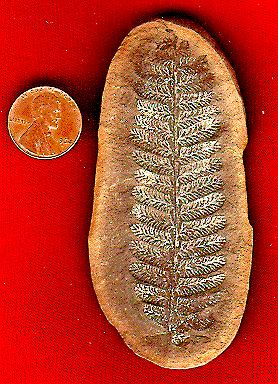
Fossil Fern from Mazon Creek, Illinois
Some of the finest fossils in the US.
Identifying Fossils
Fossils need to be identified, and the Section has written identification guides for Texas Eocene Stone City Formation, Texas Cretaceous Ammonites, Bivalves, Urchins, Gastropods, Oysters and Texas Pennsylvanian Brachiopods which you may order. We also have described the Petrified Wood in the Herbert Zuhl Collection on display at the Houston Museum of Natural Science. Please click on the PUBLICATIONS pulldown in the main menu or click on PALEO BOOKS to find out more.
Fossil Preparation
As a Section of the Houston Gem and Mineral Society, we have access to diamond saws and grinders and torches and furnaces where we sometimes turn our finds into jewelry or bookends. After you have collected a carload of petrified wood, you HAVE to do something with it. Petrified wood is a fossil, too.
We teach how to prepare fossils in our shops. We have a dedicated air tools room with micro jackhammers (Aero and Microjack 5) and a Swamblaster micro sandblaster. Those trilobites don’t come out of shale all clean and shiny
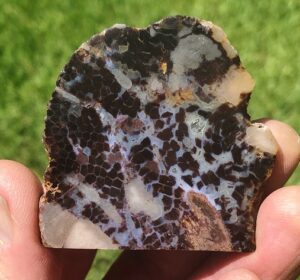
Polished slab of S. Texas “shrinkwood” – dessicated wood fossilized and filled with chalcedony
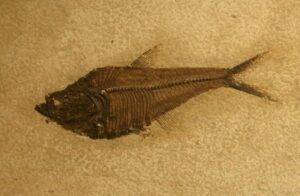
Fish Fossil after preparation and cleaning – probably from Kemmerer, Wyoming
Paleontology Section member Neal Immega says: I grew up in St. Louis, Missouri and collected fossils from the Mississippian era. This meant that echinoderms were high on my list. This crinoid, from the Paint Creek Formation, at Millstadt, Illinois, died face down on the mud which was to become shale. I was 16 at the time and was most impressed by the arms on this crinoid but had no idea how to preserve it. So I tried something: I poured bio-plastic (styrene) over the fossil. I should have used epoxy, but I didn’t know that, and I certainly didn’t have any. However, 60 years later the crinoid is in perfect shape. I expected the styrene to crack and flake off, but it looks the same as when I poured it. Note the quarter for scale.
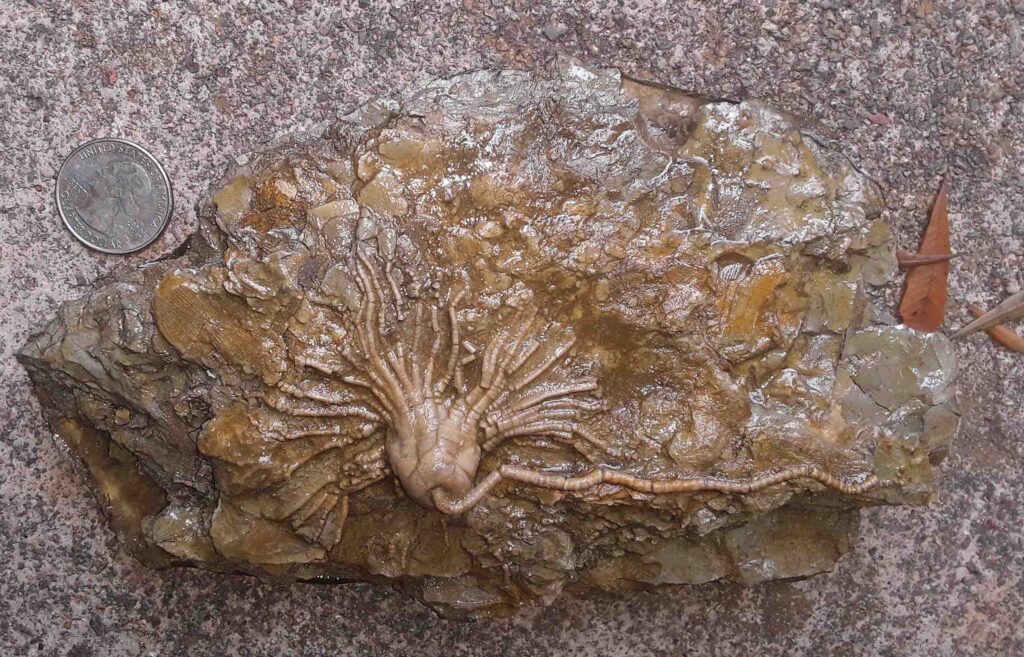
Crinoid, from the Paint Creek Formation, at Millstadt, Illinois
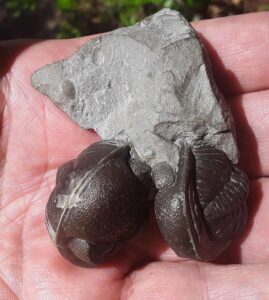
Cluster of Devonian Phacops trilobites.
Collected by member Neal Immega in Pennsylvania when he was in high school, about 1965.
There are cephlons – the “head” portion of the trilobite – on the reverse side.
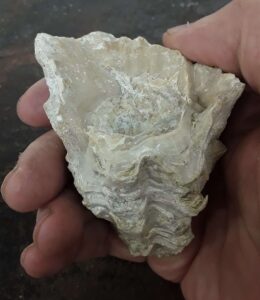
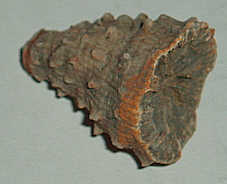
A Rudist found by Neal Immega near Belton Lake.
These are common in the Edwards Formation.
This specimen shows the classic ice cream cone shape with a small living chamber.
They are present in astronomical numbers but are unfortunately rarely complete.
In the subsurface, they frequently provide hydrocarbon reservoirs.