

Display Bases for Your Specimens
We are discussing bases for individual specimens which will help to organize and display your collection. Not every rock, mineral, crystal, or fossil is going to sit evenly in your display case by itself. Need a particular type of stand for that unique specimen? Google knows all, or at least who is selling it! You’ll be amazed at the variety of available stands. The aim is to display your mineral, rock, or fossil to best advantage.
Going for uniformity? Stick with one style. Free spirit? Artistic? Cost-constrained? Mix and match.
Got a great budget? Go acrylic all the way. All the best and most expensive collections seem to go for the high style of carved, engraved clear acrylic bases. While most are clear, black is also becoming popular. Bonus: Light passes through the clear acrylic, improving the lighting in your case.
Your case! Why cases are a good idea: that’s another whole article. Maybe next month! You will dust less often and prevent impulsive picking up of your treasures by guests (we have grandkids). I will also say that containing a lot of visually arresting objects in defined areas can make them a bit less overwhelming. That argument probably wouldn’t cut it with minimalists. For them I would recommend single, LARGE specimens with clean lines and simple custom mountings.
Let’s look at some common types, some specialized mounts, and custom mountings.
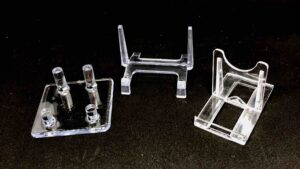
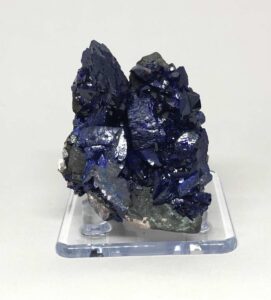
Flat bases are the most popular, with acrylic squares being the most common, although nearly any shape is possible, and many different materials are utilized. Bases can come with pegs, hooks, or ledges to support the edges of specimens. Some bases feature adjustable metal arms to hold your rock or fossil. Acrylic “C” or “U” stands can be used to elevate specimens. Riser stands can elevate whole rows.
People also use tiles, slabs, cubes, rectangles, or cylinders of stone or glass. Old cores of all sizes can make good stands, especially if polished. Sculptural glass, stone, ceramic, and metal stands are available and can be quite artistic. We have one stand that is essentially a velvet bean bag, which is excellent for supporting a spiky quartz crystal specimen.
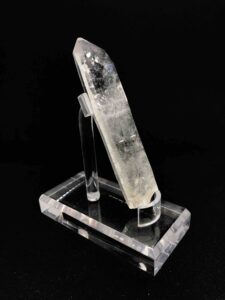
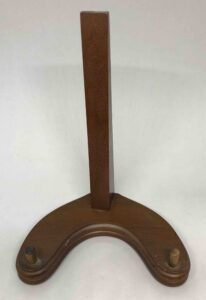
And of course, you could put everything in Perky boxes, acrylic boxes with a bottom lid. They come in different sizes, from thumbnail to – well, bigger! They certainly stack up neatly.
More specialized:
- Stands to hold vertical specimens
- Compass point or brass caliper stands
- Tripod stands of wood or metal
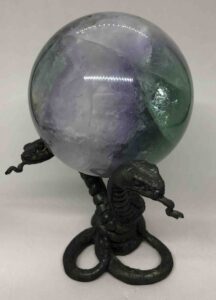
- Stands for spheres – available in many materials
- Wooden bases with reverse-carving into wooden base to support specimen
- Stands that are lighted or that rotate.
- Gemstone display stands with a clasp to hold a faceted stone
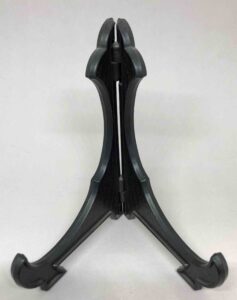
- Folding wooden, plastic, or metal tabletop-style plate stands work well for slabs.
- Wall-style plate hangers are great for large flat specimens if you have the wall space.
- Bell Jar or Cloche stands – protect a delicate specimen or prevent anyone from touching a poisonous or radioactive mineral
- Small jar for holding water in which to display opal
- Moldable clays (available in art supply stores) can be used to create bases. The clay hardens in air or after baking and should support a specimen.

Custom mounts:
- Welded strap iron stands and wall hangers can be made for you by welders
- It is possible to 3D print a stand now. Brian Greenstone of Greenstone Fine Mineralia has a process using kinetic sand. You fill a small box with the kinetic sand and then set your specimen in it in the proper position for display. You then remove the specimen and photograph the impression from many angles, and the company can use that to create a hollow plastic stand with internal ridges to strengthen it, that is like a dish that will fit your mineral perfectly.
- You can send a specimen to some fabricators, such as Stone Throne, who used to come to the HGMS show, and they can create custom, engraved acrylic bases that fit your specimen perfectly. Not cheap, but beautiful!
For those of you just starting out, stands on the cheap:
- The humble specimen box – yes, the little folded paper box that your specimen was probably in when you purchased it – can also make a good stand when turned upside down, especially on the back row.
- Sawn sections of PVC pipe can make good stands, especially for spheres.
- Sawn pieces of lumber sanded and painted or stained or covered with fabric.
You can create risers for a case in this fashion.
- Plastic jar lids – they come in all sizes.
- You can stack one specimen on another if the bottom one has a flat spot or a hollow on top to hold something else. Don’t do this with valuable specimens!
- You can carve your rock; after all, HGMS members have access to our shop’s grinding wheels and saws. Many purchased specimens come trimmed in some fashion. Sawing to create a flat spot on the bottom means it has its own base built in, and perhaps the specimen would benefit from having the amount of matrix reduced. A plus would be a felt cover on the bottom to protect glass or furniture surfaces. You can also grind off corners of specimens for better display, using lapidary grinding wheels. You can chip off pieces with a rock trimmer or glass-nipping pliers. There are even tiny equivalents of jack hammers. Any more sophisticated air tools are beyond the scope of this article.
Other questions to consider:
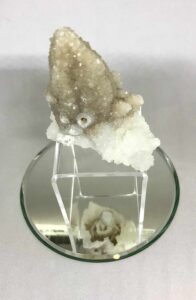
Will the specimen need to be removed from its mount to be photographed, viewed, handled, displayed elsewhere, or maybe just dusted? Some specimens are interesting from different angles or have crystals or a catalog tag on the bottom. With these you may want a custom stand with a hollow carved for the bottom of your specimen. You could also consider a mirror stand, that lets you see the back or even the bottom, if the piece can be elevated on an acrylic “U” stand.
To make your specimen stick to a base, start by trying Mintac putty (Mineral Tack brand is best). You can use Mintac to help support a small specimen or keep it from sliding. If that doesn’t work, you can use a hot glue gun with crystal clear glue sticks. To glue or not to glue – a specimen can prove too heavy and break its bond with the plate.
So, experiment with bases! They will make your collection more visible and interesting and make it more fun for you to work with and maintain it.
All photos by Steve Blyskal
For more advice on bases and maintaining your collection:
http://www.johnbetts-fineminerals.com/jhbnyc/articles/advice
