

THE BACKBENDER’S GAZETTE
Volume LIIII ----- Houston Gem & Mineral Society ----- July 2024
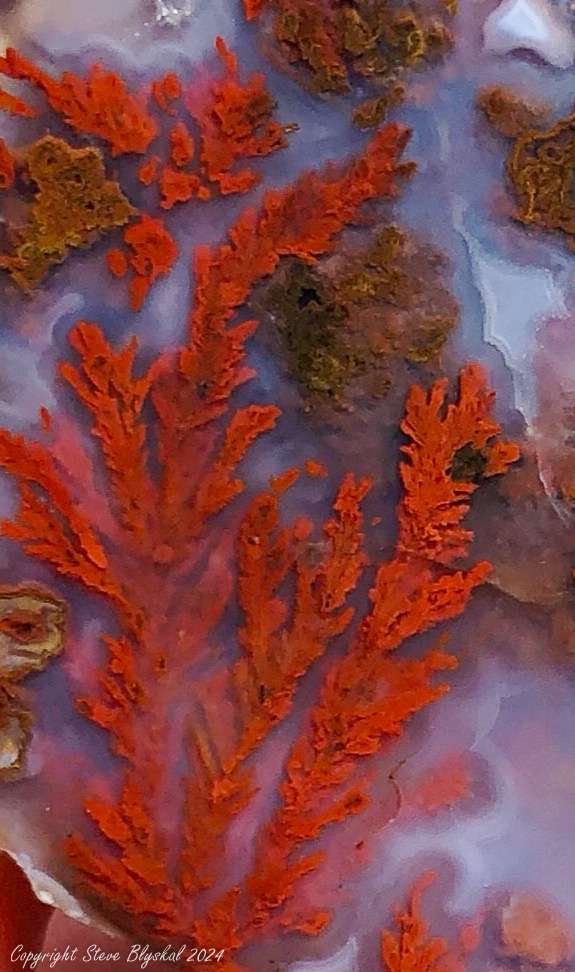
Biominerals: Microbial Life in Agates
Table of Contents
Click a Table of Contents Entry to jump to that article.
Club Information
Permission to use material originating in this newsletter is given freely providing that credit is given to the author and the source. Every article published in the BBG is edited for grammar and content. No flaming is allowed.
BACKBENDER’S GAZETTE SUBMISSION DEADLINES
Articles are due on the 15th day of the month before the date on the BBG issue.
Copy is due for the next issue by the 15th of this month. Email content to editor@hgms.org

President's Message
by LT Wilcox
After a number of our leading members were hit hard in the past 2 months, by the Derecho and by illness, we are starting to move forward again.
We did what I think is a great job coordinating work on the trim saws and had an amazing turnout, all cleaned up, 3 have new blades and a 4th is still a work in progress. There is a write-up in shop news with more info. *please note the blades are thinner!* so use light to almost no pressure when cutting. We don’t want to bend them! If you feel like you’ve got to put your back into it or take a hammer at it.. STOP! And ask a Shop Foreman for help first! Don’t be the first person to bend one..
Next we will be working on the lapidary machines!
Jeanean also held a class for 4 members on using the rolling mill! She has started a checkout process for confirming when members have been approved to use equipment. Let us know if you would like to know about being checked out to use any of the machinery in the clubhouse!
If you are interested in becoming a part of the working side of the club, let us know! We will get you started learning any one of our positions!
Reminder, we are getting to the part of the year where we see 100+ degrees! Dig responsibly!
LT
Vice-President's Message
Jeanean says she is waiting on replies about the July talk. Read your eBlast!
Do you have an interesting project? Write up and pitch it to Jeanean.
Section News
Beading – Second Saturday, 12:00 PM -3:00 or 4:00PM. Center Classroom.
Always bring beading mat, scissors, wire, wire cutter, round nose and needle nose pliers, thread, and beading needles if you have them.
For the July 13th meeting, Gretchen Cocherill will be teaching us how to quill. She has kits to make 5-pairs of earrings in different styles at a cost of $8.00 per kit. 10-kits are available for purchase. Kits include 5-pair of earring findings, jump rings, a quilling tool and quilling papers. Examples are shown in the photo. Bring any quilling tools or supplies that you have. Exact change please.
At the August 10th section meeting, Maggie will teach us to make a beaded bead in either Peyote stitch or Netting style (your choice). Bring Show & Tell items and basic tools to the meetings and any project ideas that you have.
NOTICE: Do you have a bracelet or necklace that needs restringing? The Beading Section will carefully restring your piece at an hourly rate of $15.00 + materials. Contact Beading @HGMS.org to make arrangements. All funds will go to the Beading Section.
Gemstones and Faceting – Second Thursday, 6:30 PM
For the July 9th meeting, we will have a quick report on the Montana Sapphire Mining trip recently completed by John Lee, John Becker & Randy Carlson. After that, we will be building custom specific gravity kits that our members can use to help identify their gemstones. The Section will provide the material for each member.
Lapidary and Silversmithing – Third Monday, 7:00 PM
- The program for July 15th is silicone mold making. This technique does not involve heat or pressure like the old rubber vulcanized molds. Tony will demonstrate setting up and pouring a mold and participants will be able to make a mold of their own item.Please bring an item to create a mold — any sturdy material is fine. The original item can be plastic, wood, or metal. Hollow items are not good candidates for wax casting of a molded item because they will no longer be hollow when cast and will be very heavy and use a lot of silver.
Email Lapidary@hgms.org if you have questions.
Day Light – First Wednesday, 1:00 PM
The Daylight Section meets the first Wednesday of the month from 1 to 3 PM.
Mineral – Third Wednesday, 7:30 PM
July 17th at 7:30pm will be our next hybrid meeting. Steve Blyskal will present a program on various forms of pyrite crystals. Come see Minerals! Bring yours to show. Refreshments will be served. There will be door prizes.
The link for the Zoom meeting is:
https://us02web.zoom.us/j/4517997588?pwd=SnZjckZBTnRMbHRxZitScE9WU3RWUT09
Paleontology – Third Tuesday, 7:30 PM
The next meeting is Tuesday, July 16th at 7:30 pm. Subject to be announced.
Zoom link for the meeting:
https://us02web.zoom.us/j/86053771923?pwd=ek5lNlk5SGFYNjN6U29ONU4xVElyQT09
or
Meeting ID: 860 5377 1923
Passcode: 826994
If you’d like to join the Paleo Section email list, send an email to hgmspaleosection@gmail.com and ask to be added.
Youth, First and Third Saturdays, 10:00am – 12:00pm
Next meeting is Saturday, July 6 starting at 10:00 am
and Saturday, July 20 starting at 10:00 am
Participants must be at least 5 years old and accompanied by a parent.
Mostly we will be working on cabochons.
Shop and Building News
President LT Wilcox directed a group of shop assistants and helpers including Sharon Halton, Michele Marsel, Dean Wix, Logan Wilcox, Richard Good, Steve Blyskal, David Pawek, and Dave Janos in a shop work session on Thursday. The plan is to spread the knowledge around so that more than one person knows how to fix our equipment. The
objective of the session was to clean the trim saws and replace the 10-inch blades with new 8-inch blades. These are TRIM saws, after all. After cleaning all the trim saws, they were reassembled, new blades were installed and the proper amount of coolant (rust inhibitor in water) was added. The trim saws were then tested to make sure they worked properly. Some people carried saw bases outside to wash them out and others cleaned top plates.
All the trim saws were numbered, starting from the door, so that when people report that a saw is malfunctioning, all the shop managers will know which machine they are talking about. Currently there are 3 trim saws on the first table, with space for a 4th. The larger saws were numbered too: HP 24 inch saw is #1, The HP 20 inch is #2 and the HP 18 inch is #3. Then there is the big 24 inch saw, Texaco. The grinding units have also been assigned numbers, starting with the Genie near the sink and going down the row to the super grinder. That will make reporting for maintenance easier!
Education
Class Updates By Maggie Manley
Biominerals: Microbial Life in Agate and Other Minerals
by Sigrid Stewart
A Review of the book by Marco Campos-Venuti
It’s alive! Or it was alive at one time. Have you puzzled over the intricate patterns in agates and wondered how they could possibly have formed in so many different ways? Maybe you thought that the colorful plumes and mosses of your favorite lapidary materials were a little organic-looking. And maybe you were onto something.
I have been reading a fascinating and well-researched book, Biominerals: Microbial Life in Agates and other Minerals, by Marco Campos-Venuti, an Italian vulcanologist and author of numerous scientific publications and the founder and editor of the Rivista Gemmologica Italiana. He is the author of two other books about agates and jaspers, Banded Agates: a Genetic Approach and Genesis and Classification of Agates and Jaspers: a New Theory. Campos-Venuti proposes that there is an entire new eco-system that has been overlooked. Perhaps this would sound completely far-fetched if it were not for the discovery of black smokers, deep-sea hydrothermal vents found in volcanically active locations near mid-ocean ridges and hot spots. It is not surprising that such vents deposited minerals such as iron and other metal sulfides where they entered the ocean; what is surprising is that the heat, methane, and sulfides of those deposits are converted into energy in the absence of photosynthesis by extremophile bacteria and archaea which in turn support communities of tube worms, shrimp, crabs, clams, eels, and other organisms.
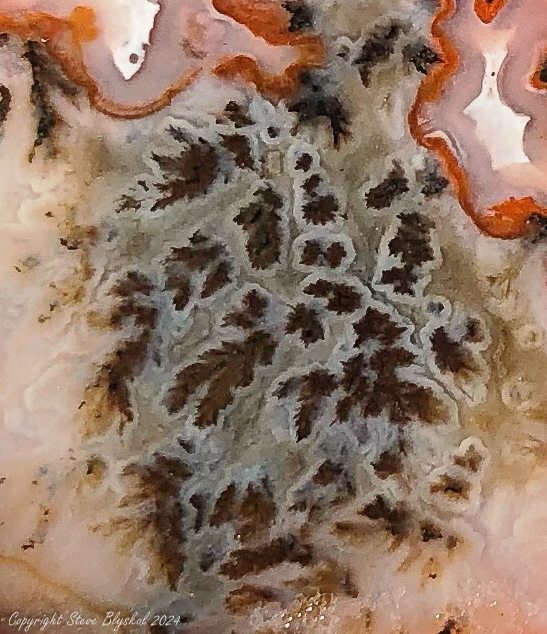
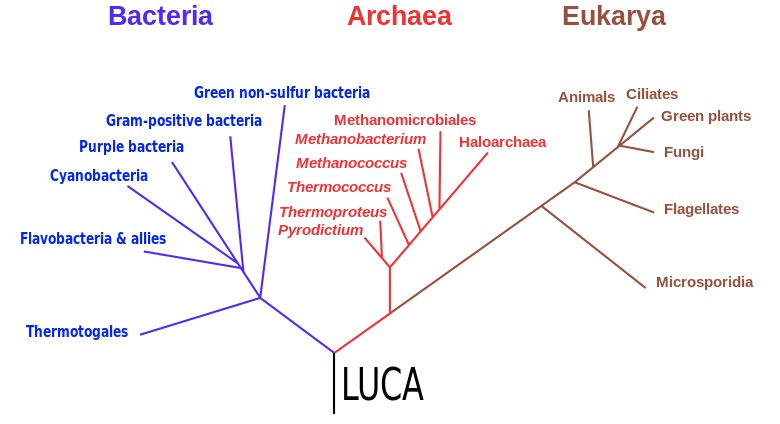
The Three-domain system classifies life into three domains, Bacteria, Archaea and Eukarya. Archaea are single-celled organisms which lack cell nuclei and are called prokaryotic, as are Bacteria. Eukaryotes have membrane-bound cell nuclei and are called eukaryotic (like all animals and humans). The Three-domain system diagram indicates where various organisms fall in the tree of life. There may be another group as well, called nanobacteria for want of a better name; organisms smaller but larger than viruses than bacteria which some scientists classify as non-living even though they replicate and can crystallize organic molecules. Nanobacteria may also be involved in mineralization
Extremeophiles are organisms which tolerate extremes of temperature, pressure, radiation, salinity, and pH level. Many Archaea are extremophiles, although some Bacteria and some Eukaryotes are as well. Extremeophiles have been found in hydrothermal vents, hot springs, salt lakes, deep ocean trenches and deep rock formations. Life finds a way and colonizes unexpected environments. Why all the biology? I’m getting to that.
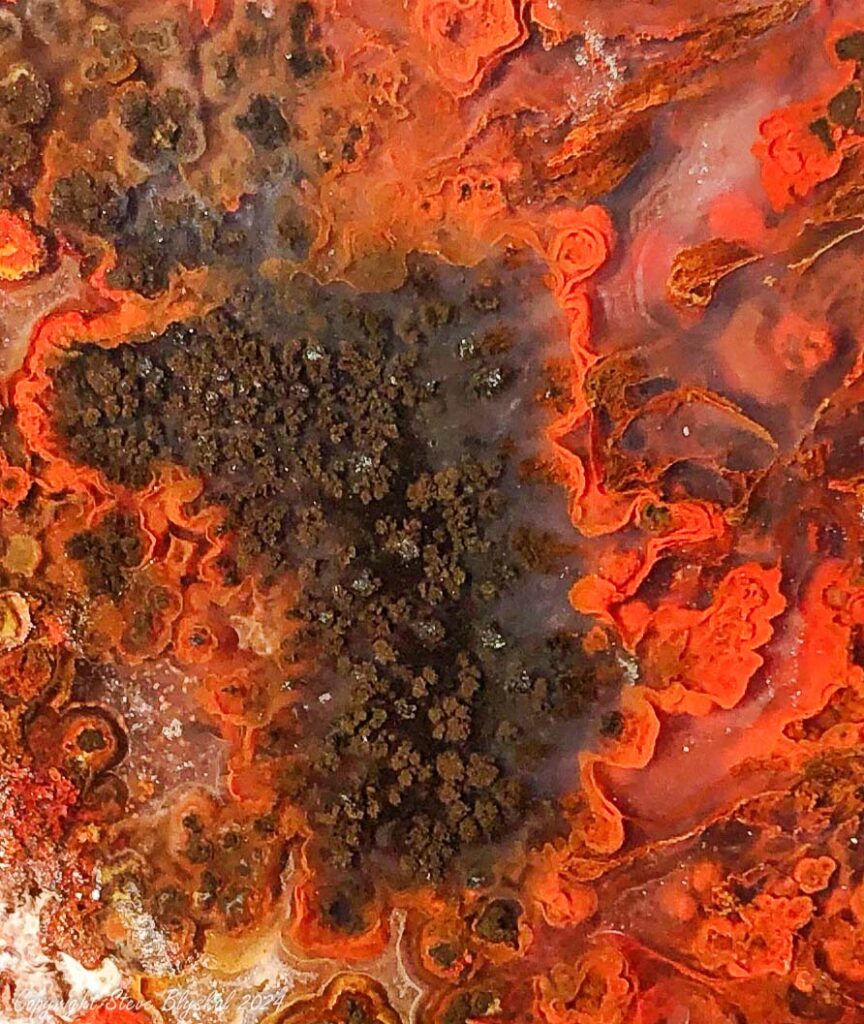
In Banded Agates: A Genetic Approach, and Genesis and Classification of Agates and Jaspers: A New Theory, Campos-Venuti outlined a model for the abiotic processes of agate formation and explains how most agates are formed at low temperatures from colloidal solutions deposited in seasonal wet-dry cycles. The geometry of the features we call mosses and plumes, however, cannot be easily explained as abiotic crystallization, so he left the non-crystalline mosses and plumes for the current book. He maintains that the biomineralization of microbial colonies can explain many of the mineral oddities that are so fascinating to the collectors of minerals and rocks, such as pyrite suns, landscape jaspers, manganese dendrites, fairy stones and moss agates.
He claims there is an entire previously unknown ecosystem: life inside dark cavities filled with chalcedony gel, with restricted space and nutrient supply, living without light. He presents evidence that these features are in fact formed by microbial colonies and that non-crystalline inclusions in agates are therefore fossils.
Cue the outrage and furious defense of previously held theories! There should be much new research devoted to proving or refuting this statement. The first half of the book reviews bacteria, microbialites (sedimentary microbial colonies) and stromatolites (carbonaceous microbial mounds). Stromatolites were recognized many years ago as biological but thought to be extinct until discovered growing in an Australian bay.
The second half of the book covers bacterial structures of the deep biosphere, below the surface soil down to 5 kilometers on continental rock and below the oceans. Thomas Gold theorized in 1993 that up to 95% of the Archaea and Bacteria on Earth might exist in the deep biosphere. Organisms have been found in rock, in vents, hots springs and deep wells.
Campos-Venuti recognized 6 groups of living microbial colonies living in the deep biosphere:
- Nodular microbialites forming concretions in deformable sediments
- Interstitial microbialites growing in the porosity of rocks such as sandstone and jasper
- Fissural microbialites growing inside crystals and in the fractures of non-porous rock
- Microbialites in agates – colonies develop in the chalcedony gel before it hardens
- Pseudokarstic microbialites – non-chalcedony, non-calcareous cavities where microbial colonies develop between flushes of mineral precipitates to produce banded rocks such as malachite and rhodochrosite.
- Open space microbialites associated with thermal springs and vents
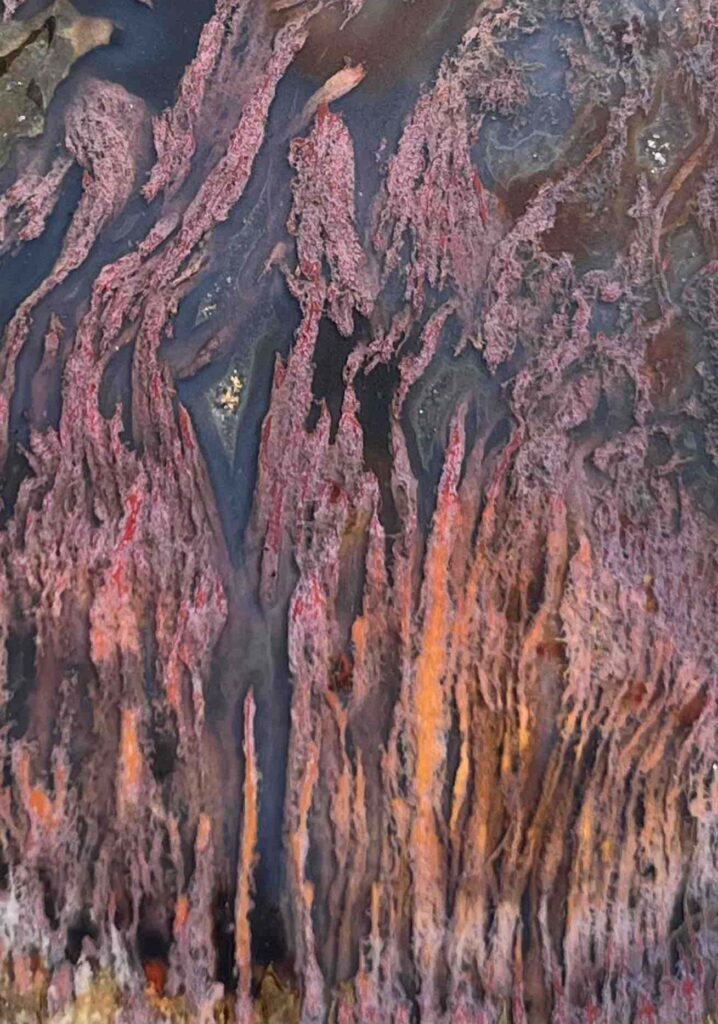
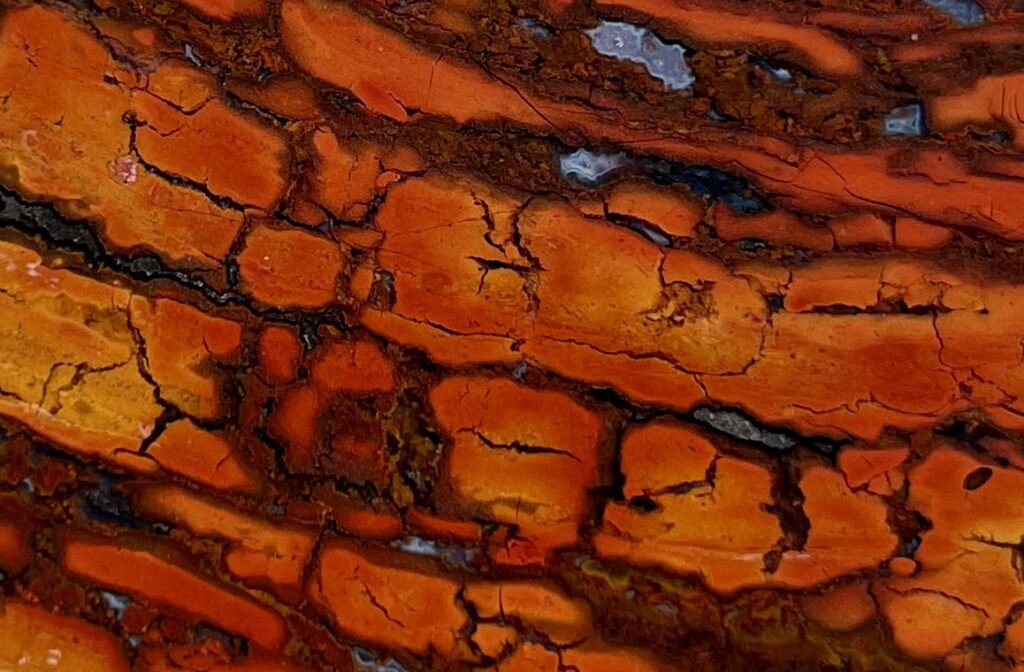
An important characteristic of these microbialites is the development of a biofilm composed of an extracellular polymeric substance produced by and enveloping the microbes. This polymer can create a tiny ecosystem in which different organisms are protected, live and feed. These biofilms are important to the development of different types of colonies and enable other substances to be trapped and help to build structures such as stromatolites and algal mounds.
To expand on #4, Microbialites in agate: in his earlier books, Campos-Venuti notes that early researchers, proposed that agates were created one band at a time by the deposition of silica-rich fluids. Then Leisegang (in 1915) developed a theory which posited that if a cavity was completely filled it would form all the bands at once and at temperatures around 200 C. This does not account for any features other than bands.
Much of this early research also led geologists to believe that agates were formed at high temperatures in volcanic environments. In the opinion of Campos-Venuti, many agates are formed at low temperatures, although a few are clearly associated with hydrothermal solutions and form at higher temperatures. Agates also form in many different potential cavities, such as petrified logs, voids in sediments, dinosaur bones and other fossils. Many do form in volcanic terrain but may do so because of the availability of silica from volcanic ash and rhyolite and the presence of cavities in basalt and of many faults and cracks in those formations. The inclusions we call plumes and mosses are more common in igneous rock than in sedimentary formations.
Ground water containing minerals, organic material and microbes which are capable of multicellular organization enters hidden cavities in porous basalt, andesite and rhyolite formations, and inflow and outflow channels develop. Agates contain 2 or 3 bands, deposited repeatedly as follows:
- Globular chalcedony (cryptocrystalline), a hydrated, transparent polymer, which forms a plastic gel or polymer before crystallizing and is the first layer in an agate, also called length-fast chalcedony. This first layer coats the cavity and can host bacterial growth. When it crystallizes it is perpendicular to the C-axis and is also called length-fast chalcedony
- Fibrous chalcedony (microcrystalline), anhydrous and white, crystallized as a rigid layer parallel to the C-axis directly from the diluted solution, and is also called quartzine or length-slow chalcedony
- Euhedral quartz (crystals), a final stage if present which forms after dilution events
The cycle of deposition depends on seasonal changes in the water table. The gel which becomes the first layer of agate can have new layers added every season and thus stay in a gel state for a long time. This means the gel can host the growth of microbial communities for long periods and support them so that they do not collapse as they grow. That’s all on the very complex chemistry of gels, polymers, colloids, and crystallizing chalcedony. There is more information available in Campos-Venuti’s books and many other sources.
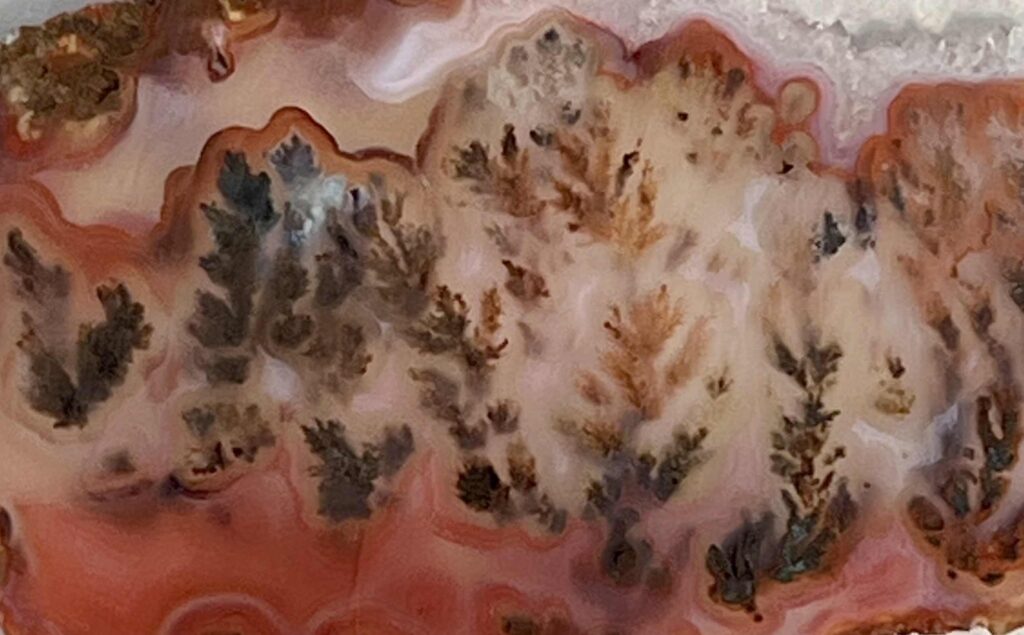
This all makes sense to me because I have seen waterline agates with plumes where a few plumes poke out into the empty cavity above the waterline. Also, the botryoidal features on the surfaces of some agates are actually the heads of plumes. I have collected small desert roses – chalcedony concretions – on the surface in the Davis Mountains which seem to be very recent creations. I have also spoken to people who have cut thundereggs and reported that where they would expect solid chalcedony, there is a rubbery not-quite-solid substance. Chalcedony that is not quite crystallized?
The fascinating aspect of all this is that eventually the chalcedony does solidify, and it preserves the detail of the formerly living microbial colonies, which can be grouped by their geometry as laminate, dendritic, lumpy or reniform, flames and plumes.
The inclusions in agate of biotic origin or mosses can be:
- Filamentous: formed by bacteria arrange in long filaments
- Lumpy: irregular or variable or dendritic
- Spheroidal or cocci: little dots which can be suspended or group at the bottom
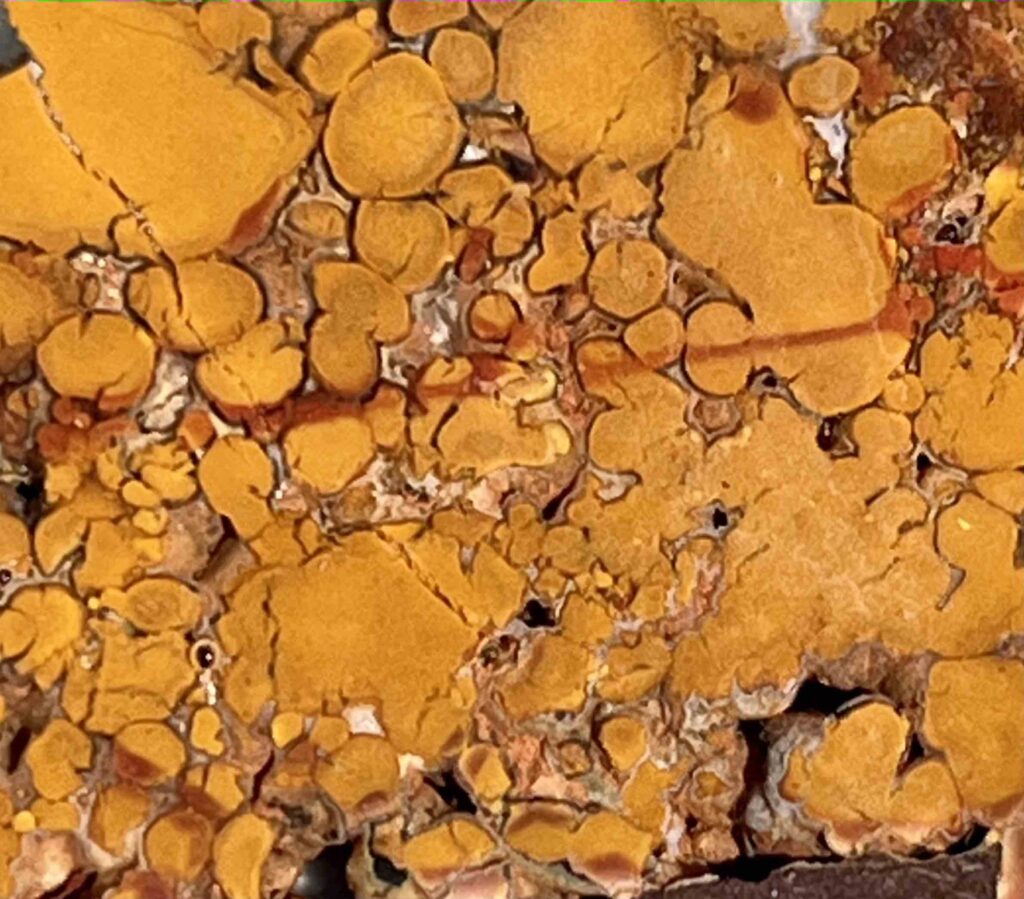
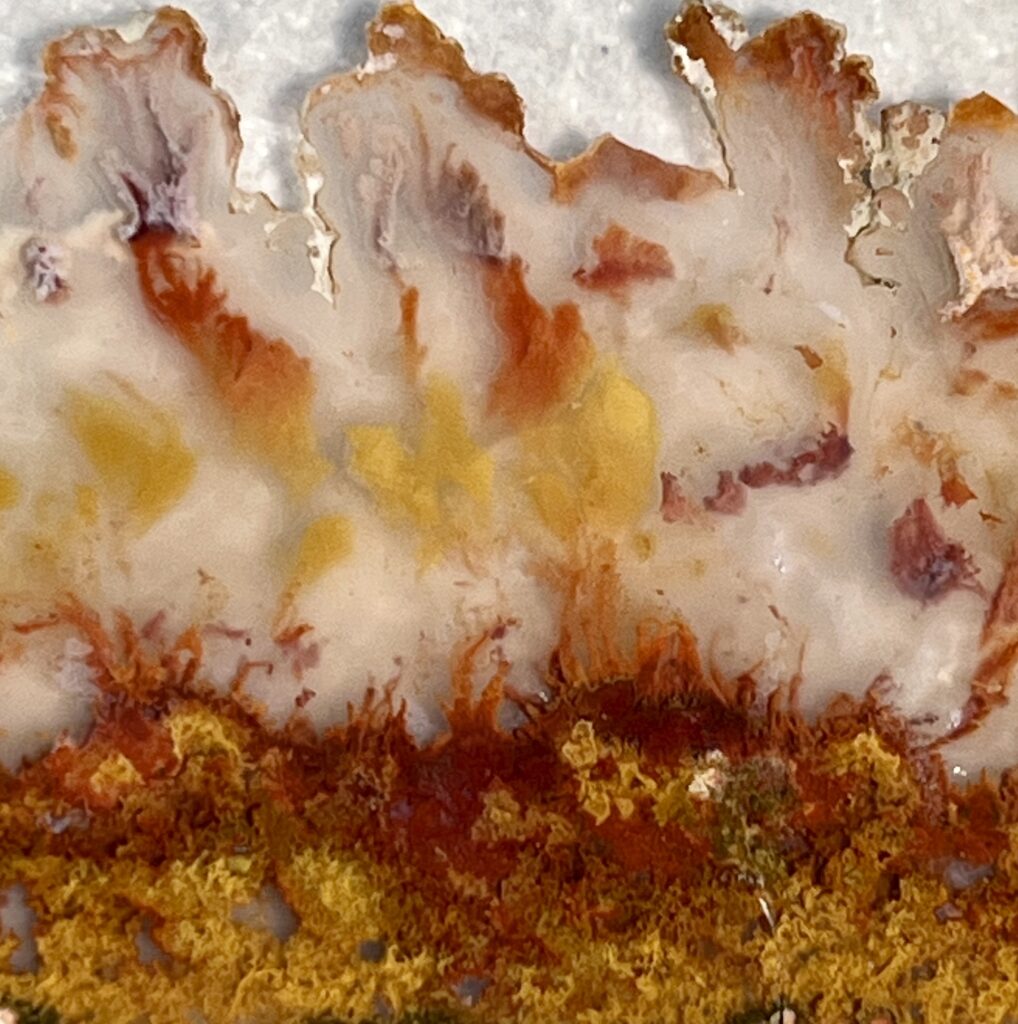
These types correspond to the three types of bacteria in multicellular microcolonies (Shapiro, 1988). Some are “benthic”, starting from the wall of the cavity and some are “planktonic” and float in the gel. These aggregations create complex colonial structures such as:
- Laminated: microbial carpets, usually horizontal, sometimes domed
- Dendritic: branching shapes
- Lumpy or reniform: spheroid, not banded
- Flame: microbial carpets with pinnacles
- Plume: Similar to dendritic but larger and coarser
Colors are variable and depend on metal ions such as iron (red, yellow and green) manganese (black, brown and purple) and aluminum (white). Goethite, psilomelane, copper and pyrite may be precipitated as part of the structures.
Finally, Marco Campos-Venuti was a dealer at mineral shows as “Gems in Gems” (a great way to support your hobby) and often spoke with enthusiastic collectors about dendritic and other forms in agates who asked, “Is this a fossil?” “No” replied Campos-Venuti, quoting textbook geology, “It may look like a fossil, but it is a pseudofossil, a mineral that crystallized in that form.”. As he began studying inclusions in agates – and got hooked – he realized he was giving a rote, textbook answer on a poorly researched subject. Now he is the one telling these people that perhaps they were right all along.
References:
Banded Agates: A Genetic Approach by Marco Campos-Venuti
Genesis and Classification of Agates and Jaspers: A New Theory, by Marco Campos-Venuti
Biominerals: Microbial Life in Agates and other Minerals, by Marco Campos-Venuti (2022)
https://en.wikipedia.org/wiki/Hydrothermal_vent
https://en.wikipedia.org/wiki/Archaea
https://en.wikipedia.org/wiki/Extremophile
https://en.wikipedia.org/wiki/Three-domain_system
https://en.wikipedia.org/wiki/Stromatolite
https://en.wikipedia.org/wiki/Microbialite
https://en.wikipedia.org/wiki/Deep_biosphere
https://www.agatesandjaspers.com/product/biominerals/
Wikipedia:
A colloid is a mixture in which one substance consisting of microscopically dispersed insoluble particles is suspended throughout another substance. Colloids include gels.
Phylogenetic tree of life based on rRNA data as proposed by Carl Woese et al. in 1990, with the hypothetical LUCA or Last Universal Common Ancestor.
Photographs:
by Steve Blyskal (so marked)
by Sigrid Stewart (not marked)
Red, White and Blue Gemstone
by Don Shurtz, President SCFMS
Reposted from the newsletter, Chips and Chatter, July 2024
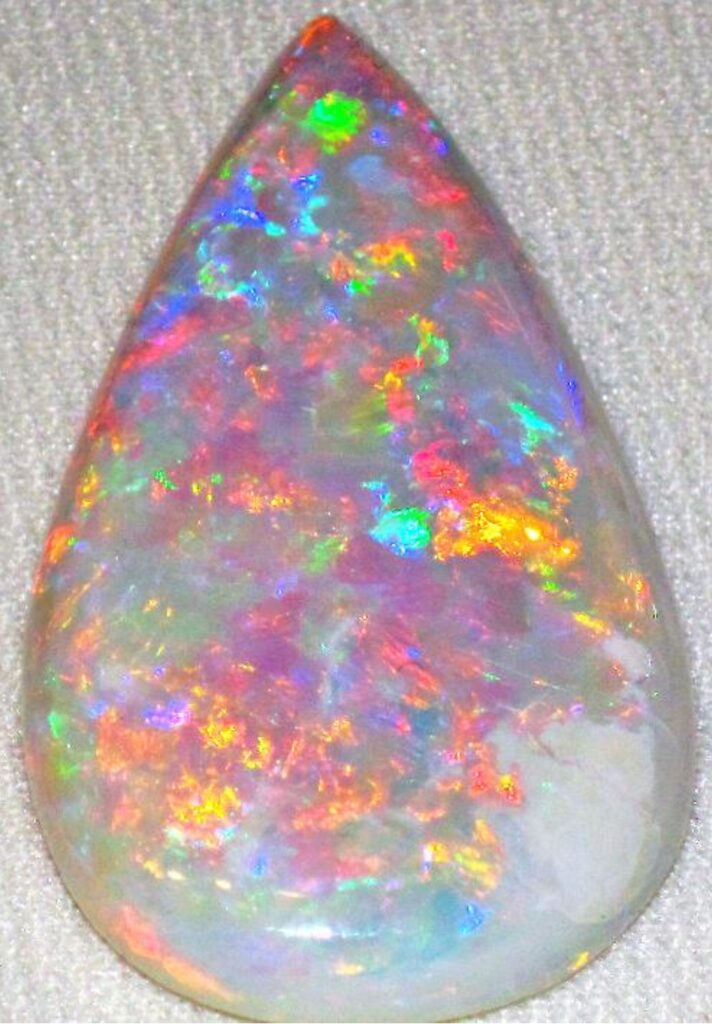
Is there such a thing as a red, white, and blue gemstone? I was hard-pressed to think of one, but I looked it up on Google and found that I was just trying too hard. Sapphire was one of my first thoughts, but it turns out that a red Sapphire is a Ruby and a white Sapphire is crystal clear. Many of the crystal clear gemstones are said to be white – Sapphire and Diamonds are classic examples. So, I looked a little more and the answer became clear. There is one obvious gemstone that has red, white, and blue all in one stone. The gemstone is not a mineral, but rather a mineraloid. Think about the color flashes of Precious Opal – red and blue flashes are not uncommon, and the base color of many Precious Opals is white. There you have it – a red, white, and blue gemstone. The red, blue, gold, green, orange, and other colors are reminiscent of fireworks.
References: White Sapphire, The Natural Sapphire Company, https://www.thenaturalsapphirecompany.com/white-sapphires/
Picture: Precious Opal picture by James St. John, used under the Creative Commons Attribution 2.0 Generic license, https://commons.wikimedia.org/wiki,

Have a GREAT INDEPENDENCE DAY celebration on the 4TH OF JULY!
Bench Tips
by Brad Smith
SANDING DISKS
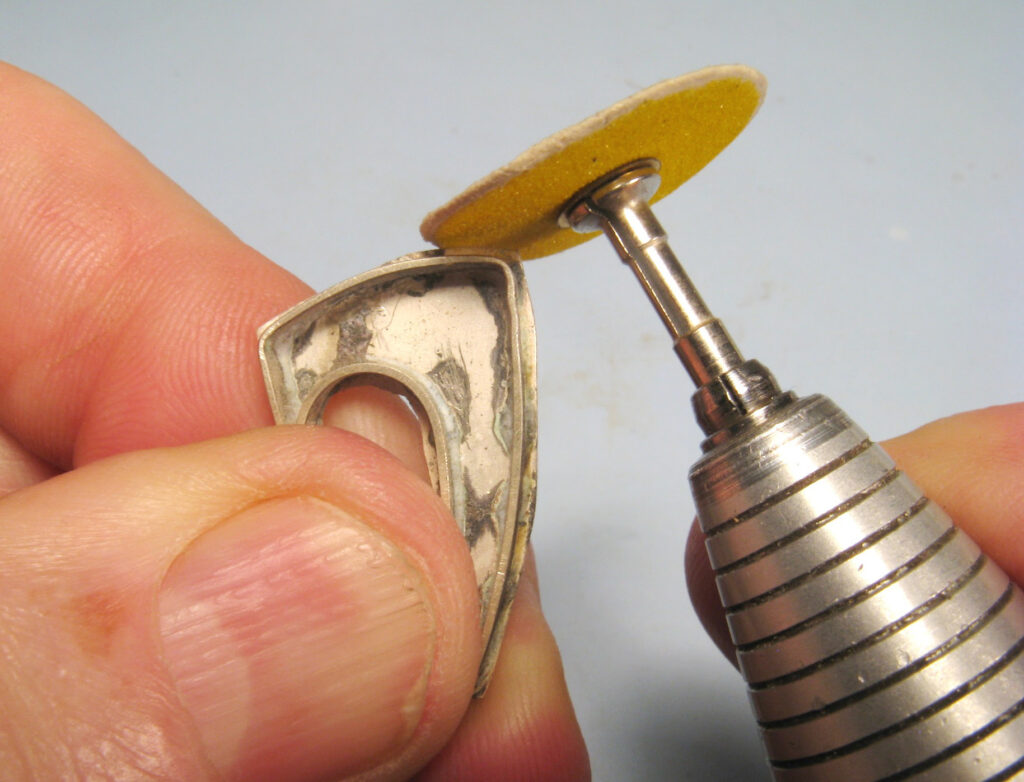
One of the flexshaft tools that saves so much time is the snap-on sanding disk. I mainly use the medium and fine grits but sometimes like the very fine ones that are sold for working with platinum.
Ordinarily, you’d think of placing the disk on the mandrel with the grit side facing away from your hand, but notice that you end up with your elbow up in the air. Instead, try flipping the disk so that the grit side is towards your hand. It’s a much more comfortable position because the elbow is down near your side, and it lets me hold the work up close where I have a better view of what I’m sanding.
I use these snap-on disks so frequently that I keep multiple mandrels with different grits already mounted in the bur stand. Some mandrels have the grit facing out and some facing in.
EASIER PRONG SETTING
When setting stones in a prong mount, the tool is less likely to slip off the prong if you grind a shallow groove into its face or rough up the face a bit with sandpaper. Some folks prefer a prong pusher for doing this, and others like a set of pliers with a slight groove on one jaw.
The easiest way to create a slot on the pusher is with a file, and the quickest way to create a slot on one jaw of your pliers is with a separating disc. Then do a rough polish on the slot with a medium grit, knife-edge silicone wheel.
Making jewelry involves a multitude of skills, intricate hand work, and a lot of problem solving. In this series Books in this series help to::
- Broaden your metalworking skills
- Improve productivity at the bench
- Save money on tools and supplies
http://amazon.com/dp/

A Review of Michigan Rocks! A Guide to Geologic Sites in the Great Lakes State
Written by Paul Brandes and Published by Mountain Press Publishing Company, Missoula, Montana, 2023
By Denise Bicknell
Michigan Rocks! A Guide to Geologic Sites in the Great Lakes States by Paul Brandes is another marvelous field guide published by Mountain Press. It is a title every Rockhound in the Great Lakes State and any avid rockhound should have in their library.
The author begins with a brief overview of Michigan geology, complete with a geologic timescale, photos, and colorful illustrations. The overview is followed by descriptions of fifty-six geologic sites found in both Upper and Lower Michigan. Each site is carefully explained and complete with photographs, beautifully detailed illustrations, and complete driving directions illustrated with a map. Following the site descriptions is a Glossary to help with terms the reader may not be familiar with, a list of further reading and internet resources, and the index. All of which contribute to the usefulness of this excellent geologic guide to Michigan.
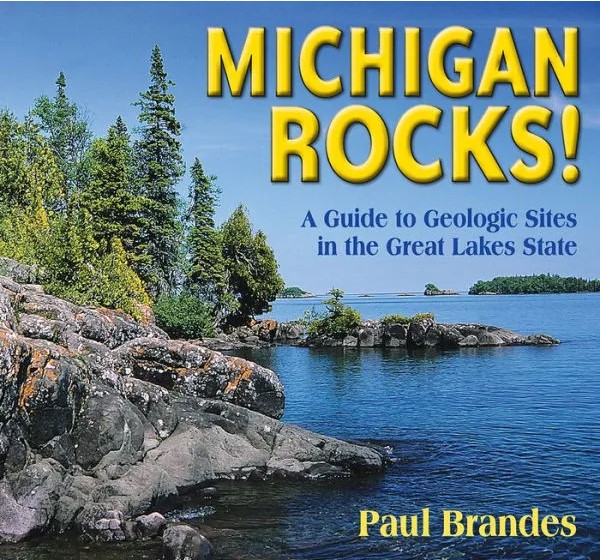
I’ve visited Michigan several times in my life, but I’ve never experienced it like I did reading this thorough guide. As I was reading, I began yearning to go see the ethereal-sounding Lake of the Clouds in Porcupine Wilderness State Park, the age-old Watersmeet Gneiss, Mt. Arvon – the tallest point in Michigan, the dreadful-sounding Deadman’s Hill, Castle Rock, Mystery Valley, and each and every one of the other sites included in this guide.
All rockhounds know about Michigan’s famous Petoskey stone – Hexagonaria percairnata, the state stone of Michigan. Site 38 features this sought-after stone and provides the reader with guidance in finding one for themselves. Another sought-after Michigan stone is the fabulous Lake Superior agate known as the Laker. These colorful beauties are described in site 4, Agate Beach. Doesn’t that just sound so delightful? A beach filled with agates! Even if you only found one such agate, it would be a grand day!
No geologic guide to Michigan would be complete without mentioning the famous copper deposits and mines of the Keweenaw. Names such as Calumet, Mohawk, Quincy, and White Pine bring mineral collectors great joy as they anticipate native copper and silver specimens, along with calcite, even copper included calcite, prehnite, and datolite specimens.
Have you ever heard of Gowganda Tillite? What about BIF? You can find out about those and Michigan’s Kimberlite deposits, glacial erratics, greenstone flows, potholes, grooves, karst topography, volcanics, conglomerates, sand dunes, beaches, the state’s oldest rocks, migmatites, sandstones, limestones, oil wells, petroglyphs and much more by reading Michigan Rocks!
Michigan Rocks! A Guide to Geologic Sites in the Great Lakes State, by Paul Brandes, a member of HGMS, provides a very useful and important guide to anyone interested in the geology of Michigan, the rocks and minerals of Michigan, or just what you are seeing as you travel around the state. This book has received two awards since it has been published including the Michigan Notable Books award and is listed as number 2 on the “20 Best Michigan Travel Guide Books of All Time”.
The New AFMS Website
Marty Hart, AFMS Webmaster
From the April 2024 AFMS Newsletter
The new AFMS website went live on February 17 at https://www.amfed.org. If you type in the website URL, be sure to include the www. There are DNS changes that may not have yet propagated and could take a couple of days. We will also be making more DNS changes in the coming days and weeks that might cause temporary interruptions while those settings are being updated.
Unfortunately, all links to pages on the old website were broken in this migration. The domain is the same, but all the pages have changed. If you try to reach a page that does not exist on the new website, you will get a 404 error. If you have any links to pages on your website, they need to be updated. Google was requested toupdate its links to the website, but it may take a while for all their old links to be updated. There is a page on the new site that has a cross-reference for many of the common page links from the Old Website to the NewWebsite.
Here is that link: https://www.amfed.org/Old-New-Xref
Since all the (old) page links were broken, the new website has a whole new hierarchy of the web pages,which is much simpler and should make it easier to find what you are looking for. The site also scales for screen resolution, so it works on mobile devices. When using your mobile device to access the AFMS website, if you do not see a menu on the left side of the page, click the menu button on the top left of the page. The menu button
(sometimes called the hamburger icon) is the “3 horizontal line” icon on the top left of the page. Clicking this button multiple times will toggle the visibility of the menu.
The credit for creating the new site goes to Lori Carter. Our most popular page has historically been the Mohs Scale of Hardness. Be sure to check out the fantastic job she did with the new Mohs Scale of Hardness.
Clicking on the “More>>” links will allow you to see more details.
Also, check out the Find a Club map of clubs. It should help visitors find a club near them and the Regional Federation associated with the club. The map only gives general locations, and visitors will need to go to the Regional Federation or club website to get detailed information. There are more things planned for the website. If you run across something missing that was on the old website or find any other issues, be sure to email us with a detailed description of the problem at: webmaster@amfed.org
HGMS Board of Directors Meeting
Meeting Minutes for June 4th, 2024
| Board Member | Section Board Member | ||
| X | President – LT [Logan] Wilcox [LT} | X | Beading – Maggie Manley [MM] |
| X | 1st Vice President – Jeanean Slamen [JS] | X | Day Light – Fred Brueckner [FB] |
| X | 2nd Vice President – Sarah Metsa [SM] | X | Gemstones & Faceting – Randy Carlson [RC] |
| X | Treasurer – Sharon Halton [SH] |
X | Lapidary & Silversmithing – Richard Good [RG] |
| X | Secretary – Michelle Wilcox [MW] | X | Mineral – Ray Kizer [RK] |
| X | Past President – Nancy English [NE] | X | Paleontology – Mike Dawkins [MD] |
| X | Web & Show – Scott Singleton [SS] |
June 11, 2024 – The second meeting, continued from June 4, 2024
President’s Comments:
Call to order (upon achieving a quorum) at 7:46 pm.
11 voting members were in attendance.
Non-voting members present: Nancy English (past president)
Motioned by LT Wilcox and Second by Michelle Wilcox
Approved: YES
Yeas 11 Nays 0
Approval of May 14, 2024, BoD meeting minutes
Motion to approve May BoD meeting minutes by: LT Wilcox
and Second by: Ray Kizer
Approved: YES
Yeas 11 Nays 0
Approval of June 4, 2024, BoD meeting #1 minutes
Motion to approve June #1 BoD meeting minutes by: LT Wilcox
and Second by: Turner Whitham
Approved: YES
Yeas 11 Nays 0
Motion: Motion to remove access/authority for Nancy English and Noor Lakhani from all bank accounts listed:
Chase Bank
Checking 7598
HY Savings 5110
Live Oak Bank
Business Savings 5947
Business Savings 6501
by: Richard Good and Second by: Jeanean Slamen
Approved: YES
Yeas 11 Nays 0
Motion: Motion to remove Noor Lakhani immediately from the bookkeeper position as soon as her name is removed from the HGMS bank accounts.
by: Richard Good and Second by: Sharon Halton
Approved: YES
Yeas 11 Nays 0
Treasurer’s Report: N/A
Membership: N/A
Old Business: N/A
New Business:
- Donation/Secure Storage – Door Prizes Cabinet: More space is needed for Ray. Working on clearing some cabinet space.
- Lapidary Machines, Saws, Equipment conditions/purchases: New wheels are being purchased. Saw repairs under review.
- Vents between rooms (Smithing, Class & Lapidary room) to improve AC Circulation: LT ran experiments on the AC and room pressure concluding installation of vents above the doors will help. They will be installed within the next few weeks.
Section and Committee Reports:
Volunteer Committee:
Show Committee:
Program Committee:
Adjourn
Motioned to adjourn the Board of Directors Meeting by: Richard Good and Second by: Sharon Halton The meeting was adjourned at 8:48 pm.
Approved: YES
Yeas 11 Nays 0
Secretary signature: ______________________
Michelle Wilcox
HGMS General Meeting Minutes
Minutes for June 25th, 2024
by Secretary Michelle Wilcox
President LT Wilcox called the meeting to order at 7:40 pm. There were eighteen attendees present and eight attendees online.
President Comments
- We have replaced Noor with Michele Marsel as our bookkeeper for the remainder of this year.
- Neil is out of the hospital and feeling much better. He will be present at the club soon.
- We will be doing maintenance in the shop area starting on Thursday 6/27/24. To replace trim saw blades and lapidary wheels and repair some of the larger saws.
- We will review the mid-year budget at the board meeting on July 2. 2024 to compare our current actuals and adjust for any changes.
- We are looking for volunteers currently who would be interested in taking seated officer positions for 2025 (membership/treasury/secretary: as an example). Please let us know as we would like to start any needed training before the end of the year.
OLD BUSINESS
- None
NEW BUSINESS
- None
SECTION NEWS
- None
COMMITTEE NEWS
- None
SHOW AND TELL
We had several show & tell items passed around the room, briefly, for everyone to look at.
The business meeting adjourned at 8:00 pm. Motion approved: Yes 26 No 0
We took a 15-minute break for refreshments: everyone enjoyed assorted brownies provided by Debbie Seid, our Social Chair.
Door Prize Winner:
Debbie Seid
Steve Blyskal identified the stone Debbie won during the meeting
PRESENTATION:
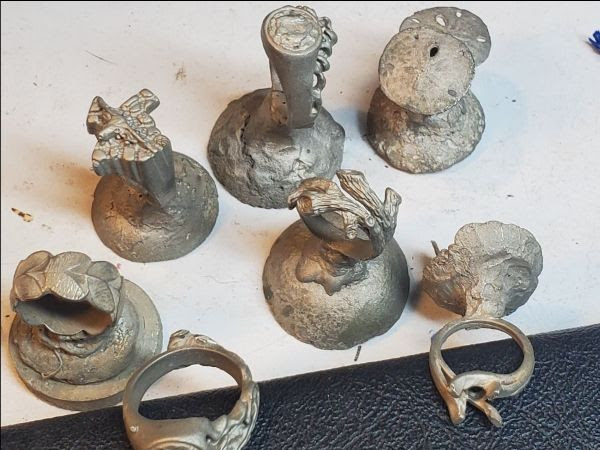
Sigrid Stewart presented the variety of stands available for mineral and fossil specimens in your collection. She also demonstrated making custom stands out of Sculpey, a bakeable clay.
Upcoming Shows
Tulsa Rock & Mineral Society Show
07/13/2024 – 07/15/2024
Sat. 9:00am – 6:00pm, Sun. 10:00am – 5:pm
Exchange Center at Expo Square
4145 E. 21st St., Tulsa OK
www.tulsarockandmineralsociety.org
Martha L. Rongey, (918) 230-1094
m_rongey@sbcglobal.net
Baton Rouge Gem & Mineral Society
08/10/2024 – 08/11/2024
Lamar Dixon Expo Center
Gonzales, LA
ARK-LA-TEX Gem & Mineral Society
08/17/2024 – 08/18/2024
Bossier City Civic Center
Bossier City, LA
larockclub@gmail.com
Lubbock Gem & Mineral Society
09/28/2024 – 09/29/2024
Sat. 10:00am – 6:00pm, Sun. 11:00am – 4:00pm
Lubbock Memorial Civic Center
1501 Mac Davis Lane, Lubbock Texas
Contact Walt Beneze (806) 797- 05832
walt@lubbockgemandmineral.org