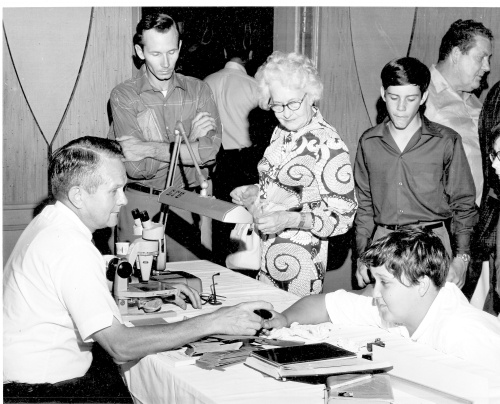
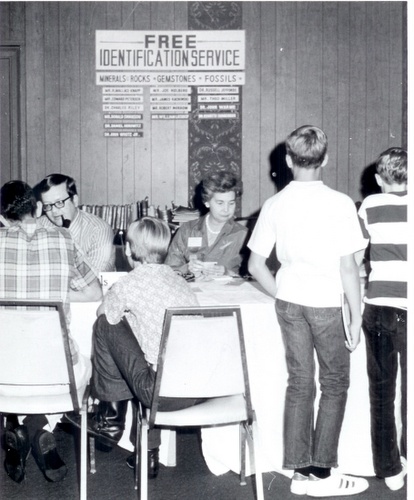
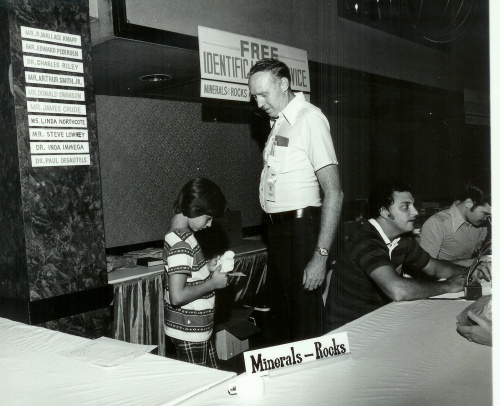
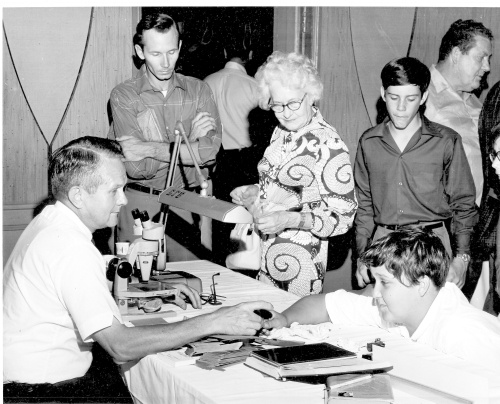
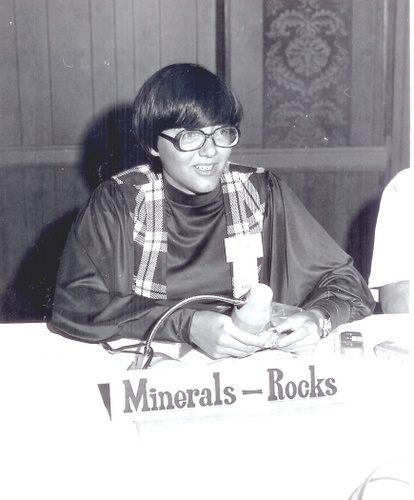
By the end of 1969, the groups holding “classes” started referring to themselves as “Sections.” Mona Miller led the Mineral Section (to be taken over by Ed Pedersen in 1972), and Irene Offeman led the Paleo Section. These individuals were instrumental in leading their sections through the next decade. (Irene and Ed also co-chaired the Identification Service at the show for many years). Their classes were serious affairs because of the specialized nature of the subject material. Because of this focus, their two sections grew and started becoming semiautonomous entities that had their own meetings and field trips. This separation became particularly noticeable with the Paleo Section because of Irene’s increasingly close association with the Houston Museum of Natural Science (HMNS).
The Lapidary Section was not really an official entity for some time because the remainder of the club (those not closely affiliated with the Mineral or Paleo Sections) effectively constituted the Lapidary Section. After all, most rock clubs consist only of a “Lapidary Section.” (Do you remember the original name of the HGMS?) Myrt Yarbrough and Chief Pomorski held informal classes using their own equipment, although by 1971 the wear and tear caused them to start charging a fee for its use.
The Faceting Section, however, was dealt a low blow when its leader and instructor, Bob Hilty, died in August of 1970. This was doubly tragic because he was also the Show Chairman in 1970. Jimmy Kachinski, the Show “Co-Chairman,” stepped in to cover as did Bob Hilty’s wife, so the show was in capable hands, but the Faceting Section did not recover for some time. (Interestingly, Jimmy Kachinski did the same thing in 1969 when the Show Chairman, Rick Ferrel, was transferred away from Houston before the Show opened).
In 1970 there was interest in archaeology, and Beth Shoemaker, a new member at that time, formed a group to hold classes in this subject. But this apparently only lasted that year because I could not find record of this having continued in subsequent years.
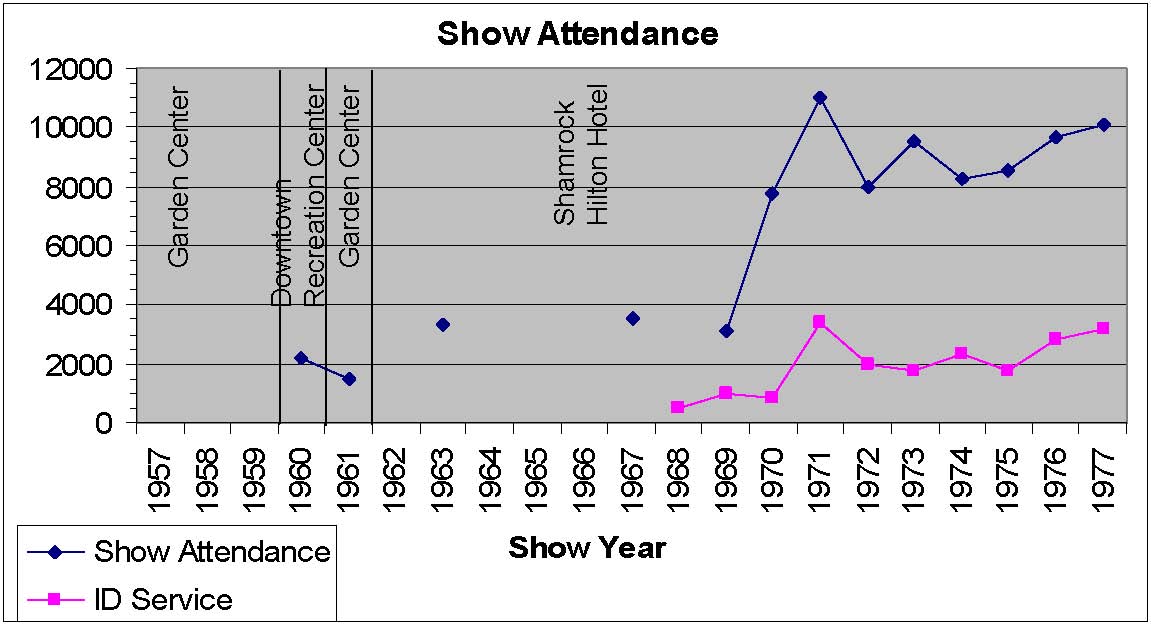
1969 and 1970 Shows: The 1969 show was similar to the 1968 show and represented a continuation of the format in the late 1960s. This was the second year of Irene’s Identification Service. She was doing her own publicity, and it showed: she tallied just over 1000 specimens identified, double from the previous year. Her list of experts doing shifts at the show was impressive: three gemologists (Bill Lathrop, Jimmy Kachinski, and Joe Holberg), and 12 geologists. Three geologists were professors at the University of Houston (U of H) and at Rice University, and five were from Esso Production Research Co. Her list included Dr. Charles Riley, Dr. Al Kidwell, and Ed Peterson on mineral ID and Dr. Russell Jeffords, Dr. Richard Zingula, and Theo Miller on fossil ID.
The attendance at this show was in the same range as in previous years (3120) because of bad weather on Friday and Saturday; otherwise it would have been greater, thus reflecting the increasing attraction of the show and publicity surrounding it. New to the show was a setup “party” on Thursday night because the show had gone to a full day on Friday. The hours were now 10 a.m. to 10 p.m. on Friday and Saturday (!!!), and 10 a.m. to 6 p.m. on Sunday. The setup night went well with lots of club members turning out to help and plenty of refreshments being provided.
Following the show, the club offered to take orders from individual club members for cases. They would have them built by one company and would cost less if a number of them were built in one order. Thirty cases were ordered and delivered to members early in 1970. Members kept these at their own homes so they could use them for their own displays. This apparently was a big focus during this period—club members creating their own case displays and showing them not only at our show but at other shows, which were proliferating at a fast pace. Butch Coleman was running the Angleton show, and there was an active Galveston show as well as a Texas City show. In addition, a number of club members would regularly go to regional and Federation shows to represent our club. Competitive exhibits were promoted heavily, and usually constituted about half of the exhibits entered in the show. (See comments below on the Judges Seminar in 1971. A similar class was held in 1970, organized by Myrt Yarbrough and Irene Offeman, with Dick Zingula providing the judging).
In 1970, the club’s show efforts came to fruition. It’s as if Bill Lathrop’s constant admonition for our club to strive to be the best and for our show to be the biggest finally was starting to be realized (Bill was in the second year of his presidency in 1970). In 1969, the Show Committee tried to get a “moon rock” from NASA for the show, but apparently was unable because it still was “hot” property and needed an official White House authorization to display. A waiting list of about 50 museums was ahead of the HGMS. However, in 1970 they were able to pull it off, not only getting a specimen from NASA but also getting Dr. Elbert King, curator of the Lunar and Earth Sciences Division of NASA (soon to be chairman of the geology department at U of H).
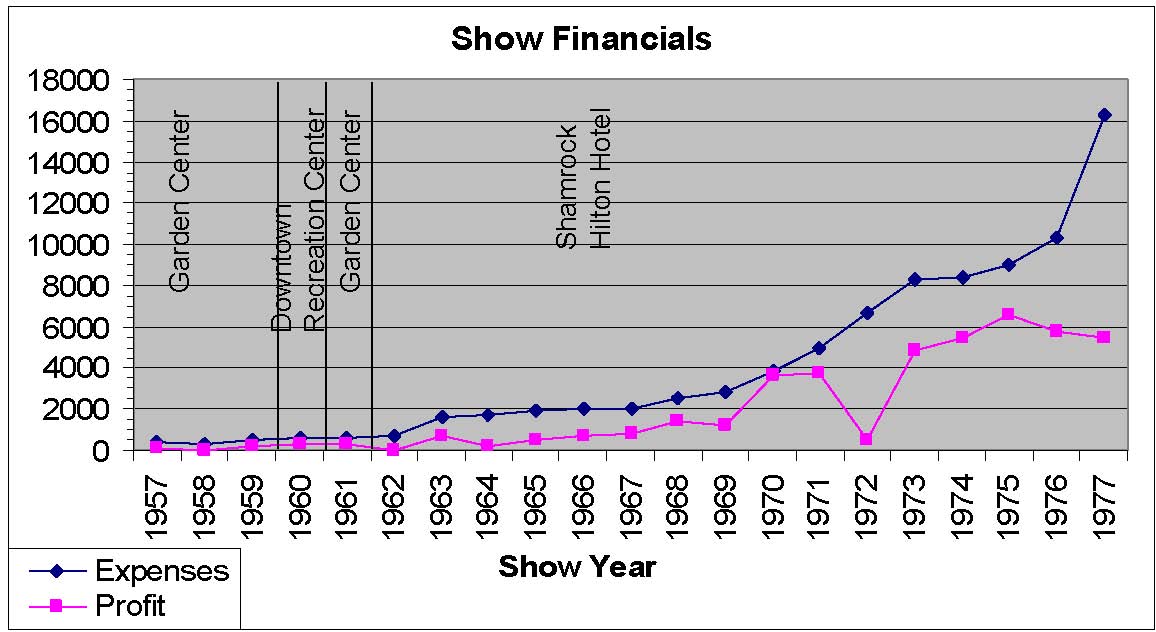
The results were nothing short of astounding. Attendance was 7,800. On Sunday, lines were reported to be around the outside of the Shamrock in both directions. Jimmy Kachinski organized a crew to go out and sell tickets to people standing in line in an effort to get them in quicker. Because of the stream of people on Sunday, a decision was made on the spot (and supported by the dealers) to extend the closing time of the show two hours (to 8 p.m.). Due to the increase in attendance, profit margin for the show was a record 96% with net profits of $3,678, three times the amount from previous years.
Vi Hazzard devoted the entire front page of the Backbender’s to a dialog about the show, using a series of drawings of a dog that gets progressively more tired as the weekend progresses (the dog is passed out by Sunday). She will have the opportunity to use this analogy several more times in subsequent years. The General Meeting program for September was merely “braggin’ about the show.”
The club had every right to feel good about this show. It blew away many previous records and created a modicum of national notoriety for the Houston club. They wasted no time in moving to capitalize on this success, organizing the Show Committee for the next year soon after the ending of this one.
The Great Show of 1971: Due in large part to the increasing success of the show, the club roster had hit 230 by the time it came out in August, 1971, thus increasing almost 40% in two years. General meetings had between 80-120 people in attendance. The club was actively supporting the Houston Museum of Natural Science, where we had an exhibit after they built a new wing in 1969. We were supporting them with monetary and specimen donations as well. The University of Houston Geology Department was also a recipient of our support—we had an exhibit there continuously during the same time period. They returned the favor by supplying experts for the ID service, giving presentations at meetings, and advertising our show.
In an atmosphere such as this, you’d think the club would welcome the opportunity to have a Federation show in Houston. However, the Board rejected a bid by the regional federation (which changed their name in 1970 from The Texas Federation to The South Central Mineral Society and was affiliated with the American Federation of Mineralogical Societies) to host a show in the next few years. The reason was not given in the Board minutes, and no further mention was made of this decision.
In any event, the Show Committee was busy lining up special exhibits for the show. The headliner was the “Inauguration Necklace” loaned by the Linde Division of Union Carbide Corp. (The necklace was worn at the inaugural balls of John F. Kennedy and Lyndon B. Johnson). It contained 50 Linde Stars* totaling 129 carats, with colors from white to cornflower blue and claret red. It also had 6.76 carats of baguette and full-faceted diamonds, all set in platinum.
* Footnote: Linde star sapphire (“Linde stars”) are synthetic star sapphires that were first made by the Linde Air Products Company in 1947 (they also developed star rubies that year). The Linde company later became a division of Union Carbide.
In addition, The Ultra-Violet Products Corp. furnished a large exhibit of florescent minerals, and U of H and HMNS also provided exhibits. The HMNS exhibit included a dinosaur egg of a 40 ft-long herbivore Hypselosaurus priscum. Dr. Benjamin Powell with Rice University showed thin sections of lunar rocks under a microscope (he was a Principle Investigator for research into the composition of the lunar samples). Last, but certainly not least, the Smithsonian Institution loaned a display of world-class gemstones for use in the show. These gemstones came along with Dr. Paul Desautels, Curator of Gems and Minerals with the Smithsonian Institution. This was a great coup by Irene Offeman to secure Dr. Desautels for this show, and was a direct result of her contacts with the other experts in her ID Service.
All successful shows rely on an effective publicity effort. The 1971 Show Committee had 19 people who helped out in publicity in one way or another. Two had contacts at TV stations which opened the doors for allowing five others to appear on various programs; two created PSAs for radio stations and got those on the air; and several more handled print media. All in all, Irene (one of the committee members) tabulated 25 mentions in print media, four TV spots, an unknown number of radio PSAs, and three displays in prominent store windows (one downtown, one on Main St., and one in the Galleria). In looking over these newspaper articles, I can assure you that nothing similar to this level of publicity had ever been generated by our club previously. Oh, and one more tidbit—not one of the articles I looked at was a paid ad. Every single one was an article or a mention in some sort of “happenings” column or a “society events” column. The total publicity expenditures for the show were $227.48.
Not to be outdone by the preparations of the Show Committee, club members were on the move as well. The “case” course taught in 1970 apparently was successful and led to more serious discussions on instruction for case competition. Thus, the HGMS, under the auspices of the South Central Federation, sponsored a 2-day judge’s training school that was held on August 7-8, 1971, at the Rice University Geology Department. Of course, it was taught by none other than Dr. Dick Zingula with the able assistance of seven trained specialists in the various competition categories. Attendees were grouped into one of five divisions they wished to study, and all were required to bring a complete copy of the AFMS Uniform Rules. It apparently went off quite well. Thirty-seven attendees went through the course, and 55 attended the banquet at the end.
With such a well-planned effort by the Show Committee and a cooperative effort among the club, one might expect that the show went off great. But that would be a tremendous understatement. The show not only went off great, it set an attendance record (approximately 11,000) that has not been equaled in 35 years since that show. Irene’s ID Service also set a record of 3,380 identifications performed, which was more than triple the totals of previous years. She thinks there were probably more since they ran out of labels the last day of the show. To cap it off, for the second year in a row the show had to stay open on Sunday past the normal closing time to accommodate a steady flow of traffic. The difference was that they stayed open only one extra hour (to 7 p.m.) instead of two hours as they did in 1970. (For those keeping track, this means that the show consisted of two 12-hour days and one 9-hour day!)
1972 – The Afterglow (?): Based on my past experience, I presume that two truths existed regarding the show in 1972—(1) the club fully expected that the results seen in 1971 were now the norm, and (2) a number of members who had helped in that monumental effort were suffering from the dreaded “show burn-out.” While it is true that the 1972 show was not a failure by any means, we have to remember that it was being compared to the incredible 1971 show, and anything short of another attendance record would be considered a setback.
Myrt Yarborough graciously volunteered to head this show effort. Myrt was one of the “Johnny-on-the-spot” club members at that time and had been co-leading the Lapidary Section with Chief Pomorski. Her Show Committee had many of the same personnel as it had the year before, with the exception that the Publicity Committee was back to its normal size again (consisting of only a few individuals). Irene Offeman was again doing her own publicity for the Identification Service which she and Ed Peterson (head of the Mineral Section) were co-chairing. Bill Lathrop was still the Dealer Chairman, although I’m wondering how active he was in the club since he had already retired, sold Lathrop’s to Jimmy and John Kachinski, and had retired to his ranch in Sabinal (between San Antonio and Del Rio).
Perhaps sensing that there was a need to “capture” the success of 1971, Irene again compiled a listing of responsibilities of each show subcommittee following that show (she did this originally in 1961 when she was Show Chairman for the Downtown Recreation Center show). As it turned out, this was a very timely observation on her part.
Anyway, the 1972 Show Committee essentially continued the same philosophy and methodology as the previous year. Emphasis was put on the special exhibits they could get for the show, which consisted of the Bart Mann golden goblet collection (shown at the Smithsonian), thin sections of moon rock shown by Dr John Adams of Rice University, a Nature’s Art Gallery by Mr. & Mrs. George Frank of San Antonio, and a 65 lb uncut topaz owned by Sarah Dowell of Edinburg, TX. The Grand Door Prize was a pendant containing an ounce of 18 carat yellow gold and a 79.8 carat Australian opal surrounded by 21 small diamonds. It was appraised at $2,500.
Attendance at this show was only 8,000. Now, any self-respecting club would not think twice about proclaiming this an outrageously successful show. However, this club had just held a show a year earlier that had attracted 11,000 attendees. This is somewhat akin to the adage that you never follow the star attraction in a performance. You always end up being compared to the star no matter how good you actually are. Nevertheless, they did acknowledge that the show was a huge success; just not as much as in the previous year.
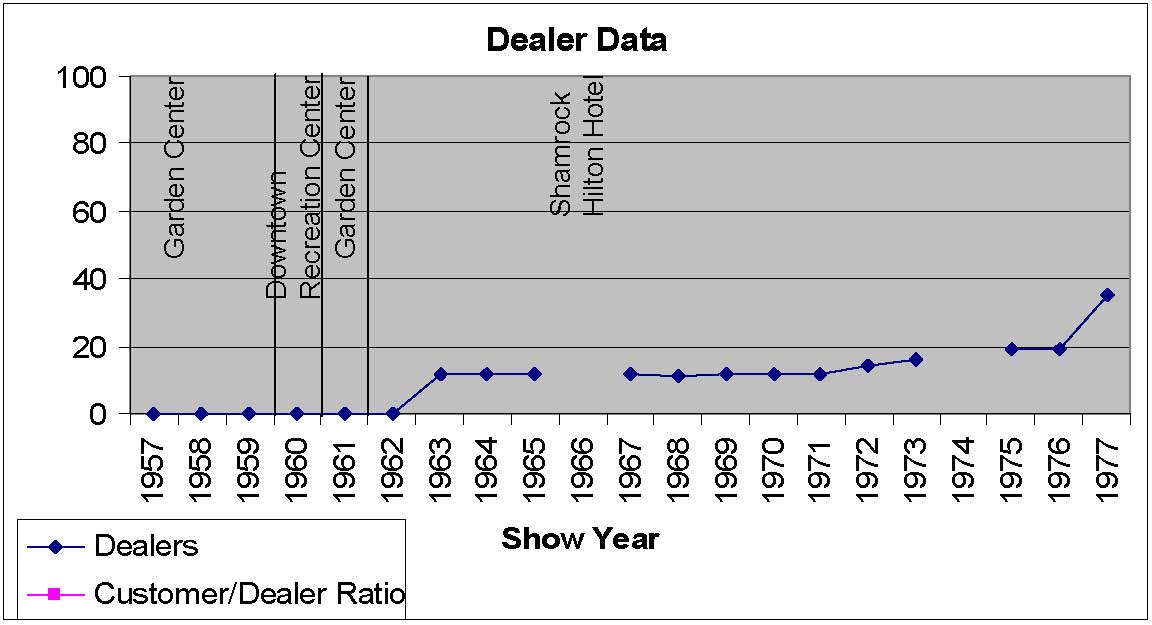
Compounding the problem is that expenses climbed significantly. They had added two dealers to the show (making a total of 14), but the loss of 3000 attendees meant that their total income was about the same as it was in 1970 while expenses had doubled. Expenses were even $1,800 over 1971, which represented an increase of over one third. Most of the increase was due to higher rent for the Shamrock, but some came from the materials for the grand door prize (they spent about $850). As a result, the net for the show was $483. After they paid a $500 deposit for the next year’s show they were in the hole.
1973-1975 – Under New Management: Bill Lathrop officially retired after the 1972 show thus leaving a void in leadership in the Show Committee. This void was immediately filled by Bill Cox and Gene Shier. With this change in management came a change in philosophy. Bill Cox was a CPA and had joined in 1971 (along with Gene). He volunteered to be Show Chairman that year, with Gene as his assistant and as Dealer Chairman. He made several immediate changes. The first of which was to squeeze more dealers into the show (two were added in 1973 and three more in either 1974 or 1975, making a total of 19). The second was to impose some financial order on the Show Committee. He instituted the concept of an annual “show budget.” (Show budgets were also prepared in 1966 and 1967, but I find no record that they continued or were a regular feature of the Show Committee’s planning.) His meetings were organized with printed agendas and were roundly applauded by those associated with the show.
He was, however, hamstrung in one aspect: He was stuck with the Shamrock as a show location. The 1972 Board had already investigated the possibility of moving the show but could find no location that was economically feasible. (Due to the huge success of the show but the limited space in which to accommodate more dealers and attendees, this would eventually prove to be one of the worst decisions the club could make. This will become apparent by 1977 and is discussed in the Epilog.)
Dr. John Pike, President in 1973, was able to get part of the Barron Collection from UT for the show. This collection included among other things, an eight-pound uncut Texas blue topaz and a cut 1,778 carat cut Brazilian topaz. Fittingly, the door prize that year was a 23 carat blue topaz.
Under Bill’s leadership, the show again returned to profitability. Net proceeds were just shy of $5,000, a typical figure for the next several years. The publicity budget expanded considerably, now being over $1,000 and resulting in a large amount of media coverage. It also helped considerably that the publicity chairman was Anna Miller, a convert from the Houston Lapidary Society who was very experienced in media relations. (She was presented an award for her media coverage in January 1974.) As a result, show attendance was around 9,500.
1974: In 1974, Bill and Gene swapped places, with Gene being the Show Chairman and Bill being Dealer Chairman as well as Club President. Gene continued all of Bill’s practices, the result of which was another very successful show. However, the focus in 1974 was not the show but the changes Bill Cox brought to the club. He initiated the practice of printing the Board minutes in the club newsletter (BBG) so that everyone could follow what was happening at the Board meetings. Burnt orange club vests were created for the men and smocks were created for the women. In late spring, he set up a long range planning committee to find a clubhouse. Dr. Pike and Al Police assisted in this effort. Their first choice was shown to be unsuitable. However, the second choice was acceptable and was rented. It was located at 7204 Alder St. in Bellaire.
This clubhouse was small and needed lots of work in order to be made useful and operational, but it was a great learning experience for the club and prepared us for the eventual purchase of our own clubhouse. The club struggled for several years to properly outfit it with equipment, keep it clean and maintain the equipment, and to keep out unauthorized persons while at the same time encouraging member use.
The club membership had grown to over 300 by midyear, an increase in a hundred in just over a year. This is a great testament to the effect that a string of several successful shows can have on the club. In the meantime, Bill Cox realized we were not making full use of our status as a growing, active club. We had won the AFMS All-American Club award in both 1972 and 1973, and it was time for the club to make the next move, which it seemed reluctant to do. I am referring to hosting a regional Federation show and eventually a national Federation show. Thus, after getting himself and Gene Shier appointed as delegates to the regional Federation meeting in Corpus Christi, Bill Cox stood up during the annual meeting and volunteered HGMS to be the host club for the next available Federation show in 1977. This wasn’t an official offer (it needs to be made in writing), but the gauntlet was essentially thrown down. It also didn’t sit easily with several on the Board, who were wondering what authority he had to make this offer. He says he gained a consensus from the Board, but this is not noted in any minutes, and so must have consisted of private conversations between him and Board members (not exactly an approved method).
So, after the sparks settled back home, the club officially submitted a bid to host the Federation show in 1977. It was accepted by the SCFMS in April of 1975. This started the club thinking on the next level, something Bill recognized as several years overdue.
1975: Gene Shier followed Bill Cox into the Presidency of the club this year while Dick Campbell took the Show Chairmanship (Dick and his wife Doris were the Publicity Chairpersons in 1974 and the Competitive Case Chairpersons in 1973). Bill Cox stayed Dealer Chairman while also pursuing what he considered the next step up the ladder—SCFMS officership. He was to obtain this midyear with his election as Vice President in the regional Federation.
The Publicity Chairpeople were Bob and Kris Wittlinger. These two were becoming very active in the club and will play important roles in the near future. They had very large shoes to fill, since as Publicity Chairpersons they were following Anna Miller (1973) and Dick and Doris Campbell (1974), both of whom had tremendously successful publicity campaigns. The number of articles generated from those two years is simply astounding. I counted at least 30 articles and ads for the 1973 show, and that doesn’t include brief notices. Similarly, there were at least 27 for the 1974 show. Of course, it didn’t hurt that in most years Irene Offeman was doing her own publicity for the ID Service.
In fact, the ID Service was regularly doing about 2,000 identifications per year through this period. It was co-chaired by both Irene and Ed Pedersen (Mineral Section Chairman through the 70s). It continued to be staffed heavily by Exxon experts (seven in 1975, including Dr. Charles Riley, Dr. Al Kidwell, Theo Miller, Dr. Russell Jeffords, and Dr. Richard Zingula), but also included several from Amoco (four in 1975, including Wally Knapp and Ed Pedersen), as well as individuals from other companies, U of H, and Rice U including John Jenkins and Art Smith. Unfortunately, there were problems securing the services of reliable gemologists since Bill Lathrop left after the 1972 show, and Jimmy and John Kachinski were busy running Lathrop’s. Thus, there was no gem ID from 1974 onward except on a sporadic basis.
The show was another success. Attendance was 8,600, and net profits were $6,600 (the rise being due to the increase in number of dealers to 19), making a profit margin of 73%. As a result, membership continued its upward march, breaking 400 by the end of the year.
1976-1977—Further Changes: As we come to the end of the era of innocence, there were further personnel changes as new members started becoming active in the running of the club. During this two-year span, the leaders were Jim Knight and Bob Wittlinger who rotated as President and Show Chairman. Bill Cox and Gene Shier were still Dealer Chairmen in 1976, but Bill left it with Gene in 1977 because Bill had moved from Vice President of the SCFMS in 1976 to President in 1977.
Several very important events transpired in this two-year span. These will be covered in the following text as well as in the Appendices.
1976: Early in the year, the club was intensely thinking about the regional Federation show to be held in 1977, specifically about the Chairman for that show and the location. Bill Cox and Gene Shier had looked for other show locations as early as 1974 and had found none. Ron Carman was becoming vocal about this problem in 1975. In 1976 Bill and Gene held discussions with the Shamrock about the 1977 show, specifying to them that they needed more space for this regional Federation show. They relented, giving us a room for lectures and the Grand Ballroom to hold more dealers. However, I note that we were not successful in getting the Grand Ballroom either in 1976 or in 1978 (see my comments on this in the Epilog).
Dick Zingula had returned from his two-year stint in Calgary and was once again holding competitive case judging seminars at Rice University. The seminar in April, 1976, was smaller than the one held at the end of April, 1977, which attracted 43 students. (The 1977 seminar was co-hosted by Jim Knight).
The AFMS National Federation Show was held in Austin in June, 1976. At that show, the HGMS was awarded yet another All-American Federation Club award for 1975, as well as taking five first-place case awards! This is no small feat, and congratulations go out to the entire club for this outstanding effort. As a consequence of the 1976 Austin show and knowing that we were going to hold the SCFMS show in 1977, many were heeding Bill Cox’s admonition to start thinking bigger. Thus, at the May Board meeting, Anne Frank moved that we submit a bid for the next SCFMS-hosted National Show (to be held in 1982). The vote carried. At the May General Meeting, President Jim Knight opened discussion on this issue after reporting the Board’s vote and the results from the three most recent National Shows. The vote carried. A letter was sent to the SCFMS Board advising of our bid. This was presented to the AFMS and accepted. In July, Anne Frank moved that we form a committee to start planning for the National Show (it was still five years away!). The vote carried. The committee would consist of the five most recent Show Chairmen and the sitting President, updating on an annual basis. Further, this committee was directed to start looking into the Astrohall as a potential show venue for August of 1982.
1977: The regional Federation show came off very nicely, thanks in part to the extra space provided by the Grand Ballroom. Thirty-five dealers were in the show, lectures were held in the Walnut Room, SCFMS President Bill Cox convened the annual Federation meeting, and 10,061 attendees enjoyed all the activities as well as upwards to 50 competitive and noncompetitive case exhibits. Expenses however, were very high—rising in all categories due to the nature of the show. These increases were almost exactly compensated by the increased income from 16 extra dealers so that the total profit did not substantially differ from previous years.
Preshow publicity was effective, being handled by Dalton and Consie Prince (Consie was the BBG Editor in 1975 and 1976, and Dalton was a Board Director in 1976 and 1977). They had at least nine people on the Publicity Committee and split tasks by media category.