

Rare Minerals of Myanmar
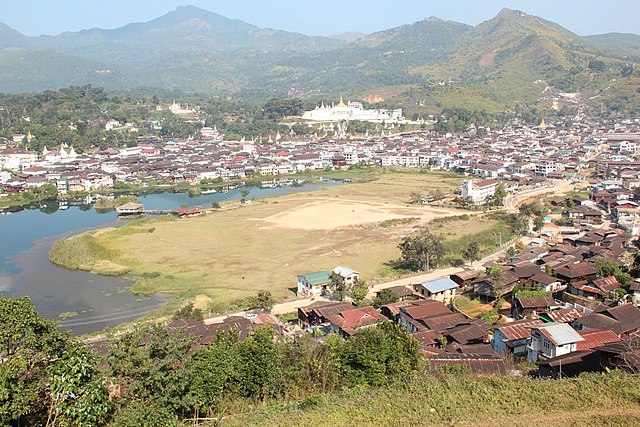
East of the Rahkine Mountains along the Bay of Bengal, across the valley of the Irrawaddy River, south of the mountains of Yunnan, China, and 200 kilometers north of Mandalay, is the city of Mogok. Also known as “Ruby Land,” Mogok is famous for the abundance and variety of its gems and minerals. The rubies of Mogok have been known since antiquity for the clarity and intensity of their “pigeon’s blood” color.
But there is more to the Mogok area than corundum, which includes both sapphires and rubies! Sapphire hunters exploring a stream bed near Mogok, Myanmar found a single transparent reddish-orange gemstone, and undoubtedly thought they had found a ruby. After study, it was recognized by the International Mineralogical Association in 2015 as a new mineral and is the only known example of Kyawthuite. The chemical formula is Bi3+Sb5+O4, with traces of tantalum. Bismuth is very heavy, so the stone is very dense, 8 times denser than water, so that the faceted stone is small for its weight. This natural bismuth-antimony oxide was named after Dr Kyaw Thu, who was a geologist at Yangon University of Myanmar. It is currently stored in the Natural History Museum of Los Angeles County.
The mineral crystallizes in the monoclinic system, so a crystal would be shaped like a parallelogram. It has a luster like diamond, Mohs hardness of 5.5, and a white streak. Geologists use the “streak”, taken by scraping a specimen across an unglazed tile, to help identify minerals. A mineral could be many different colors, but the color of its streak would not change. You can see a beautiful picture of this stone at https://www.mindat.org/min-46909.html.
In 1952, British gem dealer and mineralogist Arthur Pain also found what he thought were rubies, but after examination by the British Museum, they were also found to represent a new mineral, which was then named after Pain. A second example was found in 1970 and finally in 2001 a third was found. Much rarer than diamonds, the formula for this mineral is CaZrAl9O15(BO3), with a little vanadium and chromium to give it its reddish color. A single carat may go for as much as $60,000.
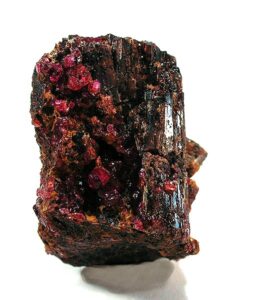
Painite is much harder than kyawthuite with a Mohs hardness of 7.5 to 8. It is transparent with a vitreous luster and red streak. Painite gemstones are pleochroic, meaning that they change hue depending on the angle from which they are viewed, and vary in color from brown to reddish-pink.
Besides painite and kyawthuite and rubies, Mogok is also famous for its sapphires and semi-precious gems such as garnet, peridot, moonstone, chrysoberyl, spinel, and possibly lapis lazuli (which is yet to be confirmed). The region is also known for pegmatites, source of large crystals and rare elements. Other rare minerals may turn up in these pegmatities.
In the break-up of Gondwanaland, a mini-continent that would one day be known as India spun off and then collided with the continent of Asia, leading to the formation of the Himalayas. Geologists believe that the intense heat, pressure, and subsequent migration of hot mineralized fluids accompanying this great collision, is responsible for the creation of the gemstones in the area of Mogok.
The gems are found by panning or digging in alluvial gravels, from the metamorphosed limestones marbles, of the Mogok metamorphic belt. Gemstones are sold in the markets of Mogok, but sorry, rockhound tourists, you must have special permits to visit, and you must purchase gems from government-licensed dealers.
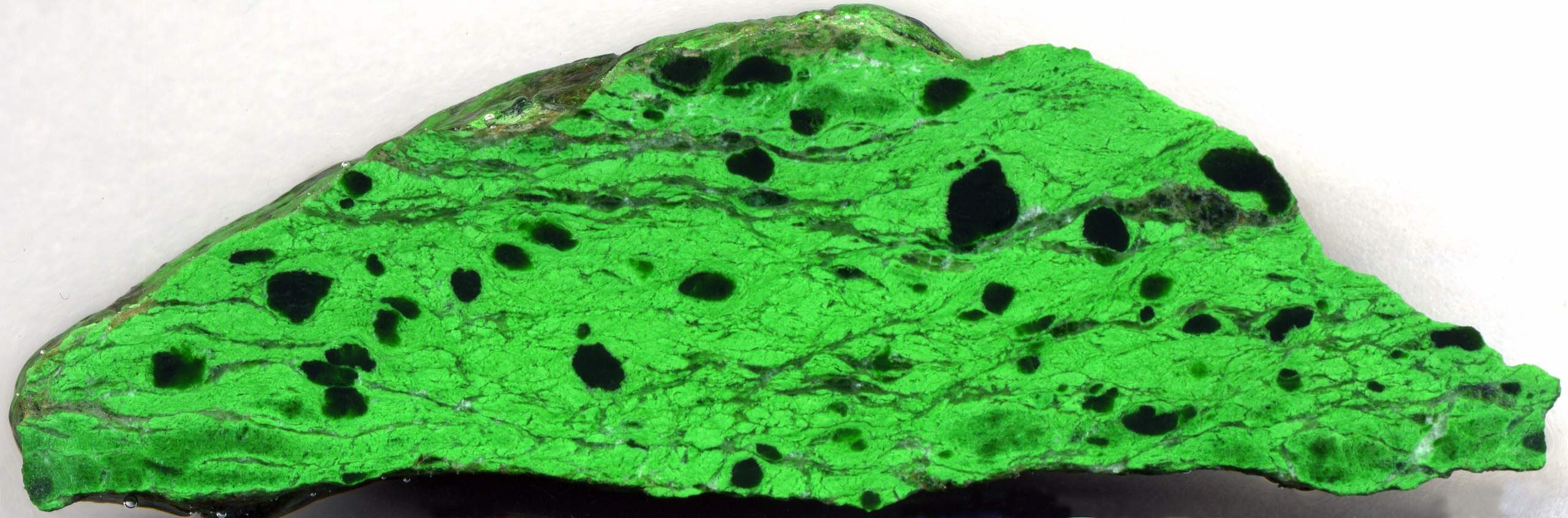
Mogok is not the only source of gemstones in Myanmar. Check out these two.
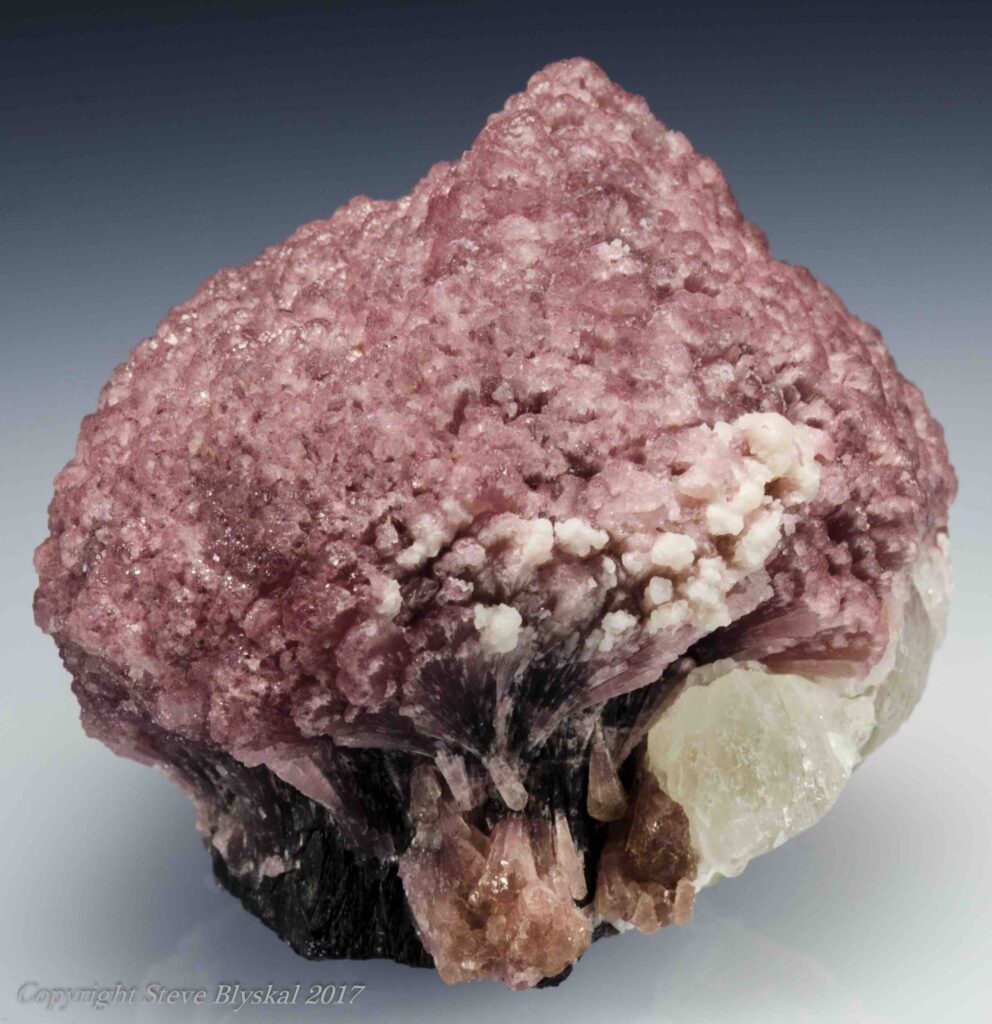
Title picture: “Mushroom tourmaline”, Momeik Township, Kyaukme, Myanmar not far from Mogok.
Photo by Steve Blyskal. Cap of elbaite over schorl.
By James St. John – Mawsitsit (chromian jade) (Namshamaw Deposit, Hpakan-Tawmaw Jade Tract, Late Jurassic, 147 Ma; Maw Sit Sit, near Kansi, western Kachin State, Indo-Burma Range, northern Burma) 5, CC BY 2.0, https://commons.wikimedia.org/w/index.php?curid=40022868
References:
https://a-z-animals.com/blog/the-rarest-mineral-on-earth/
https://www.iflscience.com/there-is-only-one-specimen-of-the-rarest-mineral-on-earth-67276
https://www.mindat.org/min-46909.html
https://en.wikipedia.org/wiki/Mogok
GIA Gemologists search for Reference Gemstones in Mogok:
https://www.gia.edu/gia-news-research/blue-sapphire-lapis-lazuli-mogok-myanmar-field-expedition
And for a description of the field trip of a lifetime:
https://www.gemscene.com/mythical-mogok-and-its-mines.html
Attribution Painite:
Corundum var. ruby on a large painite crystal, Mogok, Burma. (size: 3.7×3.1×2.3 cm)
Rob Lavinsky, iRocks.com – CC-BY-SA-3.0 Ohngaing, Mogok, Sagaing District, Mandalay Division, Burma (Myanmar)
Attribution Mogok2 By JimmyWinMGK – Own work, CC BY-SA 4.0, https://commons.wikimedia.org/w/index.php?curid=93598849