School Collections
This article originally appeared in the February 2021 Backbender’s Gazette
SCFMS Editor’s Contest 2022, First Place Original Adult Article Advanced
When you enter the HGMS clubhouse through the garage door, one of the first things you see is the large metal rack to your left, covered with a green tarp and holding numerous flats labeled with the names of different rocks. On the other side of the rack, near the garage door are lots more flats with mineral names on them. Many of you have probably wondered why these flats are there and what they are for. This is the story of how those flats came to be where you see them. Our club has been built over the last 60+ years by people who saw a need, came up with an idea to fill that need, and worked to make it a reality.
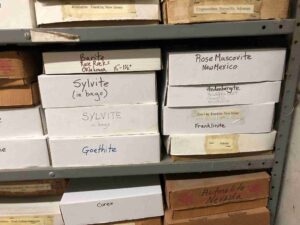
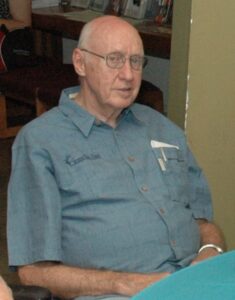
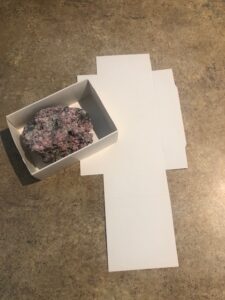
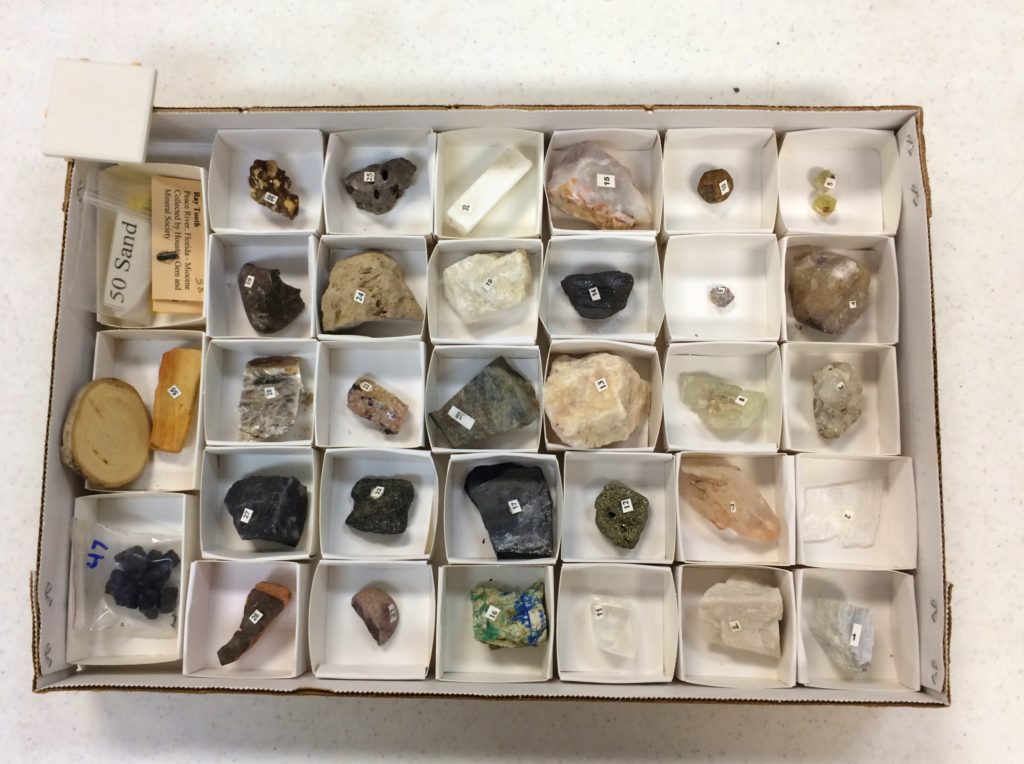
Many years ago, there were members, mostly retired, who regularly made trips to elementary and middle schools in the Houston area to talk about minerals, rocks and what could be done with them. They often took their own specimens with them to illustrate their talks. Teachers often asked if there was any way they could get supplies of minerals and rocks to use in their classroom. One of our members, Art Smith, Jr., heard their pleas and determined to do something about it. As a practicing petroleum geologist Art had many connections in the oil industry. After inquiries he approached Conoco, a major oil company (now ConocoPhillips), which had an interest in educating young people in the earth sciences. They reached an agreement wherein Conoco would provide a yearly grant of $3000 to HGMS for the purchase of minerals and rocks and supplies to create rock and mineral sets that could be left with teachers after HGMS members had talked to their classes. In return Art documented his expenditures and provided statistics on how many sets were distributed. With these funds secured he needed a place to store the specimens he was acquiring. After receiving permission from the HGMS Board he purchased heavy duty industrial shelving and got it erected in an unused portion of the garage area. He then began to purchase wholesale flats of minerals and solicited donations from members and friends from his mineral trading contacts. Gradually these acquisitions built up a sufficient supply to start creating sets in white mineral flats. These sets were a labor of love for Art. Each involved folding 30-40 small boxes and gluing numbers onto each specimen so the teachers could keep track of them when kids inevitably mixed them up in the box. He often worked on these in his mineral room while watching the Astros play baseball on the weekends. Hundreds of these sets, complete with documentation, were passed out to Houston area teachers over the years. Art did this completely on his own and never asked for help. He had strict rules (no sets to Boy Scouts), so he would not be overwhelmed by the number of requests.
Eventually, as he grew older, he got tired of dealing with the constant demand for sets and said he would not do it anymore. At that point I stepped in and said I would take over the manufacture of the sets. That was about 15 years ago. Since then, the program has continued and expanded and changed dramatically. Conoco declined to participate in giving HGMS money after their merger with Phillips Petroleum, and our contacts there retired or were re-assigned. Without a source of funds, the acquisition of new specimens was mostly by donation. The efforts of Art Smith left us well supplied to produce sets for the next 20 years at least, so donations for the most part have been enough to get by.
Several years ago, the Republican Party took over the State of Texas School Board organization, and since many of the new members were Creationists, they were very much against the teaching of geology in schools. Any mention of Earth Science was pushed down to the 3rd and 4th grade elementary levels. As a result of this a group of us decided to redo the basic school sets to reflect these changes. Under the guidance of members Neal Immega and Lexy Bieniek new sets were organized and documentation was updated and improved. These new sets, which contain a hardness set of minerals (1 through 9), some common minerals, common rock types, a few fossils, a topographic map and a streak plate, have been our new standard.
How has School Collections changed over the last few years?
- The Education Committee requested mineral and rock sets to give to teachers who bring classes to the Show and take them through several stations. School Collections created 3 mineral and rock sets and a fossil set for teachers to choose from. These sets, housed in 17-space plastic craft boxes, consist of individually numbered specimens and include paper keys and information for teachers.
- The School Collections expanded who can receive donations of rocks and minerals. To date we have created sets of both for two universities in Africa who were starting from scratch. Also, since Geology has been approved as a high school science class, we have donated appropriate specimens to teachers who needed them. Science Olympiad, a high school program for future scientists, focuses on earth sciences every few years and school collections has donated specimens to sets used to help prepare these students for the competition. We have also added some Home School groups to the ones able to get sets, depending on the number of students reached.
- I don’t do all the work myself. I have reached out to members to fold and create small boxes (30+ per set) and to put numbers on the 1500 specimens that make up the 50 sets we put together each time.
So where is School Collections going in the future? With the pandemic and the closing of the clubhouse in 2020 and 2021 not much has been happening, but that will change as life begins to return to normal by 2022. The number of sets on the shelves has declined to the point where new ones need to be created. These are done 50 at a time to maximize the benefits of scale. Throughout 2021 I will be putting out requests for volunteers to fold boxes and glue numbers on specimens.
What does the future hold? I am going to be 73 this year and while I am able to organize and manage School Collections, there is no one behind me to take over if I can’t do it anymore. Who is going to step up and lead here? Don’t let School Collections become a failed program, shut down for lack of membership participation! Make it count!