THE BACKBENDER’S GAZETTE
Volume LVI ----- Houston Gem & Mineral Society ----- February 2026
January Field Trip to Midlothian
Table of Contents
Click a Table of Contents Entry to jump to that article.

President's Message
by Jeanean Slamen
Winter weather!
The club’s closures and cancellations due to the late January freezing temperatures will hopefully not be repeated in February. Everyone is grateful for all the help and cooperation from those members who actively worked to make sure the clubhouse was prepared and members were given as much notice of cancellations as possible.
Getting the word out to everyone via the Event Blast is our most reliable way to communicate late-breaking notices to all club members. Always check your email for notices from the Event Blast that could give you valuable information about cancellations or closures. Is it time to review utilization of the clubhouse?
Judging from comments I received in the last few months, some members think we’ve become so accustomed to current arrangements in the clubhouse that we don’t see things that should be addressed. Here are some common (and sometimes competing) themes:
The Meeting Room:
Contains equipment and other inappropriate items that should be stored in other parts of the club; has table and chair storage that interrupts aisles; needs more flexibility to give privacy to small groups or meetings.
The main Library:
Needs books reviewed to remove those that are not being accessed by members; needs remaining historical mining books returned to the library; needs the master catalogue (spreadsheets) updated for accuracy; needs the beading books from the Houston Beading library added to shelves.
The “middle” Library space:
Currently used as storage for items that belong elsewhere; could hold the remains of the historical mining books; “would make a good meeting space for Sections or classes”; “needs to be put to better use.”
The Office:
Full of rocks; has a storage rack with things that have nothing to do with an office.
The Middle Classroom:
Overcrowded to the point of being unusable as a classroom; used for storage of rocks; contains equipment that gets very little use; needs cleaning and sprucing up.
The Clubhouse Entry:
Not inviting for visitors or new members; cluttered and “scruffy”; needs better signage labeling adjacent spaces; needs cleaning/painting/updating to be an attractive entry.
Whew! That’s a lot of things to consider. I will promote discussion of these ideas at the General meeting and in our publicity outreach. We need a full airing of ideas to create Spring Cleaning projects. If you have opinions about these or other ideas, drop your comments in an email to president@hgms.org; I will collect and publicize them (without names) so our conversations can reflect members’ ideas.
- Popular ideas that emerge could prompt a quick survey via MailChimp to prioritize a list of our Spring projects.
Vice-President's Message
by Julius Albonetti, 1st Vice President
Jacob Proctor will be our speaker at the general meeting in February. Jacob is a geologist and the owner of Katy Rock Shop, which has had many recent improvements. He will speak to HGMS about microbialites, their growth and their diversity with modern and ancient examples. Microbialites are the oldest life form known on Earth. A recent discovery has revealed they date back as far as 3.7 billion years.
Make plans to attend the February general meeting and let’s have a big attendance for our speaker!
January Field Trip to Midlothian
by Nancy Fischer
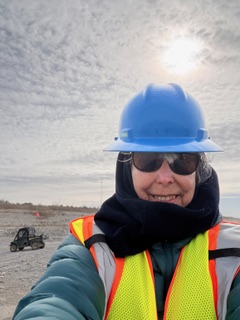
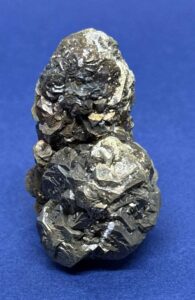
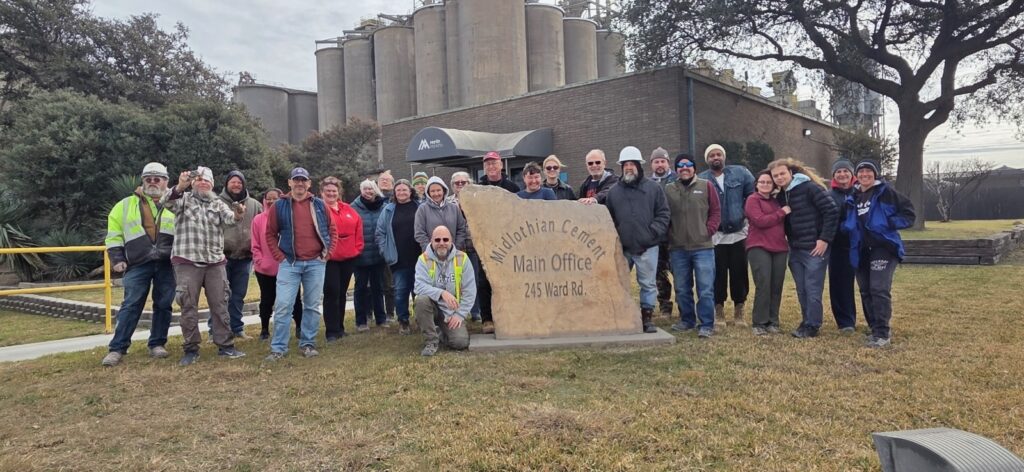
26 intrepid HGMS members met at 8:15 on Saturday morning, January 17, at the Martin Marietta Midlothian Cement Plant. This used to be a fairly regular field trip, but hasn’t happened since before COVID. Mike Sommers made the arrangements for us to go. We were going to look for pyrite. The quarry has 2 sections. One part is limestone and that is where the pyrite is found. The other part of the quarry is shale and contains marine fossils.
Some of the members traveled to Midlothian, about 4 hours from Houston, on Friday night before the field trip. A small group met for dinner and had a great discussion about what to expect.
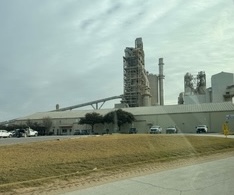

We were met by Kristen, Mike’s contact from the quarry, and 5 or 6 other employees. They invited us inside where they had safety gear ready for us. We had to wear safety vests, hardhats, safety glasses and gloves. They also had coffee, donuts and a local delicacy – fried biscuits- which were biscuits filled with sausage and of course, deep fried. Mike had samples of different configurations of pyrite nodules to show us what to look for. He also explained how each was formed.
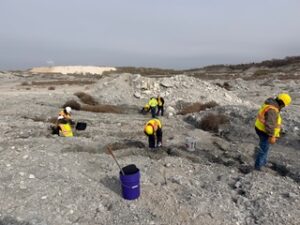
We each got into our respective vehicles and caravaned out to the dig site. Everyone got out and started looking around. After a few minutes, Kristen called us together and said they were going to take us to a different spot since they didn’t see much pyrite. We got back in the vehicles and went about 4 minutes further into the quarry. A note: There were many ‘sort of’ roads that crisscrossed the quarry. It would have been very easy to get lost without our guides.
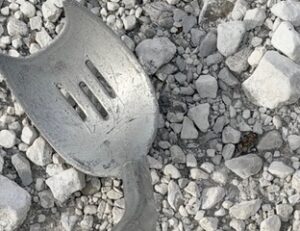
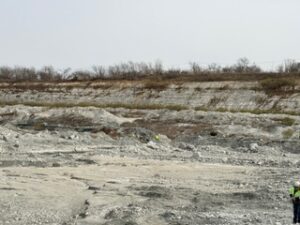
Some very simplified geology – limestone and shale are both sedimentary rocks that form from ancient inland seas. Limestone is calcium carbonate and forms from the shells, coral, algae and other marine life. It is an excellent host since it is very porous. It is also permeable. The pyrite forms from a combination of iron and sulfur in the limestone. Shale is often formed in the same environment but is basically layers of compressed mud. It is not permeable. Fossils are found in the layers.
There were high mounds of limestone, dirt, and clumps of rocks and matrix. The incline was really steep – a veritable slippery slope. Club members just started climbing and soon had the hillside covered. We were told that the larger, more defined specimens were at the top. The pyrite had more chances to weather as you got lower. The pyrite was noticeably different from the limestone and easy to spot. You could just pick it up in some cases or nudge it out of the limestone with the pick end of a rock hammer. I was able to get to most of the things I collected just using my long-handled rock scoop. I stayed on the flats, but some people found pyrite and nice fossils at the top. I saw some people set up mini mining operations, really digging things out.
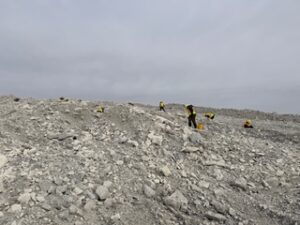
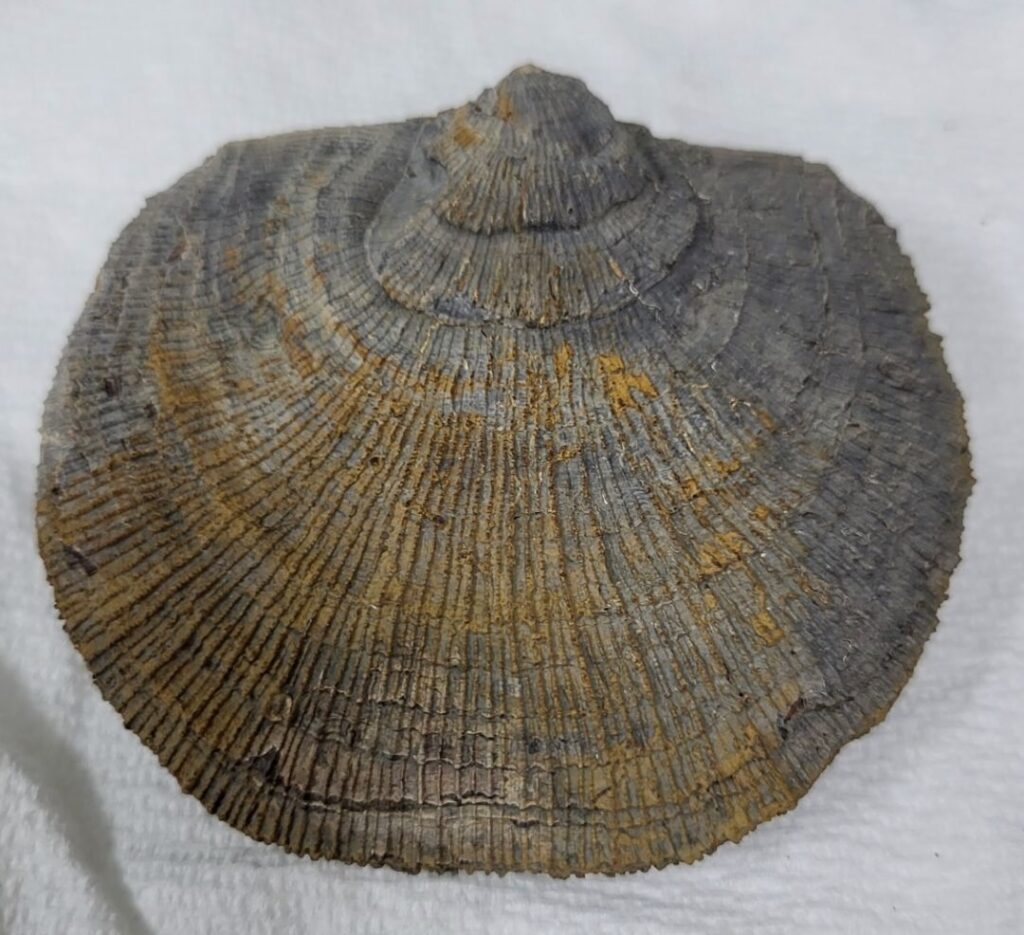
The employees had lots of information and were eager to share. They were also very helpful in pointing out pockets of pyrite. I learned all kinds of things. They thought they had about 45 years of material to take out at their present rate.
One side of I-35 is clay (from shale), the other is limestone which is a perfect mix for making cement. That’s why that area has a lot of quarries. The limestone has too much pyrite to use for concrete but is perfect for cement.
The starting salary at the quarry is $30 per hour. As the employees gain skills, the salary increases. $40 an hour is fairly common.
The land is reclaimed. It is filled back in to the original elevation with a profile similar to the original lay of the land. They let nature take its course – birds, wind, animals replant the area. Several states have to put the land back exactly the way it was, down to planting cactus at the original locations. Luckily for us, Texas is not one of those states. They just have to approximate the original appearance.
After a half hour or so, we given the opportunity to go to the fossil site. Some of the group formed another caravan and went to the shale side. That was an entirely different kind of dig. Paleo people sat and carefully sifted through the shale looking for sharks’ teeth and shells. Several large sharks’ teeth were found. Some people were finding were calcite crystals. I found an inoceramus clam.
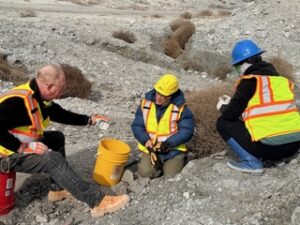
One of the great things about the trip is that we brought our own experts along. There is so much individual and collective knowledge in HGMS. Mike Sommers and Dean Lagerwell were generous with their knowledge of pyrite and Ray Kizer and Mike Dawkins were so patient, answering questions at the paleo site.
11:45 came too soon. There was a time limit on the trip. We all reconvened and caravaned back to the parking lot/office. We got together one last time to take a group picture, then headed out. It was a great trip! Mike said he will try to get another trip together soon, perhaps to the shark tooth area.
Section News
Beading – Second Saturday, 12:00 PM
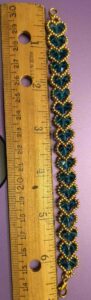
IMPORTANT NOTICE: Starting in March 2026 the Beading Section Meeting will start at 10 AM rather than Noon. We will meet from 10 AM to 1 PM and those who choose to can join us for lunch afterwards.
Some kits and materials may be available.
NOTICE: Do you have a bracelet or necklace that needs restringing? The Beading Section will carefully restring your piece at an hourly rate of $15.00 + materials. Contact Beading @HGMS.org to make arrangements. All funds will go to the Beading Section.
Always bring beading mat, scissors, wire, wire cutter, round nose and needle nose pliers, thread, and beading needles if you have them.
Find out more about the Beading Section!
Lapidary and Silversmithing – Third Monday, 7:00 PM
The next meeting will be on February 16th at 7:00 pm. We will explore opal cutting and polishing! Bring your opal to show off
- Last month we made cowboy hat earrings with a hydraulic press and special jig.
Email Lapidary@hgms.org if you have questions, and check out the Lapidary and Silversmithing Section page.
Day Light – First Wednesday, 12:00 PM
The Daylight Section meets the first Wednesday of the month from 12 to 3 PM.
The next meeting of the Daylight Section is Wednesday, February 4th at 12 PM.
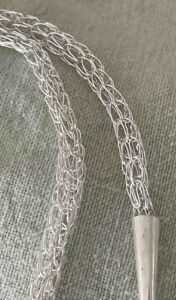
Our February project of a copper Viking Weave bracelet, will be taught by Margaret Hardman-Muye.
While the picture shows silver, this will be a copper project. Registration will be limited to 8-10 participants. The fee is $5.00.
Gemstones and Faceting – Second Thursday, 6:30 PM
Our next meeting will be February 12th at 6:30 pm.
The topic will be recognizing common mistakes made by beginning and even experienced gemstone cutters.
Randy Carlson and John Lee have been busy training people who signed up at the show in basic faceting! And we had 9 first time visitors to our Jan 15th meeting!
Paleontology – Third Tuesday, 7:30 PM
The next meeting is Tuesday, February 17th at 7:30 pm. After Show ‘n’ Tell, Jeanean Slamen will present the program “Five Times that Life Hit Reset”, a review of the “Big Five” extinctions of life over the last 445 million years of Earth’s history.
Zoom link for the meeting: https://us02web.zoom.
Zoom link for the meeting:
https://us02web.zoom.us/j/86053771923?pwd=ek5lNlk5SGFYNjN6U29ONU4xVElyQT09
or
Meeting ID: 860 5377 1923
Passcode: 826994
If you’d like to join the Paleo Section email list, send an email to hgmspaleosection@gmail.com and ask to be added.
Mineral – Third Wednesday, 7:30 PM
The next meeting is Wednesday, February 18th at 7:30 pm.
We will continue the Common Minerals program with Celestine. There will be lots of appropriate specimens.
There will be a door prize and snacks and a small Silent Auction. Come see some rocks and ask questions!
Zoom link for the meeting:
https://us02web.zoom.us/j/4517997588?pwd=SnZjckZBTnRMbHRxZitScE9WU3RWUT09
or
Meeting ID: 451 799 7588
Passcode: 623955
If you’d like to join the Mineral Section email list, send an email to mineral@hgms.org and ask to be added.
Youth, First and Third Saturdays, 10:00am – 12:00pm
Next meetings will be on February 7th and 21st.
Mostly we will be working on cabochons. Children must be accompanied by parents.
New Member Orientation
On Sunday, February 8th, from 1-3 PM at the Club, Sarah Metsa, Vice-President of Membership, will be holding HGMS’s first New Member Orientation meeting; sorry we had to cancel our first date in January due to the winter storm. This is a new program for 2026 and going forward. There will be snacks.
Each New Member Orientation will follow this agenda:
For each of the following officers, Section representatives, and committee members, Sarah will introduce that person if they can be present, and then they will say a few words about their role in the Club. Otherwise, Sarah or another representative will provide welcome and history
President of the Club
Sections (Beading, Day Light, Faceting and Gemstones. Lapidary and Silversmithing, Mineral, Paleontology, and Youth Section)
Education (mission, classes, libraries and scholarships)
The Backbenders Gazette (BBG) (our newsletter)
Weekly eBlast (what is happening in the next week or two)
Volunteering (There are many opportunities!)
Publicity (for the Annual Show, plus Facebook and Instagram)
Lapidary shop (sawing and grinding, silverworking, air abrasive)
Tour of the club
Sarah will end with a tour of the club and will thank everyone for coming. If the President is there, our President will say a few final words.
Slab thickness guides for the HGMS shop
by Steve Blyskal
For those of us who cut slabs, to use in making cabochons or for other purposes, getting the right thickness is a never-ending process. For most cabochons you want a ¼” thick slab, but other thicknesses are needed for different purposes, thicker for a higher dome and thinner for adding a quartz cap or a basanite back. The four slab saws in the shop all present different problems getting the right cut. The 18” and 20” HP slab saws take about 7 turns to get ¼’ and the 24” saws are each different numbers of turns to get that thickness. Many times, despite our best efforts, the slabs get cut too thin or too thick. So how do you handle this problem? One way is to cut a slab the correct (or almost correct) thickness and use it as a guide for the next slabs. Or have a piece of wood more or less than ¼” thick. Not satisfied with this hit or miss process? There is an answer.
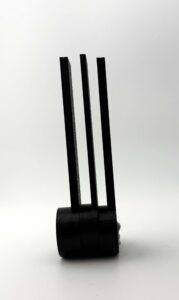
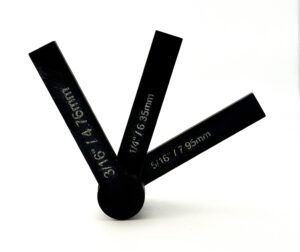
Last October, when I was at the Austin clubhouse for the SCFMS convention meetings, I was given a tour of their “Slab Shed” by the outgoing president, John Conner. I saw some plastic sticks stuck to a piece of metal by magnets with thickness dimensions on them, including the usual ¼’ thickness. John told me they were slab thickness gauges and that they had been made up for the Austin club by one of the members using his 3D printer. I expressed an interest and he emailed both of us by way of introduction. Fast forward a month to November, when I was in town to give a talk to the Austin club at their general meeting. The next day we were back at the AGMS clubhouse, and I got to see the slab saw guides in action. They helped a saw master cut identical thickness slabs for an Austin Community College class on cabochons. After that experience I reached out to the club member, and he agreed to print a couple sets of gauges for HGMS in three thickness sizes. He also sent me a diagram on how to use these gauges properly. Eventually the gauges arrived and will be delivered to the club shop in February with the diagrams. Due to their small size, they will be stored in a cabinet and brought out for use by the shop supervisors.
Shop and Building News
David Pawek reports that the club received a shipment of grinding wheels for the grinding stations in the Shop, enabling him to replace damaged and worn-out wheels.
Wonderful news! Now let’s keep them in good shape by remembering NEVER PRESS A SHARP EDGE INTO A RESIN WHEEL! That’s what metal 100-grit wheels are for.
A sharp edge can tear the surface of a resin wheel, where the diamond coating resides, making it useless.
A three-person team will reassess the Ventilation Project to protect our members from fumes in Shop spaces. Lillian Skogsberg and Debbie Seid have expressed interest in being involved.
Bench Tips

BEZEL CLOSER
A bezel closer is a steel punch that makes quick work out of pushing the metal down over a round stone and burnishing it. It works with regular bezels, with tube settings, and with prong settings. Stones can be set in as little as 30 seconds.
The working end is a concave cavity that fits over the bezel or prong setting and is pushed and twisted to capture the stone. Sets can be purchased but are expensive and contain many sizes you will probably never use. If all you need is one or two sizes, here’s how you can make them yourself.
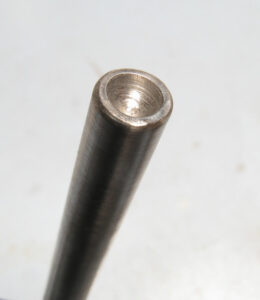
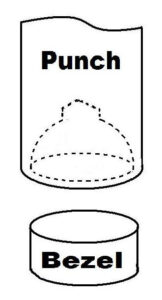
Find a round steel rod or bolt a little larger in diameter than your bezel cup or prong setting. Cut a 5-inch length. File both ends flat. Locate the center of one end, centerpunch a divot, and drill a small pilot hole about 5 mm deep. Remember to use a little oil as lubricant when cutting steel.
Select a ball bur a bit larger than the bezel. Enlarge the pilot hole to a full hemispherical cavity. Test for proper fit with your bezel. Bezel should first contact the cavity about a third of the way in. When the size is correct, polish the cavity using Zam on a length of chopstick in your flexshaft. If the tool is not polished, it will leave scratches on your bezel or prongs.
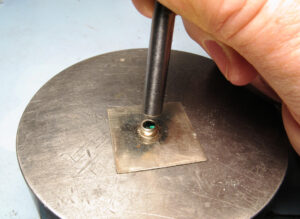
When using the tool, the first step is to capture the stone correctly. I usually work by hand and push the punch straight down over the bezel or prongs. This causes the metal to start bending over the stone. The next step is to inspect the stone with a lens to be sure it is staying level. Repeat until the stone is seated on its bearing and can’t move anymore.
Finally, force the metal down onto the stone uniformly all the way around. While this can be done by hand, I often gently tap the punch with a hammer. Finish by twisting the bezel back and forth to burnish the top of the bezel.
BENCH SHEARS
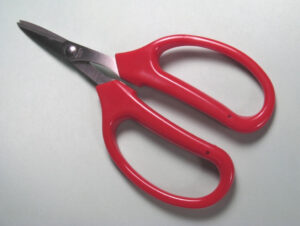
When cutting sheet metal, it’s quicker and easier to use a set of shop shears as compared with using a hand saw. The cut is not as precise, but many times you don’t need that. Shears will easily cut up to 24 gauge sheet, and some will cut 22 or even 20 gauge.
Current prices for shears run from $13 – $36 in jewelry catalogs, and the Joyce Chen scissors recommended on some jewelry blogs run more than $20. But I found cheaper alternatives at the 99 Cent Store for use in my classes. They’re great for cutting bezels, trimming around a bezel cup and cutting a piece off a larger sheet.
Can I Interest You in a Field Trip to South Texas?
by Jeanean Slamen
President of HGMS
Can I Interest you in a Field Trip to South Texas?
Ten months ago, I stumbled by chance upon a recently uploaded YouTube video titled “Ancient Landscapes of South Texas: Hiding in Plain Sight” (https://youtu.be/398URwHw8VU). I was swept up in a riveting geologic history of the Rio Grande Valley that spanned 40 million years and made me want to visit the fascinating sites featured in the video.
Originally a feature film produced by the University of Texas Rio Grande Valley, “Ancient Landscapes” was created to educate the residents of the Valley about the landforms and geologic features of the places they see in their everyday lives. The film and coordinated exhibits toured venues in the Valley for two years after release. Afterward, it was converted into video and uploaded to YouTube. The film’s high production values and lush, engaging viewing experience translated well to video.
There are too many topics from the film to survey here, but I can’t resist describing the roadside feature that captured the enormity of geologic processes 27.4 million years ago. Many of us have collected petrified wood here in Texas that originated in the Catahoula Formation. Some of us have read that the silica that enabled the fossilization of trees in the Catahoula was ash carried on prevailing winds from enormous volcanic eruptions during the Oligocene and Miocene in what is now Mexico.
Imagine standing next to a 20 meter deposit of white Catahoula ash capped with the Goliad Formation: seventeen meters are above the surface and LIDAR confirms there are three meters below the surface. Geologists estimate that this exposure was deposited in a single event that occurred within several days to two weeks.
It would have buried miles of sabal palm forest along 136 miles of coastline. That same ash fall contained the uranium that has been mined for years near Three Rivers, Texas.
I hope you’ll view “Ancient Landscapes” for this and many more examples of the geology of the Rio Grande Valley. A journey from Houston to the Valley and back could be planned to visit a number of interesting geological (and paleontological) sites along the way.
If the film sparks your interest you can email president@hgms.org and I’ll send you related links (including a second, related video and several papers) that I researched after becoming entranced with the topic.
Chris Garvie’s recent program at the November ’25 General Meeting reminded us that in the ‘90s HGMS used to routinely have field trips that went as far afield as Alabama, the East Coast and similar distances. Maybe a visit to the Valley could re-establish our former ambitions!
A Mineral for Winter
by Don Shurtz
Don Shurtz, Pleasant Oaks Gem and Mineral Club
and Past President, South Central Federation of Mineral Societies
As I write this article, we are expecting an arctic front to pass through the Dallas area. Each year, in the Dallas area, we get one, two, or sometimes more ice storms associated with these arctic fronts. We dread them. Ice and packed snow accumulate on the roads. Living as far south as we do, the cities have few (if any) snow plows and limited equipment to remove Ice. Sand is used on inclines and some intersections, and in the last few years, they have started treating major roads with a brine solution before the storm hits. Generally, we just wait until the sun comes back out to melt the snow and Ice to clear our roads. Travel can be treacherous.
So, what does an ice or snow storm have to do with rockhounding in Texas? First, let’s consider what a mineral is. A mineral is a naturally occurring, inorganic, solid material of a consistent chemical composition and a definitive crystalline structure. Rain is definitely not a solid; the solid form of rain (water) is Ice. Under the right conditions, Ice can form a definitive crystalline structure. It is certainly naturally occurring and has no organic material. In other words, Ice is the crystalline form of water, and it is a Mineral until it melts.
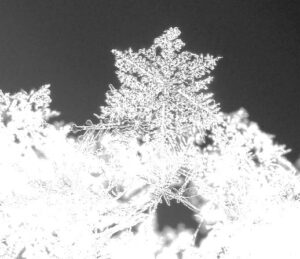
One of the most beautiful natural objects that you will ever see is a snowflake. A snowflake is a dendrite form of Ice. The angular separation of the hydrogen to oxygen bonds in a water molecule is 104.5°. With only a little distortion, water molecules can easily form a six-sided hexagon with legs separated by 120°. As the plate grows, it sinks further in the atmosphere. When the temperature and pressure reach a critical point, the hexagonal core stops growing and starts forming dendrites at its vertices.
These dendrites continue to grow symmetrically as the snowflake falls through the atmosphere. It is possible to capture a single snowflake. We used to capture them on our knitted gloves. We could look at them for a few seconds before they started to melt. It is also possible to capture them on a cooled microscope slide for viewing under a microscope. I have also seen a single flake adhere to a cold, vertical window pane and remain visible for an extended period. The crystal is colorless, but diffraction of the light from the faces of the crystal causes it to appear white. The problem with Ice minerals, including snowflakes, is that they melt.
As indicated above, Ice forms in hexagonal crystals. Generally, these crystals are microscopic, but under certain conditions, they can grow into visible hexagonal crystals.
Reference: Wikipedia, various topics, https://en.wikipedia.org/wiki/
Picture: Picture by brianjobson, released to Public Domain, from Wikimedia Commons, https://commons.wikimedia.org/
Terror Birds
by Sigrid Stewart
Have you ever watched a chicken chasing a grasshopper? If so, you may have been glad the hen or rooster was a relatively small bird, no danger to a human being. This image will, however, give you a little insight into the Terror Birds. Just imagine them upsized to 10 feet tall and up to 1000 pounds! Their heavy, curved beaks and the sickle claw carried above three “running” toes would certainly have inspired a little respect. Where have you seen a claw like that? Think Jurassic Park.
Terror Birds, or members of Family Phorusrhacidae, were predatory carnivores that lived primarily in South America from the Eocene to the Late Pleistocene. They were predators of open savannas, relying on excellent vision, strikes from claw and beak, and speed to catch their prey. They evolved in South America and a few species made it to North America after the formation of the Isthmus of Panama. Fossils have been found in Texas and Florida. Their extinction 2 million years ago may have been due to mammals introduced from North America, although possibly they persisted in some areas as late as 6000 years ago.
Possibly they were hunted by Native South Americans. Possibly they tasted like chicken!
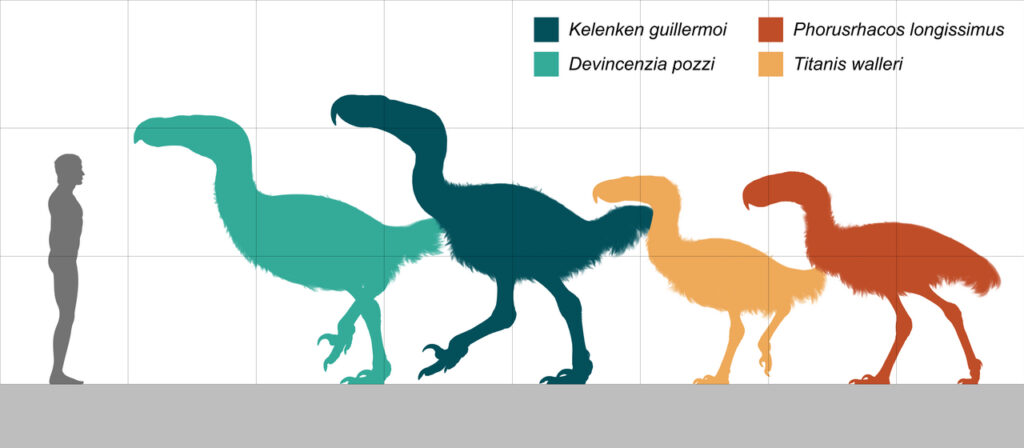
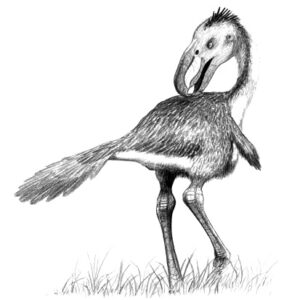
Other large flightless birds are not Terror Birds. Ostriches, from Africa; Emus from Australia; Cassowaries from New Guina, Australia and nearby islands; Rheas from South America; Kiwis from New Zealand and their extinct cousin the Moa; and the extinct Elephant Bird of Madagascar are all ratites, members of Infraclass Palaeognathae. Most ratites are herbivores or opportunistic omnivores rather than carnivores. The lineage which these birds belong to is very different from the lineage of the Terror Birds. They are similar because of their size and because of convergent evolution – evolution enabling species to occupy an ecological niche. Two species of seriemas of South America are the only known living relatives of the Terror Birds, but they are not carnivores, but omnivores, eating plants as well as insects, lizards, snakes and smaller birds, and they are much smaller.
References:
https://en.wikipedia.org/wiki/Phorusrhacidae
Diagram of Terror Bird heights: PaleoNeolitic – Own work · CC BY 4.0
Drawing of Andalgalornis by John.Conway – Own work · CC BY-SA 3.0
HGMS Board of Directors Meeting
Meeting Minutes for January 6, 2026
| Board Member | Section Board Member | ||
| X | President – Jeanean Slamen | X | Beading – Maggie Manley |
| X | 1st Vice President – Julius Albonetti | X | Day Light – July |
| X | 2nd Vice President – Sarah Metsa | Gemstones & Faceting – vacant | |
| X | Treasurer – Rhett Cooper |
X | Lapidary & Silversmithing – Richard Good |
| X | Secretary – Debbie Seid | X | Mineral – Ray Kizer |
| Past President – by invitation | Paleontology – Al Robb | ||
- Call to order
President Jeanean Slamen called the meeting to order at 7:37 pm. A quorum was present. Lillian Skogsberg was welcomed as a guest and potential Beading Section Board Representative.
- Approval of Previous Minutes
No action required. December 2025 minutes were previously approved and published in the January 2026 Backbender’s Gazette.
- Treasurer’s Report
Treasurer Rhett Cooper presented the financial statement as of January 6, 2026, noting that the organization is in strong financial position.
- Officer and Section Reports
Membership: 417 memberships, 553 authorized members as of December 31, 2025.
Monthly reporting and a new member orientation (first session January 24) were announced. Membership renewals are encouraged with multiple payment options available.
Programs: Upcoming speakers include Jessica Bamford (Space Center Houston) and Jacob Proctor (Katy Rock Shop). Coordination with sections for future topics is ongoing.
- Unfinished Business
Bylaws Revision: The Board discussed and approved an amendment restoring the President’s right to vote and to make motions, to be voted on at the January 27 General Meeting. The motion to reinstate the President’s right to vote and to make motions was made by Sarah Metsa, and seconded by Ray Kizer. The motion was approved unanimously.
Houston Gem and Mineral Society
Board of Directors Meeting Minutes
January 6, 2026
Prepared by Debbie Seid
Ventilation Project: A three-person team will reassess the project. Lillian Skogsberg and Debbie Seid expressed interest in being involved.
Standing Committees: Expansion to include more members with leadership and relevant experience was discussed.
Shop Training and Policies: Progress on shop safety training and policy manual. Shop access will be restricted for members not current on dues after March 31, 2026.
Meeting Protocol: Efforts to streamline meetings and expedite minutes and action items using AI tools.
Field Trip Committee: Plans to formalize field trip organization and registration, with a focus on equitable access and proper documentation.
- New Business
2026 Budget: The President and Treasurer expect year-end figures by mid- January and will begin drafting the 2026 budget once they are in hand. They will status the effort at the February Board meeting, and hold whatever interim meetings necessary with the
Board to complete a proposed budget for Board approval.
IT and Email: Officer email addresses will transition to role-based accounts pending Microsoft authorizations.
The Board discussed restricting eBlasts to members only as a benefit of membership. A motion to limit eBlasts to members only was made by Sarah Metsa and seconded by Maggie Manley. The motion was approved unanimously. A separate motion to revise the By-Laws to include the emailing of eBlasts to members only was made by Sarah Metsa and seconded by Maggie Manley. The motion was approved unanimously.
Treasurer Reporting: Future reports will be streamlined for timely communication.
Section Highlights:
Beading: Successful integration of former Houston Beading Club members and heightened visibility through multiple events generated high level of interest.
Daylight: Strong participation in 2025 projects and strong anticipation for 2026 activities.
Adjournment: Sarah Metsa made a motion to adjourn, and it was seconded by Ray Kizer. The motion passed
HGMS General Meeting Minutes
The January 27th meeting was cancelled due to the winter storm.
Upcoming Shows
Stone Crystals
Rose Garden Center, 402 Rose Park Dr,
Tyler, Texas
02/07/2026 – 02/08/2026
Sat. 10:00am – 5:00pm, Sunday 10:00 – 4:00pm
Contact Keith Harmon, TX, (903) 316-2967
Email: keithharmon19@gmail.com
Jasper, Texas, Rock and Gem Exhibition at 324 W Gibson St, Jasper, TX
Williamson County Gem & Mineral Show
02/14/2026 – 02/15/2026
Sat. 10:00am – 6:00pm, Sunday 10:00 – 4:00pm
San Gabriel Park Community Center
445 E Morrow St, Georgetown TX 78628
https://www.facebook.com/WilliamsonCountyGemSociety
Clear Lake Gem and Mineral Society Annual Show
02/28/2026 – 03/01/2026
Sat. 10:00am – 6:00pm, Sun. 10:00 – 5:00pm
Pasadena Convention Center,
7902 Fairmont Pkwy, Pasadena TX.
Support our sister club!
And farther out:
- Mar 7-8 Corpus Christi, Texas, Gulf Coast Gem & Mineral Society
- Mar 7-8 Big Spring, Texas, Big Spring Prospectors Club
- Mar 14-15 Abilene, Texas, Central Texas Gem & Mineral Show
- Apr 11-12 San Antonio, Texas, Southwest Gem and Mineral Society
- Apr 17-19 Alpine, Texas,Alpine Gem & Mineral Show at the Alpine Civic Center Email: Rocksofalpine@gmail.com
- May 2-3 Waco, Texas, Waco Gem & Mineral Society
- May 23-24 Fort Worth, Texas, Fort Worth Gem & Mineral Society
Club Information
Houston Gem & Mineral Society
Regional and National
American Federation of Mineralogical Societies
(AFMS) https://www.amfed.org
South Central Federation of Mineral Societies
(SCFMS) https://www.scfms.net
Permission to use material originating in this newsletter is given freely providing that credit is given to the author and the source. Articles published in the BBG is may be edited for grammar and content.
BACKBENDER’S GAZETTE SUBMISSION DEADLINES
Articles are due on the 15th day of the month before the posting of the BBG.
Email content and comments to editor@hgms.org